Healthy Indian Grocery List USA: Patel Brothers, Costco
Healthy Indian grocery list for the US: weekly amounts per adult from the ICMR-NIN plate, Patel Brothers vs Costco, label tips. Printable.
The short answer
A healthy Indian grocery list follows the ICMR-NIN My Plate. For one adult on about 2,000 kcal a day: about 250 g grains or millets, 85 g pulses, 400 g vegetables, 100 g fruit and 300 ml milk or curd daily, with little oil. Times seven, that is the weekly table below; scale it to your calories.
Work out your own numbers
Generate protein-fat-carb targets based on calorie goal and training objective.
Free, takes a minute, and uses the same formulas our coaches use.
Open the Macro Split CalculatorOn this page
In short: for one adult on about 2,000 kcal a day, buy about 2.8 kg vegetables, 1.75 kg grains and millets and 595 g dal a week, then adjust to your calories.
You plan a week of dal, sabzi (cooked vegetable dish) and rotis, then the Costco trolley and the Patel Brothers bill come out looking nothing like the plan. A healthy Indian grocery list helps, but most lists online are long item dumps with no amounts and no reason behind them.
This page builds the list the other way round. We start from the plate that India's National Institute of Nutrition recommends and turn it into weekly amounts for one adult. Along the way we explain Telugu and South Indian staples, where to shop in the US, and how to read a US label. In a hurry? Jump to the printable weekly list. This is general education, not a medical diet.
If you are managing a health condition, start with the page that fits you:
- Diabetes or prediabetes: see our diabetes diet chart for Indians.
- PCOS: see our PCOS diet chart for Indian women.
- Pregnant or breastfeeding: see our breastfeeding diet chart.
On this page
- Build the list from the plate
- Dals and pulses to buy
- Atta, rice and millets to buy
- Vegetables, fruit, curd and oil
- Reading the US label
- Patel Brothers vs Costco
- The printable weekly list
Build the list from the plate, not from the store {#start-with-the-plate}
ICMR-NIN (the Hyderabad institute that writes India's dietary guidelines) publishes a "My Plate for the Day". For about 2,000 kcal a day, in raw weights, it lists cereals including millets 250 g, pulses 85 g, milk or curd 300 ml, vegetables and greens 400 g, fruit 100 g, nuts and seeds 35 g, and fats and oils 27 g.[2] The plate gives about 15% of energy from protein and about 30% from fat, and vegetables, fruits, greens and roots make up about half of it.[2] Treat the plate as a model, not a lab number.
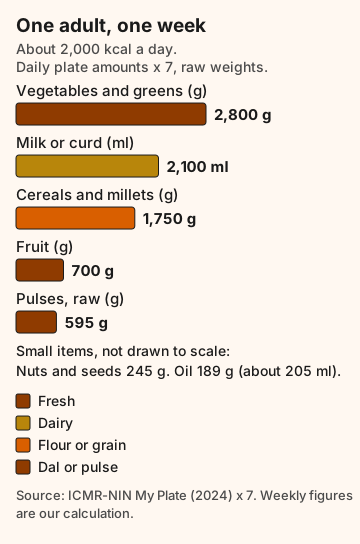
Weekly raw amounts for one adult at about 2,000 kcal a day. Milk or curd is by volume; nuts (245 g) and oil (189 g) are too small to show on this scale. These are the daily My Plate amounts multiplied by seven, our calculation.[2]
The Dietary Guidelines for Indians add that cereals should supply about 45% of daily energy (the My Plate table above works out slightly lower, about 42%, because it is a food-weight model rather than an energy target), pulses, eggs and flesh foods about 14 to 15%, total fat 30% or less, and added sugar under 5%.[1]
A shop happens once a week, so here is our calculation from source 2 (not the source's own figures): multiply each daily amount by seven.
- Cereals and millets: 1,750 g
- Pulses: 595 g
- Milk or curd: 2.1 L
- Vegetables and greens: 2.8 kg
- Fruit: 700 g
- Nuts and seeds: 245 g
- Oil: 189 g, which is about 205 ml (our conversion, using about 0.92 g per ml for oil)
Three cautions. First, this is a 2,000 kcal reference, and your energy need depends on your weight and activity.[2] For reference, ICMR-NIN's reference Indian woman weighs 55 kg and needs about 1,660 kcal a day if sedentary and 2,130 kcal with moderate work.[3] Second, the plate says eggs, fish or meat can replace part of the pulses, and a portion of dal can be swapped for egg, fish, chicken or meat.[1][2] Third, this is not a diabetes meal plan: carbohydrate needs differ from person to person, so use the diabetes page above if that is you.
To scale the list to your own calories and protein, use our free macro split calculator or the TDEE calculator.
Scaling the list for fewer or more calories
The plate says the vegetable, fruit and milk proportions stay the same when total calories change.[2] For the other lines, here is our simple rule, not an ICMR-NIN table: multiply grains, pulses, nuts and oil by your daily calories divided by 2,000. A dietitian can fine-tune it.
| Weekly line | About 1,600 kcal a day | About 2,000 kcal a day | About 2,400 kcal a day |
|---|---|---|---|
| Grains, millets, flours | 1,400 g | 1,750 g | 2,100 g |
| Pulses, raw | 476 g | 595 g | 714 g |
| Nuts and seeds | 196 g | 245 g | 294 g |
| Oil | 151 g | 189 g | 227 g |
| Vegetables, fruit, milk or curd | as in the main list | as in the main list | as in the main list |
If you want to lose weight
ICMR-NIN says a slow and steady reduction in body weight is advisable.[1] Our coaches suggest not cutting the vegetable, dal or curd lines first. Trim from the extras instead: sweet drinks, boxed snacks, extra oil and ghee. Please agree your calorie level with your doctor or a registered dietitian, and see the red flags at the end of this page. We promise no amount of weight loss.
Dals and pulses to buy, and how to use them {#dals-and-protein}
Some words first. A dal (pappu in Telugu) is a split or whole lentil or pulse, cooked. Kandi pappu is toor dal (split pigeon pea). Pesalu is whole green gram (moong); pesarattu is the green gram dosa (thin crisp pancake) made from it. Senagalu is whole Bengal gram (kala chana), and minapa gundlu is whole urad (black gram).
ICMR-NIN names lentils, green gram, horse gram, black gram, chickpeas, kidney beans, cowpeas, soyabean and green peas as vegetarian protein sources.[1] That gives you a simple shopping base: kandi pappu, moong (whole and split), chana dal and whole chana, rajma (kidney beans), urad and lobia (cowpeas).
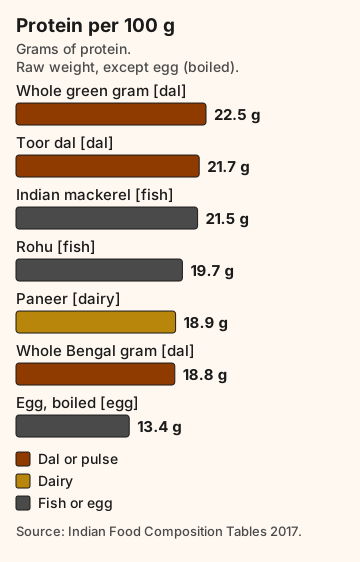
Protein per 100 g raw (egg boiled), from the Indian Food Composition Tables.[4]
Here is what the Indian Food Composition Tables 2017 give per 100 g raw:
- Whole green gram (pesalu): 22.5 g protein and 17.0 g fibre.[4]
- Toor dal (kandi pappu): 21.7 g protein.[4]
- Whole Bengal gram (senagalu): 18.8 g protein and 25.2 g fibre.[4]
- Paneer (Indian cottage cheese): about 18.9 g protein and about 305 kcal.[4]
- Whole boiled egg: about 13.4 g protein and about 148 kcal.[4]
- Rohu fish: 19.7 g protein. Indian mackerel: 21.5 g protein and about 101 kcal.[4] Mackerel is hard to find in most US stores, so look for it only if your desi store has a fish freezer.
These are raw weights. A 30 g portion of raw toor dal gives about 6.5 g protein, and 30 g of moong dal about 7.2 g.[4] Cooked dal weighs much more because it soaks up water, so measure before cooking.
How 595 g of dal becomes meals. This is our coaches' example, not a rule. The 85 g a day could be about 30 g of whole green gram soaked for a pesarattu breakfast, about 30 g of kandi pappu in the lunch dal or sambar, and about 25 g of chana or rajma in an evening curry. Eggs or fish can take the place of one of these on some days.
Vegetarian or egg-and-fish version. The list works as written for vegetarians. If you eat eggs, fish or chicken, our coaches suggest swapping the dal on two or three days a week for them and buying a little less dal. We do not give exact swap weights here, since a coach would match them to your calories.
Pulses have also been studied directly. A meta-analysis of 26 trials with 1,037 people (each lasting at least 3 weeks) found that about one serving of pulses a day (median 130 g) lowered LDL cholesterol by 0.17 mmol/L compared with control diets.[23] That is a modest change in trials, not a treatment.
Real-world intake is lower than the guideline. In a survey of 18,090 adults across India (ICMR-INDIAB, not NRIs), protein supplied only 12% of energy against the 15% guideline.[17] For more ideas, see our page on high-protein Indian vegetarian foods and the protein intake calculator.
Our coaches suggest these buying habits:
- Buy whole dals and whole pulses as the base, since they carry more fibre. Keep split dals for fast weekday cooking.
- Rinse canned chickpeas and rajma before using, since canned foods can be salty (see the label section below).
- Soak and pressure-cook dried beans in batches and freeze portions.
Rajma safety. Raw or undercooked kidney beans contain a natural toxin. The FDA advises soaking dried kidney beans for at least 5 hours and then boiling them in fresh water for at least 30 minutes. Canned, properly cooked kidney beans are fine.[31]
A note for vegetarians. The Academy of Nutrition and Dietetics says appropriately planned vegetarian and vegan diets can be adequate for all life stages, and that vegans need a reliable source of vitamin B12.[27] A review of 18 studies using sensitive markers found B12 deficiency in 62% of pregnant vegetarian women, and high rates in other groups too.[28] Please ask your doctor about B12 testing. We give no dose here.
Atta, rice and millets to buy {#grains-and-millets}
More words. Atta is whole wheat flour, the base for phulka (thin oil-free roti). Sona masoori is the medium-grain rice common in the South. Ragi is finger millet (ragi java is the porridge), jonna is sorghum (jowar), korralu is foxtail millet and oodalu is barnyard millet.
ICMR-NIN prefers whole grains and millets over refined grains.[1] Per 100 g raw, the food tables give:
- Milled (white) rice: about 356 kcal, 2.81 g fibre.[4]
- Brown rice: about 354 kcal, 4.4 g fibre.[4]
- Wheat atta: about 320 kcal, 10.6 g protein, 11.36 g fibre.[4]
- Ragi: about 321 kcal, 11.18 g fibre and 364 mg calcium.[4]
- Jowar: 10.22 g fibre.[4]
- Foxtail millet (korralu): about 331 kcal and 12.3 g protein.[5]
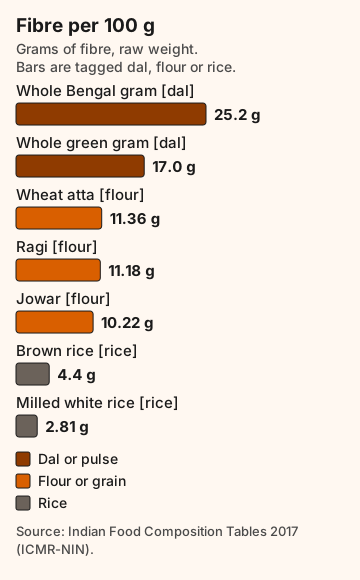
Fibre per 100 g raw, from the Indian Food Composition Tables.[4]
Now the honest part. "Millets are better" is too simple. A review that gathered glycaemic index (GI) values from 39 studies found that millets averaged 52.7 against 71.7 for milled rice, and ragi averaged 61.1. A lower GI means a slower rise in blood sugar.[21] But in the ICMR-INDIAB survey of 18,090 adults, swapping refined cereal for whole wheat or millet flour without lowering the total amount of carbohydrate was not linked to lower diabetes or to less belly fat.[17] Millets also contain compounds (phytic acid and tannins) that can lower how much iron and other minerals the body absorbs.[5][33] So portion size matters as much as grain type. That is our framing, and it is why the weekly amount above stays the same whichever grain you pick.
On rice itself, results are mixed. In a randomised crossover trial of 166 overweight adults in Chennai, brown rice instead of white rice for two meals a day over 3 months made no significant overall difference to blood sugar or blood fats. Small improvements showed up only in some subgroups, such as people with metabolic syndrome or a BMI of 25 or more, and a sizeable share of people did not finish the trial.[20] A pooled analysis of cohort studies linked each 3 servings a day of whole grains with a lower risk of type 2 diabetes (relative risk 0.68, from 10 of the 16 studies), an association, not proof.[19]
Rice and arsenic, an NRI-specific point. In a lab study of long-grain polished, parboiled and brown rice, cooking in excess water and draining it cut inorganic arsenic by about 40% in long-grain polished rice, 60% in parboiled and 50% in brown. It also cut iron, folate, niacin and thiamin by 50 to 70% in enriched polished and parboiled rice.[9] It measured contents, not health outcomes. The FDA advises eating a variety of nutrient-dense foods across food groups, which limits exposure to a contaminant from any one food.[10] So we do not tell anyone to avoid rice. We suggest varying your grains.
Thyroid condition? Our coaches suggest not swapping all your grains for millets overnight. Ask your doctor whether millets, or the timing of your thyroid tablet around meals, matter for you.
Our coaches suggest buying a mix, not one grain: atta for phulkas, one rice (sona masoori or basmati) in a small bag, ragi flour plus one of jowar, bajra (pearl millet) or korralu to rotate, and oats if you like them. Buy small bags of millets first to test the taste.
| Telugu kitchen swap | What it means | Our coaches' starting point |
|---|---|---|
| Jonna rotte (sorghum flatbread) | In place of part of your roti count | Swap one roti a day, then see how you feel |
| Ragi java (finger-millet porridge) | In place of a sugary breakfast cereal | Make it plain, with no added sugar |
| Korralu annam (foxtail-millet "rice") | In place of some white rice | Cook a small first batch |
Vegetables, fruit, curd and oil {#produce-dairy-fats}
There are two numbers in circulation, from two sources. WHO advises at least 400 g of fruit and vegetables a day.[6] The ICMR-NIN plate has 400 g of vegetables and greens plus 100 g of fruit.[2] This page uses the ICMR-NIN numbers in the table.
Our coaches suggest this produce list: palak (spinach), methi (fenugreek), gongura (roselle leaves), gourds, okra, brinjal (aubergine), beans, cauliflower, tomatoes, onions, ginger, garlic, curry leaves and coriander, plus guava, papaya, banana, apple and citrus. When fresh methi, palak or gongura is hard to find, we suggest frozen. Frozen peas, mixed vegetables and grated coconut also help on busy weeks. We make no claim here about nutrient retention in frozen food. If you have kidney disease, check with your renal dietitian before filling the trolley (see the red flags below).
Curd and milk. The plate has 300 ml of milk or curd a day.[2] Curd (dahi, perugu in Telugu) and majjiga (thin spiced buttermilk) both count. Whole cow milk is about 73 kcal and 3.3 g protein per 100 g, and the food tables do not list curd, so milk is the closest proxy.[4] Our coaches suggest plain US yoghurt as a stand-in for perugu, with a label check for added sugar.
Oil and ghee. ICMR-NIN advises limiting ghee (clarified butter) and butter, not reheating or reusing heated cooking oil, and preferring pressure cooking and steaming to deep frying.[1] Oils and ghee are 100% fat at about 9 kcal per gram.[4] The plate allows 27 g of fat a day.[2] By our arithmetic, a 1 L oil bottle holds about 920 g of oil, which is a bit over a month for one person at that amount. That is a handy check on how fast oil leaves your kitchen.
Nuts and seeds. A meta-analysis of 20 prospective studies linked each extra 28 g a day of nuts with lower cardiovascular disease and lower all-cause mortality, which is an association, not proof.[12] The plate lists 35 g of nuts and seeds a day.[2] Check for nut or sesame allergy first.
Eggs, fish and chicken. These can replace part of the pulses, as above.[1][2] Our coaches expect to find eggs and frozen fish in any US supermarket. Millet-forward readers can also see our page on millets for weight loss.
Reading the US label: sodium, added sugar and fat {#read-the-label}
US packs show a Nutrition Facts label. The FDA's quick guide says 5% Daily Value (DV) or less per serving is low and 20% DV or more is high.[8] On a 2,000 kcal diet, the Daily Values are sodium under 2,300 mg, added sugars under 50 g, saturated fat under 20 g and fibre at least 28 g.[8] Serving size shows what people typically eat and is not a recommendation, and eating two servings doubles the numbers.[8]
Indian guidance is stricter on two points. ICMR-NIN advises at most 5 g of salt a day (about 2 g sodium) and added sugar under 5% of energy (about 20 to 25 g).[1] WHO also says salt under 5 g a day, and free sugars under 10% of energy with extra benefit at 5% or less.[6]
| What to check | Where it hides | What the numbers say |
|---|---|---|
| Sodium | Pickles, papad (thin lentil crisps), namkeen (savoury snacks), ready curries, canned beans | FDA: 20% DV or more is high; 2,300 mg DV.[8] ICMR-NIN: 5 g salt a day.[1] |
| Added sugar | Flavoured yoghurt, ready chai mix, mithai (Indian sweets) mix, boxed cereal | FDA DV under 50 g.[8] ICMR-NIN: under 5% of energy.[1] |
| Saturated fat | Ghee, frozen parathas, paneer blocks | FDA DV under 20 g.[8] WHO: no more than 10% of energy.[6] |
| Trans fat | "Partially hydrogenated" oil on the list, margarine, vanaspati (hydrogenated vegetable fat), biscuits | WHO: under 1% of energy, about 2.2 g on 2,000 kcal.[7] |
WHO names partially hydrogenated oils, vanaspati ghee, margarine, and fried or baked goods like biscuits and crackers as the main industrial sources of trans fat.[7]
Spices. The FDA monitors ground cinnamon sold at US retail for lead and issues public alerts for some products.[11] This is about cinnamon only, and we are not saying any store or brand is affected. Check FDA alerts before buying ground cinnamon in bulk. Our coaches suggest whole spices from stores with quick turnover.
Boxed snacks and ready meals. In a 2-week inpatient trial of 20 adults, people ate about 508 kcal a day more on an ultra-processed diet than on an unprocessed one, even though the meals offered were matched for calories, sugar, fat and fibre.[24] It was a small, short trial. Our coaches suggest keeping boxed snacks and ready meals to a short list.
Sweet drinks. A meta-analysis of 17 cohorts (38,253 cases of type 2 diabetes) linked each daily serving of sugar-sweetened drinks with 13% higher diabetes incidence after adjusting for body fat.[25] Sugar in your chai counts as added sugar too.
What to buy at Patel Brothers vs Costco {#where-to-buy}
This is our coaches' practical guide, not a research finding. Stock differs by city and changes often, so we name no brands or prices. Use it to decide where to look first, and check your own store.
| Item group | Desi store (Patel Brothers-type) | Warehouse club (Costco-type) | Regular supermarket |
|---|---|---|---|
| Whole and split dals, moong, chana, rajma, lobia | Widest range, small packs | Some bulk lentils, check | Limited |
| Atta, ragi flour, jowar, bajra, korralu | Best place to look | Rarely | Some millet flours, oats |
| Frozen methi, palak, gongura, grated coconut | Best place to look | Large general frozen vegetable bags | Frozen vegetables |
| Curd and buttermilk | Small tubs of dahi | Large tubs; plan to use within a week | Plain yoghurt |
| Paneer | Yes | Blocks, check | Some |
| Ghee and oil | Small sizes | Large sizes | Small to mid sizes |
| Eggs, chicken, frozen fish | Rohu and similar in freezers, check | Yes | Yes |
| Spices | Small bags, quick turnover | Common staples like cumin | Limited |
| Sweets, namkeen, frozen snacks, ready mixes | Many | Some | Some |
Our rules of thumb:
- Buy dal, flour and rice in sizes you will finish in two to three months.
- Keep a freezer list, and buy fresh greens weekly.
- Buy large tubs of curd only if you can finish them in a week.
- Skip cheap-per-kg traps. A bag you throw away costs more.
Why a list helps. In the MASALA study of 874 South Asian adults living in the US, longer US residence was linked with eating fewer beans and lentils, less rice and bread or grain dishes, and less milk and dairy. It was also linked with more total fat, saturated fat and trans fat.[13] That study looks at one point in time, so it shows a link, not a cause.
For batch cooking after the shop, see our Indian meal prep week plan and read why Indians gain weight after moving to the USA.
The printable weekly list, and who should check first {#printable-list-and-safety}
Below is a one-adult example for a week, built from the ICMR-NIN plate (about 2,000 kcal a day, raw weights).[1][2] It is an example, not a prescription. Print this page or copy the table.
| Tick | Group | Weekly amount, one adult | Telugu-friendly picks |
|---|---|---|---|
| ☐ | Vegetables and greens | 2.8 kg | Palak, methi, gongura, okra, gourds, brinjal, tomato, onion |
| ☐ | Fruit | 700 g | Guava, papaya, banana, apple, citrus |
| ☐ | Pulses (dal), raw | 595 g | Kandi pappu, pesalu, senagalu, rajma, lobia |
| ☐ | Grains, millets and flours, raw | 1,750 g (keep rice small) | Atta, ragi, jonna, korralu, one small bag of rice |
| ☐ | Milk or curd | 2.1 L | Plain perugu or dahi, majjiga |
| ☐ | Nuts and seeds | 245 g | Groundnuts, almonds, sesame, flax |
| ☐ | Oil | About 189 g (about 205 ml) | One oil in a small bottle; ghee in small amounts |
| ☐ | Optional swaps for part of the pulses | As you prefer | Eggs, fish, chicken |
For two adults, double it. For other calorie levels, see the scaling table above. Children, pregnant or breastfeeding women, and anyone with a medical condition need different amounts. ICMR-NIN's reference figures add about 350 kcal a day in pregnancy.[3] The macro split calculator and the meal calorie calculator help you scale.
When to see a doctor
See your doctor or a registered dietitian before using any grocery list if:
- You have diabetes, prediabetes, heart disease or high blood pressure, or take medicines that interact with food. This list is general, not a treatment plan or a diabetes meal plan. The American Diabetes Association consensus says there is no single ideal split of carbohydrate, protein and fat for everyone, and plans should be individualised.[16]
- You have kidney disease. Some foods high in potassium or phosphorus may need limits, so ask your renal dietitian. The National Kidney Foundation says potassium and phosphorus plans should be individualised and that not everyone with CKD needs a low-potassium diet.[32]
- You have a thyroid condition and want to change your grains or the timing of your tablet.
- You are pregnant, trying to conceive or breastfeeding. Needs differ. For fish, the FDA lists king mackerel, marlin, orange roughy, shark, swordfish, tilefish (Gulf of Mexico) and bigeye tuna as highest in mercury, and advises 2 to 3 servings a week from its "Best Choices" list.[29] "Mackerel" covers many fish, so ask about any you are unsure of. The FDA says pregnant women should avoid unpasteurised milk and unpasteurised milk products, and lists raw sprouts among foods that carry a high Listeria risk for people at higher risk.[30] Our coaches suggest checking that paneer, curd and soft cheese are made from pasteurised milk.
- You have a food allergy (nuts, sesame, dairy, wheat) or coeliac disease. Our coaches suggest reading labels closely as a precaution, since millets are naturally gluten free[5] but flours may be milled or packed alongside wheat (our precaution, not a sourced finding).
- You are vegetarian or vegan and have not had your B12 checked.[27][28]
- You have a history of disordered eating. Please do not use a list as a way to restrict food.
- You plan very low-calorie eating. Ask your doctor first.
What to buy first
- Dals and vegetables. Start with whole dals and the biggest line, vegetables and greens, with frozen greens as a backup.
- A mix of grains. Atta, one small bag of rice and one or two millets to test.
- Check the label. Look at sodium, added sugar and the serving size before you buy.
Want this list adjusted to your numbers and your food? Start with the free macro split calculator, or book a free consultation call with a Flexcellence coach in your time zone at /book. There is no pressure and no promise of results, just a plan built around normal Indian food.
Common questions
What should be on a healthy Indian grocery list?
ICMR-NIN's My Plate groups are the base: grains and millets, pulses, vegetables and greens, fruit, milk or curd, nuts and seeds, and a little oil. Eggs, fish or chicken can replace part of the pulses. Our coaches suggest whole dals, atta, millets, plain curd and frozen greens as the core.
How much dal, rice and vegetables do I need per week for one person?
On the ICMR-NIN plate for about 2,000 kcal a day, one adult gets 85 g pulses, 250 g grains and millets and 400 g vegetables and greens daily, raw. Our calculation for a week is about 595 g pulses, 1,750 g grains and 2.8 kg vegetables. Your calories may differ.
Which millets should I buy first, and are they better than rice?
Start with ragi flour and one of jowar, bajra or korralu in small bags. Millets had a lower average glycaemic index than milled rice in one review, but in an Indian survey, swapping refined grain for millet flour without cutting total carbohydrate was not linked to lower diabetes risk. Portion matters as much.
Is it okay to buy frozen or canned Indian vegetables and beans?
Our coaches suggest frozen methi, palak and mixed vegetables when fresh is hard to find, and rinsing canned chickpeas or rajma because canned foods can be salty. We make no nutrient-retention claim here.
What should I buy at Patel Brothers vs Costco?
Our coaches suggest a desi store like Patel Brothers for whole dals, millet flours, greens and small spice bags, and a warehouse club like Costco for eggs, large oil or ghee and bulk staples. Stock changes by city and date, so check your store.
How do I read a US food label for sodium and sugar?
Look at serving size first, since two servings doubles every number. The FDA says 5% Daily Value or less per serving is low and 20% or more is high. ICMR-NIN advises at most 5 g of salt a day, which is stricter than the FDA sodium figure.
Reviewed by
Not yet reviewed by a Flexcellence coach.
Sources
ICMR-National Institute of Nutrition, Hyderabad. Dietary Guidelines for Indians (2024 revision) (2024).
ICMR-National Institute of Nutrition, Hyderabad. Policy Brief: Promotion of 'My Plate for the Day' and physical activity (2024).
ICMR-National Institute of Nutrition, Hyderabad. A Brief Note on Nutrient Requirements for Indians: RDA and EAR 2020 (2020).
ICMR-National Institute of Nutrition (Longvah T et al.). Indian Food Composition Tables 2017 (2017).
ICAR-Indian Institute of Millets Research, Hyderabad. Nutritional and Health Benefits of Millets (2017).
World Health Organization. Healthy diet (fact sheet) (2026).
World Health Organization. Trans fat (fact sheet) (2024).
US Food and Drug Administration. How to Understand and Use the Nutrition Facts Label (2024).
Food Additives & Contaminants Part A (Gray PJ et al., US FDA). Cooking rice in excess water reduces both arsenic and enriched vitamins in the cooked grain (2016).
US Food and Drug Administration. Arsenic in Food (2024).
US Food and Drug Administration. Lead in Food and Foodwares (2025).
BMC Medicine (Aune D et al.). Nut consumption and risk of cardiovascular disease, total cancer, all-cause and cause-specific mortality: a systematic review and dose-response meta-analysis of prospective studies (2016).
Public Health Nutrition (Talegawkar SA et al.; MASALA study). Dietary intakes among South Asian adults differ by length of residence in the USA (2016).
Diabetes Care (ADA consensus report; Evert AB et al.). Nutrition Therapy for Adults With Diabetes or Prediabetes: A Consensus Report (2019).
Nature Medicine (Anjana RM et al., ICMR-INDIAB). Dietary profiles and associated metabolic risk factors in India from the ICMR-INDIAB survey-21 (2025).
European Journal of Epidemiology (Aune D et al.). Whole grain and refined grain consumption and the risk of type 2 diabetes: a systematic review and dose-response meta-analysis of cohort studies (2013).
British Journal of Nutrition (Malik VS, Sudha V et al.). Substituting brown rice for white rice on diabetes risk factors in India: a randomised controlled trial (2019).
Frontiers in Nutrition (Anitha et al., ICRISAT). A Systematic Review and Meta-Analysis of the Potential of Millets for Managing and Reducing the Risk of Developing Diabetes Mellitus (2021).
Canadian Medical Association Journal (Ha V et al.). Effect of dietary pulse intake on established therapeutic lipid targets for cardiovascular risk reduction: a systematic review and meta-analysis of randomized controlled trials (2014).
Cell Metabolism (Hall KD et al.). Ultra-Processed Diets Cause Excess Calorie Intake and Weight Gain: An Inpatient Randomized Controlled Trial of Ad Libitum Food Intake (2019).
BMJ (Imamura F et al.). Consumption of sugar sweetened beverages, artificially sweetened beverages, and fruit juice and incidence of type 2 diabetes: systematic review, meta-analysis, and estimation of population attributable fraction (2015).
Journal of the Academy of Nutrition and Dietetics (Melina V, Craig W, Levin S). Position of the Academy of Nutrition and Dietetics: Vegetarian Diets (2016).
Nutrition Reviews (Pawlak R et al.). How prevalent is vitamin B12 deficiency among vegetarians? (2013).
US Food and Drug Administration. Advice about Eating Fish (2021).
US Food and Drug Administration. Listeria (Listeriosis) (2025).
US Food and Drug Administration. Natural Toxins in Food (2026).
National Kidney Foundation. Creating a Kidney Friendly Plate (2026).
Frontiers in Nutrition (Reddy BHR et al.). A Natural Low Phytic Acid Finger Millet Accession Significantly Improves Iron Bioavailability in Indian Women (2022).