Gained weight after moving to the USA? Why Indians do
Why Indians and other South Asians gain weight in America: driving, portions, eating out, sleep. A 90-day plan with Indian food and when to see a doctor.
The short answer
Indians often gain weight after moving to the US because of more driving and sitting, bigger portions, eating out, sugary drinks and fewer beans and lentils. South Asians face diabetes risk at a lower BMI, so check your numbers early and see a doctor if unsure.
Work out your own numbers
Calculate total daily energy expenditure from BMR and activity.
Free, takes a minute, and uses the same formulas our coaches use.
Open the TDEE CalculatorAlso useful
On this page
If you have gained weight since moving to the US, you are not alone. The reasons are mostly everyday ones: more driving and sitting, bigger portions, more eating out, sugary drinks, and a plate that slowly drifts away from dal and vegetables. This guide explains each one, why it matters more for South Asians, and a calm 90-day plan built on your own Telugu and Indian food.
Who it affects most. In a US national survey from 2000 (32,374 adults, 14% of them immigrants), obesity was 8% in immigrants who had lived in the US under a year and 19% in those who had lived there 15 years or more.[1] That survey covered all immigrants, not only Indians, and newer data may exist. In a later study of South Asians in the US, women were more likely to gain weight than men.[27]
This is general education, not medical advice. It is written for adults who are not pregnant or breastfeeding. If you are, follow your obstetrician or dietitian instead. If you have a health condition or take medicines, especially for diabetes or blood pressure, check with your doctor before changing how you eat or exercise. BMI (body mass index) is weight in kilograms divided by height in metres squared, and the BMI cut-offs below are for adults.
Weight gain after moving to America: what the research shows
Most of these studies are snapshots, so they show links, not proof of cause.
- More years in the US, higher BMI. In the 2000 survey, after adjusting for other factors, 10 to 15 years in the US went with a BMI about 0.88 higher than recent arrivals, and 15 years or more with a BMI about 1.39 higher.[1] A review of 15 studies of US immigrants found that 14 linked more years in the US with a higher BMI.[2]
- For South Asians, it is not only a "later" problem. The MASALA study followed 634 South Asian adults near San Francisco and Chicago, mostly middle-aged and older, highly educated Asian Indian immigrants, for 4.8 years on average. Of them, 34.7% gained 5% or more of their body weight and 32.3% gained 5% or more around the waist.[27] In this group, more years in the US did not raise the odds of gaining.[27]
Do not wait for a "10-year mark". Two studies in the review saw weight gain begin after about 10 years.[2] In MASALA, more years in the US did not go with higher odds of gain,[27] and the review itself recommends prevention within the first decade.[2] Our coaches suggest setting up good habits in your first year.
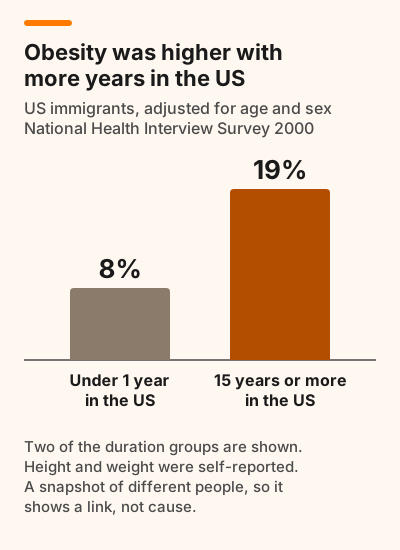
Figure: Age- and sex-adjusted obesity among US immigrants, National Health Interview Survey 2000. Two of the duration groups are shown. Height and weight were self-reported, and the survey compared different people at one point in time.[1]
Why it happens: six everyday changes after you land
None of these is a personal failing. They are changes in the place you live, and each one can be adjusted. Weight usually creeps up slowly. In one model of adult weight, a small gap of about 7 kcal a day, kept up for years, matched the average weight gain of US adults over decades.[16]
1. You drive and sit more
In a study of adults in the Atlanta region, each extra hour a day in a car went with 6% higher odds of obesity, and each extra kilometre walked a day with 4.8% lower odds.[10]
Think about your own day. In Hyderabad you may have walked to the auto-rickshaw stand, climbed office stairs and gone down to the kirana (neighbourhood grocery) shop. In Dallas or New Jersey the car is in the garage, the office has a parking lot, and groceries come in one big weekend trip.
2. Portions and plates are bigger
A Cochrane review of 72 trials, 81% of them run in the US, found that adults eat more when they are given larger portions, packages or plates.[11]
3. Eating out and fast food become routine
In the CARDIA study of black and white US adults who were 18 to 30 at the start, those who ate fast food more than twice a week at both the start and the end of 15 years (87 people) gained about 4.5 kg more than those who ate it less than once a week at both points (203 people).[12] UK adults who cooked at home more than five times a week were 28% less likely to have an overweight BMI than those who cooked fewer than three times.[13] Both are links, not proof. South Asian immigrants in Canada also reported eating more convenience food and eating out after moving.[4]
4. Sugary drinks and coffee-shop drinks
In a review of studies in adults, each extra daily serving of a sugary drink went with about 0.12 to 0.22 kg more weight gain a year, and in trials, adding sugary drinks raised weight by about 0.85 kg.[14] ICMR-NIN (India's National Institute of Nutrition) advises avoiding soft drinks and keeping added sugar under 5% of daily energy.[22] Free refills, large sodas and sweetened lattes make these drinks easy to pick up without thinking.
5. Your Indian food changes too
In MASALA, 874 South Asian adults with 2 to 58 years in the US were asked about their diet. Longer residence was linked with more total fat, saturated fat and trans fat, more alcohol, and more mixed dishes like pizza and pasta. It was also linked with less fibre and fewer beans and lentils.[3]
Some changes went the other way. South Asian immigrants in Canada said they ate more fruit and vegetables, grilled more and deep-fried less after moving, but also ate more convenience food, sugary drinks and red meat.[4] So the research points less to Indian food itself and more to a changing pattern: fewer beans and lentils, more fat and mixed dishes, more eating out and sweet drinks. These are links, not proof of cause.
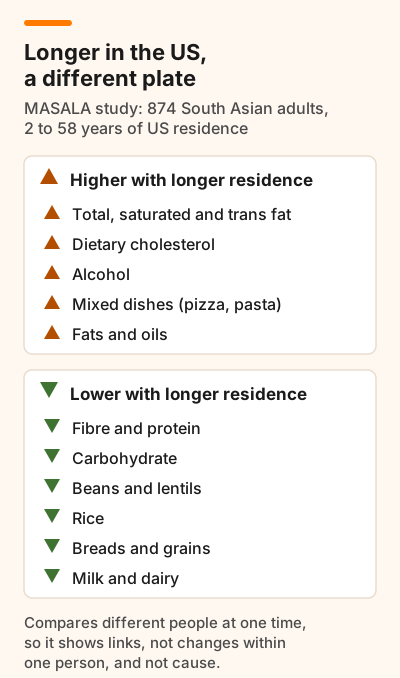
Figure: Foods and nutrients linked with longer US residence in MASALA. It compares different people, so it shows links, not changes within one person.[3]
6. Sleep, shifts, winter and the holidays
In a pooled analysis of 604,509 adults, short sleep was linked with 55% higher odds of obesity, mostly from snapshot studies.[17] ICMR-NIN advises 6 to 8 hours of sleep a day to help avoid unhealthy eating and weight gain.[22] In a convenience sample of 195 US adults weighed from early autumn to late winter, the average gain was about 0.48 kg, and it was not lost over the following spring and summer in the 165 who were weighed again.[15]
Why it matters more for South Asians
A WHO expert group found that many Asian populations have a high risk of type 2 diabetes and heart disease at a BMI below 25, the usual "overweight" line. It said no single cut-off could be set for all Asians and did not redefine the cut-offs. It did identify public health action points at BMI 23.0, 27.5, 32.5 and 37.5.[6]
US data also show more diabetes in South Asian adults:
| Study | Who | Diabetes |
|---|---|---|
| NHANES 2011-2016, 7,575 US adults in all (909 non-Hispanic Asian), age- and sex-adjusted[5] | South Asian / East Asian / non-Hispanic white | 23.3% (95% CI 15.6-30.9%) / 14.0% / 12.1% |
The range around the South Asian figure is wide. Read more in our guide to South Asian diabetes risk.
This is why the BMI cut-off matters. In a pooled cross-sectional analysis of four cohorts of Asian American adults aged 45 or older, screening only at a BMI of 25 or more would miss 36% of those with newly diagnosed type 2 diabetes, while a cut-off of 23.5 found about 80%.[7] The American Diabetes Association (ADA) advises testing adults with overweight or obesity who have another risk factor, counting overweight from BMI 23 in people of Asian ancestry. For adults without those risk factors, it advises starting at age 35.[8]
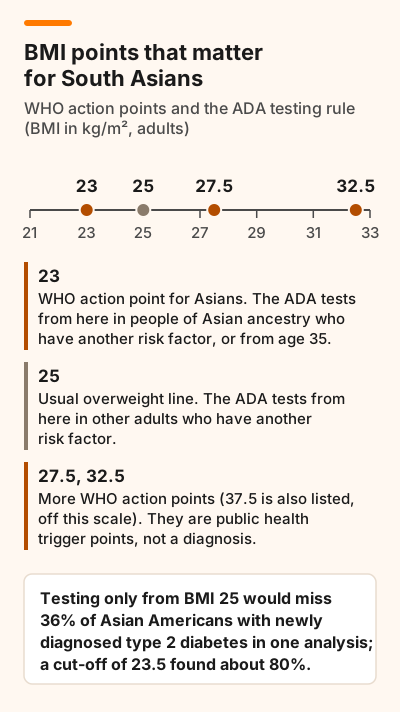
Figure: WHO BMI action points for Asians,[6] ADA screening rule,[8] and the share of new diabetes missed by a BMI 25 cut-off.[7]
Check your waist, not only your BMI
In the IDF definition of the metabolic syndrome, a waist of 90 cm or more in men and 80 cm or more in women counts as central obesity in South Asians. Measure with a tape in a horizontal line midway between the lowest rib and the top of the hip bone.[29] This is a risk marker to discuss with your doctor, not a diagnosis.
Your first 90 days in the US: a plan for NRIs
Many NRIs ask about weight loss first. Our coaches suggest starting with habits, not a number on the scale. This is the order they usually suggest. You do not need to do it all at once, and if you have been in the US for years, the same steps still apply.
| Weeks | One action | Use |
|---|---|---|
| 1-2 | Know your numbers: energy needs, waist, a check-up | TDEE calculator |
| 3-4 | Set up your Indian kitchen and measure the oil | Healthy Indian grocery list |
| 5-8 | Walk daily and add two short strength sessions | Steps-to-calories converter |
| 9-12 | Plan restaurants, drinks and weekends | Meal prep plan |
Weeks 1-2: know your numbers
Start with the free TDEE calculator to estimate how much energy your body uses in a day. It starts from the Mifflin-St Jeor equation, which was built from measurements in 498 healthy adults, so the result is an estimate.[20] For an Indian reference point, ICMR-NIN puts the energy need of a sedentary 55 kg woman at about 1,660 kcal a day and a sedentary 65 kg man at about 2,110 kcal.[21] Measure your waist as above. If any red flag in the doctor section below applies, book that check-up now.
Be patient with the scale. In the weight model mentioned earlier, body weight responds slowly to a change in eating, with a half-time of about a year.[16] Judge progress over months, not days.
Weeks 3-4: set up your Indian kitchen
ICMR-NIN's "My Plate" for a day of about 2,000 kcal (Table 1 of an ICMR-NIN report on children's macronutrient intake, designed for a sedentary man or an active woman with a normal BMI) uses these raw amounts:[28]
| Food group | Raw amount per day |
|---|---|
| Cereals and millets | 260 g |
| Pulses (eggs, fish or meat can replace some) | 85 g |
| Milk or curd | 300 ml |
| Vegetables and leafy greens | 400 g |
| Fruit | 100 g |
| Nuts and seeds | 30 g |
| Fats and oils | 27 g (about 6 teaspoons by our conversion) |
Raw weight is before cooking, so cooked food looks bigger. For people who need more or less than 2,000 kcal, ICMR-NIN says to raise or lower cereals and pulses, keeping about 3 parts cereal to 1 part pulses.[28]
Our coaches suggest a simple first grocery run at Patel Brothers (an Indian grocery chain in the US) or any Indian store: toor dal, whole green gram, ragi (finger millet) flour, whole-wheat atta, brown or parboiled rice, roasted chana, and frozen vegetables for busy nights. They also suggest measuring oil and ghee with a teaspoon instead of pouring. Our healthy Indian grocery list for the US goes aisle by aisle, and our Indian meal prep plan for the week shows how to batch-cook pappu (dal), kura (vegetable curry) and batter on a Sunday.
Weeks 5-8: put walking and strength back into your day
Use the free steps-to-calories converter to see what your walks add up to. The Compendium of Physical Activities rates brisk walking for exercise as clearly more demanding than slow walking, so pace changes the result.[19]
How much? WHO advises 150 to 300 minutes of moderate activity a week plus muscle-strengthening on 2 or more days, and says short bouts count.[25] A consensus group for Asian Indians recommends 60 minutes of activity a day, including about 15 minutes of muscle-strengthening work.[24] For steps, a 2022 analysis of 15 groups of adults found that the lower risk of death levelled off at about 8,000 to 10,000 steps a day in adults under 60. That study looked at death rates, not weight.[18]
Our coaches suggest a 10-minute walk after lunch, laps in a mall or a big store during snowy months, and parking at the far end of the lot. For strength at home, two simple options are sit-to-stand from a chair and wall or knee push-ups. If you have joint, heart or other health problems, ask your doctor before you start. If you take medicines that lower blood sugar, see the note after the sample day.
Weeks 9-12: eating out, drinks and weekends
Breakfast is the easiest meal to fix first. See our high-protein Indian breakfasts for ideas. Here is what our coaches suggest for common US situations:
- Indian restaurants and buffets: start with salad, dal and a vegetable dish, and choose roti or tandoori items more often than naan, fried starters and cream gravies. Share one biryani instead of ordering one each.
- Chain restaurants and takeout: in a burrito-bowl place, go for beans and vegetables with one scoop of rice. At a coffee shop, choose a small size and fewer syrup pumps.
- Costco and bulk packs: split packs into small boxes at home so the portion is decided before you sit down.
- Drinks: swap soda or sweet coffee drinks for majjiga (thin spiced buttermilk), plain tea or water.[14] ICMR-NIN advises avoiding alcohol, and in MASALA longer US residence went with more alcohol.[22] [3]
- Potlucks and weekends: eat something before you go, bring a dal or vegetable dish you like, and box half of a large plate before you start.
If your situation is...
- Working 9-to-5 and commuting by car: a packed lunch from your Sunday batch cook, plus one walk at lunch.
- H-4 spouse (dependent visa) at home: set fixed meal times and a daily walk with a friend or neighbour.
- F-1 student (student visa) with a tight budget: dal, eggs, frozen vegetables and rice cooked in bulk are cheaper than daily takeout.
A sample Indian day with US groceries
This is our coaches' example for a sedentary adult, not a prescription. Portions are in katoris, the household measure our coaches use (a katori is a small bowl of about 150 ml). The day roughly follows the ICMR My Plate food groups, which are set for people needing about 2,000 kcal: cereals, pulses, vegetables, curd or milk, fruit and a little oil.[28]
| Meal | Telugu / South Indian option | North Indian option | Where to buy in the US |
|---|---|---|---|
| Breakfast | 2 pesarattu (green gram dosa) with ginger or tomato chutney | Besan chilla (gram flour pancake) with curd | Whole green gram and besan at Patel Brothers or any Indian store |
| Lunch | 2 phulkas (thin oil-free roti) or 1 katori rice, 1 katori kandi pappu (toor dal), 1 katori kura (vegetable curry), 1 katori perugu (curd) | 2 phulkas, 1 katori rajma (kidney bean curry), 1 katori sabzi (vegetable dish), salad | Atta, toor dal and rajma at Indian stores; vegetables at any supermarket |
| Evening snack | Handful of roasted chana (roasted Bengal gram) with a glass of majjiga | Roasted chana with masala chai (spiced milk tea), less sugar | Roasted chana at Indian stores; plain yogurt for majjiga at any supermarket |
| Dinner | 1 katori ragi java (finger millet porridge), or 1 katori rice with sambar (lentil and vegetable stew) and extra vegetables | 1 katori dalia (broken wheat porridge) with vegetables | Ragi flour and dalia at Indian stores; frozen mixed vegetables at Costco or any supermarket |
| Before bed (only if hungry) | 1 small glass warm milk | 1 small glass warm milk or a piece of fruit | Any supermarket |
This base day is light. By our coaches' rough count it is about 1,300 to 1,500 kcal, which is below the ICMR-NIN energy needs quoted earlier for sedentary adults.[21] Treat it as a base and scale up if you are a man, a student, active, hungry or tired: add a second katori of dal or sabzi, another phulka, or a fruit.
Protein add-ons. ICMR-NIN's My Plate gives about 14% of energy from protein and says eggs, fish or meat can replace some pulses.[28] Per 100 g raw, the Indian Food Composition Tables list protein of about 22.5 g in whole green gram, 21.7 g in kandi pappu, 18.9 g in paneer and 13.3 g in whole egg.[23] Vegetarians can add paneer or an extra pulse portion. If you eat eggs, 1 or 2 eggs at breakfast also work. If you eat fish or chicken, add a palm-sized portion at lunch or dinner.
If you take medicines. Cutting rice or roti, skipping snacks or walking much more can change how your body handles diabetes medicines such as insulin or sulfonylureas, and blood pressure medicines. Talk to your doctor before you change your food or activity a lot, and ask what low-sugar symptoms to watch for.
If you have already gained weight
You have not missed your chance. Because the body responds slowly,[16] our coaches suggest keeping the steps above going for months. ICMR-NIN advises slow, steady weight reduction and warns that extreme approaches may harm health, so skip crash diets and detox plans.[22] Our Indian meal prep plan can help you keep habits going week after week.
See your doctor if...
Book a check-up, and ask for these tests or conversations, if any of these apply to you:
- You are of South Asian ancestry, your BMI is 23 or more, and you have another risk factor such as a parent or sibling with diabetes, high blood pressure or PCOS. Ask for a diabetes test.[8]
- You are 35 or older and have never been tested. Ask anyway. If the result is normal, the ADA says repeating it at least every 3 years is reasonable, sooner if your risk changes, for example with weight gain.[8]
- You notice signs that can go with diabetes: strong thirst or hunger, passing urine often, blurred vision, sores that heal slowly, tingling or numb hands or feet, or weight loss you did not intend. Some people with type 2 diabetes have no signs at all.[30]
- Your weight gain comes with tiredness, feeling cold, constipation, low mood, dry skin or hair, hair loss, or heavy or irregular periods. These can be signs of an underactive thyroid, which often develops slowly and is easy to miss, so ask your doctor about a thyroid test.[26]
- Your weight is changing fast without a clear reason, your mood is very low, or your eating feels out of your control. Please see a doctor soon. (General safety advice, not from a single study.)
- You have sudden breathlessness, chest pain, or new swelling of your legs or face. Seek urgent medical care. Do not wait for a routine appointment. (General safety advice.)
If your doctor tells you that you are at high risk of type 2 diabetes (this includes prediabetes) and you have overweight, the ADA advises referral to a diabetes prevention programme that aims for at least 5-7% weight loss and at least 150 minutes a week of moderate-intensity activity.[9] Those goals are for that group and are set with your doctor. They are not a target for everyone.
Do not wait to be asked. In the 2000 survey, immigrants were less likely than US-born adults to report discussing diet and exercise with clinicians,[1] so bring up your weight, diet and activity yourself at your next visit.
Key takeaways
- Weight gain after moving to the US is common, and more years in the US did not raise the odds in MASALA, so do not wait for a "10-year mark". Our coaches suggest starting habits in your first year.
- The main drivers are everyday ones: more driving, bigger portions, eating out, sweet drinks, fewer lentils and later sleep.
- South Asians face diabetes risk at a lower BMI, so ask about testing from BMI 23 with another risk factor, or from age 35.
- Start with habits: walk, cook your own dal-and-vegetable meals, measure the oil and fix your sleep.
- Check with your doctor if you are pregnant, take medicines, or have any of the red flags above.
Your next step: start with the free TDEE calculator and the steps-to-calories converter. If you would like help from a nutritionist and fitness coach who understand both Telugu kitchens and US life, book a free 30-minute consultation. Not sure what to look for in an online dietitian? Read our guide to choosing an online Indian dietitian in the USA.
Common questions
Is it normal to gain weight after moving to the USA?
It is common. In a 2000 US survey, obesity was 8% in immigrants under a year in the US and 19% in those there 15 years or more, and a review found 14 of 15 studies linked more US years with higher BMI. In the MASALA study of US South Asians, 34.7% gained 5% or more of their weight over about 4.8 years.
How long after moving does weight gain usually start?
Some studies of US immigrants saw BMI rise after about 10 years. In the MASALA study of US South Asians, more years in the US did not raise the odds of gaining weight, so our coaches suggest setting up good habits in your first year.
Is Indian food the reason Indians gain weight in America?
The research points more to changes in diet pattern, driving and eating out than to Indian food itself. In US South Asians, longer residence was linked with more fat, pizza and pasta and fewer beans and lentils. These are links, not proof of cause. Keeping dal-and-vegetable meals in your week is a sensible habit.
Do I need a diabetes test even if my BMI is normal by US charts?
Possibly. The ADA advises testing adults with overweight or obesity and another risk factor, counting overweight from BMI 23 in people of Asian ancestry, and everyone else from age 35. In one analysis, screening Asian Americans only at a BMI of 25 would miss 36% of those with newly diagnosed type 2 diabetes.
How can I lose weight after moving to the USA?
Start with habits, not a number on the scale: more walking, home-cooked dal-and-vegetable meals, fewer sweet drinks, a steady sleep time and a check-up for diabetes and thyroid if you have risk factors. Body weight responds slowly, so judge progress over months. See the 90-day plan above, and check with your doctor first if you take medicines or are pregnant.
Why do I gain weight in my first US winter or holiday season?
In a convenience sample of 195 US adults, the average gain was about 0.48 kg from autumn to late winter, and it was not lost by the next autumn. Short sleep is also linked with higher odds of obesity.
Reviewed by
Not yet reviewed by a Flexcellence coach.
Sources
JAMA (Goel MS et al.). Obesity among US immigrant subgroups by duration of residence (2004).
Obesity Reviews (Oza-Frank R, Cunningham SA). The weight of US residence among immigrants: a systematic review (2010).
Public Health Nutrition (Talegawkar SA, Kandula NR, Gadgil MD, Desai D, Kanaya AM; MASALA study). Dietary intakes among South Asian adults differ by length of residence in the USA (2016).
PLoS ONE (Lesser IA, Gasevic D, Lear SA). The association between acculturation and dietary patterns of South Asian immigrants (2014).
JAMA (Cheng YJ et al., CDC). Prevalence of Diabetes by Race and Ethnicity in the United States, 2011-2016 (2019).
The Lancet (WHO Expert Consultation). Appropriate body-mass index for Asian populations and its implications for policy and intervention strategies (2004).
Diabetes Care (Hsu WC, Araneta MR, Kanaya AM, Chiang JL, Fujimoto W). BMI cut points to identify at-risk Asian Americans for type 2 diabetes screening (2015).
Diabetes Care (American Diabetes Association Professional Practice Committee). 2. Diagnosis and Classification of Diabetes: Standards of Care in Diabetes-2026 (2026).
Diabetes Care (American Diabetes Association Professional Practice Committee). 3. Prevention or Delay of Diabetes and Associated Comorbidities: Standards of Care in Diabetes-2026 (2026).
American Journal of Preventive Medicine (Frank LD, Andresen MA, Schmid TL). Obesity relationships with community design, physical activity, and time spent in cars (2004).
Cochrane Database of Systematic Reviews (Hollands GJ et al.). Portion, package or tableware size for changing selection and consumption of food, alcohol and tobacco (2015).
The Lancet (Pereira MA et al., CARDIA study). Fast-food habits, weight gain, and insulin resistance (the CARDIA study): 15-year prospective analysis (2005).
International Journal of Behavioral Nutrition and Physical Activity (Mills S et al.). Frequency of eating home cooked meals and potential benefits for diet and health: cross-sectional analysis of a population-based cohort study (2017).
American Journal of Clinical Nutrition (Malik VS, Pan A, Willett WC, Hu FB). Sugar-sweetened beverages and weight gain in children and adults: a systematic review and meta-analysis (2013).
New England Journal of Medicine (Yanovski JA et al.). A prospective study of holiday weight gain (2000).
The Lancet (Hall KD et al.). Quantification of the effect of energy imbalance on bodyweight (2011).
Sleep (Cappuccio FP et al.). Meta-analysis of short sleep duration and obesity in children and adults (2008).
The Lancet Public Health (Paluch AE et al., Steps for Health Collaborative). Daily steps and all-cause mortality: a meta-analysis of 15 international cohorts (2022).
2024 Adult Compendium of Physical Activities (Herrmann SD et al., Journal of Sport and Health Science). 2024 Adult Compendium of Physical Activities: walking category (2024).
American Journal of Clinical Nutrition (Mifflin MD, St Jeor ST et al.). A new predictive equation for resting energy expenditure in healthy individuals (1990).
ICMR-National Institute of Nutrition. A Brief Note on Nutrient Requirements for Indians, the RDA and EAR (ICMR-NIN 2020) (2020).
ICMR-National Institute of Nutrition, Hyderabad. Dietary Guidelines for Indians 2024 (booklet, direct PDF) (2024).
ICMR-National Institute of Nutrition (Longvah T, Ananthan R, Bhaskarachary K, Venkaiah K). Indian Food Composition Tables 2017 (2017).
Diabetes Technology & Therapeutics (Misra A et al., Physical Activity Consensus Group). Consensus physical activity guidelines for Asian Indians (2012).
British Journal of Sports Medicine / World Health Organization (Bull FC et al.). World Health Organization 2020 guidelines on physical activity and sedentary behaviour (2020).
NHS (UK). Underactive thyroid (hypothyroidism): symptoms (2025).
Obesity Pillars (Seetharaman S, Allen I, Gadgil M, Srinivasan S, Topor L, Kanaya A; MASALA study). Predictors of weight and waist gain in US South Asians: Findings from the MASALA study (2024).
ICMR-National Institute of Nutrition (Hemalatha R, Neeraja, Senthil Kumar B). What India Eats: Macronutrient intake of different food groups for infants and children (Table 1, My Plate for a 2000 kcal diet) (2023).
International Diabetes Federation. The IDF consensus worldwide definition of the metabolic syndrome (2006).
US Centers for Disease Control and Prevention. Diabetes symptoms (2026).