High-Protein Indian Breakfasts with US Ingredients
High-protein Indian breakfasts for US kitchens: 3 recipes, chilla, idli, bhurji and a 7-day chart with sourced protein grams.
The short answer
Idli, dosa and poha give only about 1-4 g protein each, while a moong dal stuffed cheela gives about 16 g and a 170 g tub of nonfat Greek yogurt about 17 g. Our coaches suggest adding one protein food, such as dal batter, eggs, yogurt, tofu or cottage cheese, to a breakfast you already enjoy.
Work out your own numbers
Estimate optimal daily protein intake by weight and goal.
Free, takes a minute, and uses the same formulas our coaches use.
Open the Protein Intake CalculatorAlso useful
On this page
Many Indian breakfasts are carb-led. An idli gives about 1.2 g of protein, a plain dosa about 3.7 g, and a bowl of poha about 3.3 g, going by the Indian Nutrient Databank.[5] That is fine for taste and comfort, but it leaves room to add a protein food. This guide is for kitchens in the US, where you may have one trip to an Indian store and one trip to a regular supermarket each month. It shows how to add protein to breakfasts you already like. It is not a weight-loss plan, and it makes no promise about kilos.
The short list of best picks: a moong dal stuffed cheela (about 16 g protein), a paneer or tofu cheela or bhurji (about 14-24 g), a Greek yogurt bowl (about 17 g from the yogurt alone), and egg bhurji (about 7 g per egg). Each is covered below with its source.
A few words used below: dal is split lentils or beans, besan is chickpea (gram) flour, paneer is fresh Indian cheese, dahi is curd (set yogurt), and a chilla or cheela is a savoury pancake made from a lentil or flour batter. Idli is a steamed rice-and-urad-dal cake, dosa is a thin fermented rice-and-dal crepe, vada is a fried dal fritter, poha is flattened rice cooked with onion and spices, upma is a savoury semolina porridge, sambar is a lentil-and-vegetable stew, and a bhurji is a spiced scramble made from eggs, tofu or paneer. Other dish names are explained where they first appear.
A note on the numbers: the dish values come from the Indian Nutrient Databank (INDB). It calculates nutrients from recipes and ingredient tables, rather than lab-testing each dish, so every dish figure here is an estimate.[5] Raw-ingredient values come from the Indian Food Composition Tables (IFCT) and USDA FoodData Central.
How much protein at breakfast is enough? {#how-much}
What ICMR says you need in a day
The Indian Council of Medical Research (ICMR) sets the protein RDA for healthy Indian adults at 0.83 g per kg of body weight per day. For the reference woman of 55 kg, that is 45.7 g a day.[1] The same ICMR note says people who eat a cereal-based diet with low-quality protein need 1 g per kg per day.[1] The 2024 Dietary Guidelines for Indians add that an adult Indian diet often already gives 60-70 g of protein a day. They say the main gap is protein quality, not quantity.[2] One reason is that Indian diets draw almost 60% of their protein from cereals, which are lower in quality.[14]
Pregnancy and breastfeeding change the numbers. ICMR adds 9.5 g a day in the second trimester, 22.0 g in the third trimester, and 16.9 g in the first six months of breastfeeding.[1] If you are pregnant or breastfeeding, plan with your doctor or dietitian.
Why US kitchens often need a second look
If you live in the US, you may have noticed that your plate has changed since you moved. In the MASALA study of 874 South Asian adults in the US, longer US residence was linked to eating less protein, fibre, beans and lentils, and dairy.[16] This is an association from one survey, not a cause. It does not mean you did anything wrong. It means dal and dahi are worth bringing back on purpose.
Why spreading protein out is a reasonable idea
In one small feeding study, 8 healthy adults ate either an even pattern of protein (about 31.5, 29.9 and 32.7 g at breakfast, lunch and dinner) or a lopsided one (about 10.7, 16.0 and 63.4 g). Their 24-hour muscle protein synthesis was 25% higher with the even pattern.[17] The study was short and tiny. It shows a mechanism, not a long-term health result. Both patterns added up to about 90-94 g of protein a day, roughly twice the ICMR RDA of 45.7 g for the reference woman, so read it as a point about distribution, not a target. That daily total is our own sum of the study's meal figures.
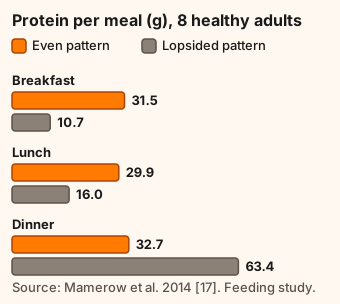
Figure 1. Even versus lopsided protein across three meals in a feeding study of 8 healthy adults (a controlled study, not a real-life diet). Source: Mamerow et al.[17]
A review of protein and weight management says higher-protein diets of 1.2-1.6 g per kg a day, possibly with at least about 25-30 g per meal, may help appetite, body weight management or cardiometabolic risk factors.[22] The sports nutrition position stand gives 20-40 g per meal, but that is for people who exercise.[23] Neither is an official breakfast target for Indian women.
Our coaches suggest a simpler rule: look at your plate and check that one clear protein food is on it. Do not chase a fixed gram number at every meal. To get your own daily figure, use the free protein intake calculator.
What the research says about protein at breakfast, and what it does not {#research}
The research is mixed, and most of it is not on Indian meals.
- In a 6-day crossover trial of 20 overweight breakfast-skipping girls (mean age 19) in the US, a 35 g protein breakfast gave more fullness than a 13 g one. Compared with skipping breakfast, the 35 g breakfast also reduced evening snacking on high-fat foods. Daily energy intake did not differ.[18]
- A 12-week trial in 57 breakfast-skipping young people with overweight or obesity (mean age 19) compared a 13 g protein breakfast and a 35 g protein breakfast with skipping breakfast. The authors concluded that the high-protein breakfast prevented body fat gain in this group, but the abstract reports no differences between the high-protein and normal-protein breakfast groups on any outcome, so do not read this as a protein effect.[19]
- A review found that solid breakfasts with at least 30 g protein and 350 kcal gave a bigger appetite response than skipping. It also said longer trials are still needed.[20]
- A BMJ meta-analysis of 13 trials in adults from high-income countries found that people who ate breakfast did not lose more weight than people who skipped it. The difference slightly favoured skipping (about 0.44 kg), breakfast eaters took in about 260 kcal more a day, and the authors rated the trial quality as low.[21]
- Higher-protein meals give a modest fullness effect, but they do not reliably lower what you eat at the next meal.[22]
In plain words, protein at breakfast is a sensible habit for some people. It is not a trick, and adding a breakfast is not a weight-loss method by itself.
Swap list: Indian ingredient to US shelf {#swaps}
You do not need special shopping. These US foods have protein close to the Indian ones, gram for gram. Always read the pack label, because brands vary.
| Indian item | US stand-in | Indian item, protein per 100 g | US stand-in, protein per 100 g |
|---|---|---|---|
| Paneer (fresh Indian cheese) | Firm tofu, or low-fat cottage cheese | 18.9 g[4] | Tofu 17.3 g[8]; cottage cheese 12.4 g[9] |
| Dahi (curd) | Plain nonfat Greek yogurt | Not given here, since home-made curd varies | 10.2 g[6] |
| Besan (gram flour) | Chickpea flour | 22.4 g (same food)[11] | 22.4 g[11] |
| Moong dal (pesara pappu, split green gram) | Same, from an Indian store | 23.9 g[4] | Same food |
| Urad dal (minapa pappu, split black gram) | Same, from an Indian store | 23.1 g[4] | Same food |
| Groundnuts (palli) | Raw peanuts, or smooth peanut butter | Same food | Raw peanuts 25.8 g[31]; peanut butter 22.2 g[10] |
| Cow milk | Soymilk with added calcium | 3.3 g[4] | 2.86 g (about 7.0 g per cup)[13] |
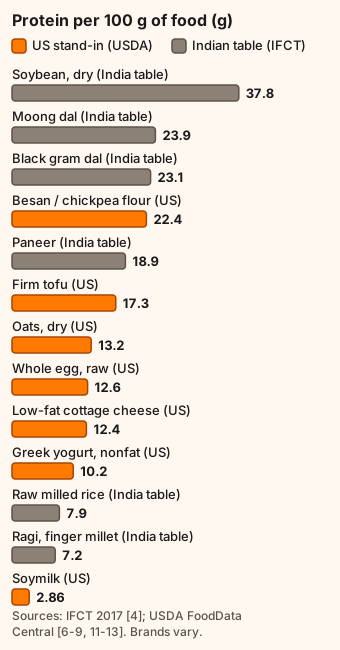
Figure 2. Protein per 100 g for Indian foods and their US stand-ins. Sources: Indian Food Composition Tables (soybean, moong dal, black gram dal, paneer, rice, ragi)[4] and USDA FoodData Central (besan, tofu, whole egg, oats, cottage cheese, Greek yogurt, soymilk).[6][7][8][9][11][12][13]
Firmness matters with tofu. Softer tofu is lower in protein than firm tofu, so check the label; the 17.3 g figure is for firm tofu.[8] Peanut butter is rich in protein but also dense in calories: 2 tablespoons give about 191 kcal.[10] For a full shopping list, see our healthy Indian grocery list for the US.
High-protein South Indian breakfasts (Telugu favourites) {#south-indian}
Pesarattu (green gram dosa)
Pesarattu is the Andhra breakfast made from a batter of whole green gram (pesalu), ground and cooked like a dosa. Per 100 g it has about 12.3 g protein and 286 kcal, and a small piece gives about 3.3 g protein and 76 kcal.[5] Whole green gram has 22.5 g protein per 100 g raw.[4]
In a study of 23 Hyderabad breakfast foods in ten participants per food, pesarattu had a glycaemic index (GI) of 60.7, against 79.4 for a plain dosa.[24] GI is a measure of how fast a food raises blood sugar. This was a small sample, so it does not tell you what will happen with your own blood sugar. If you have diabetes, see our guide to Indian breakfasts for diabetes.
Idli and dosa: build the plate
An idli has 1.2 g protein and 34 kcal, and a plain dosa has 3.7 g protein and 138 kcal.[5] (Dish values are from the INDB recipe file on GitHub, github.com/lindsayjaacks/Indian-Nutrient-Databank-INDB-.) On their own they are low in protein. A bowl of sambar adds about 8.6 g protein and 249 kcal, and each tablespoon of peanut chutney adds about 2.5 g protein and 54 kcal.[5] So three idli, one bowl of sambar and two tablespoons of peanut chutney come to about 17.2 g protein and 461 kcal, by our sum of the unrounded Databank values.
In the same Hyderabad study, vada sambar had a GI of 36.9.[24] Our coaches suggest a boiled egg or a small bowl of yogurt on the side if you want more protein without changing the dish. A boiled egg has about 6.7 g protein and 69 kcal.[5]
Upma and other cereal breakfasts
A bowl of plain rava upma (rava is wheat semolina) gives only about 3.5 g protein.[5] Raw semolina has 11.4 g protein per 100 g.[4] Our reading of the two numbers is that a bowl holds a fairly small amount of rava, but neither source says this directly. Vegetable upma served as a larger plate gives about 11.1 g protein and 345 kcal.[5] Our coaches suggest stirring in roasted peanuts or serving it with a bowl of yogurt.
More Telugu-style ideas
These are our coaches' ideas, not tested recipes, and we give no protein numbers for them: a pesarattu with a small bowl of yogurt, sprouted pesalu (green gram) cooked well in an upma, ragi (finger millet) dosa with an egg or a bowl of sambar on the side, and idli or minapa-based (black gram) tiffins with a protein side such as yogurt or an egg.
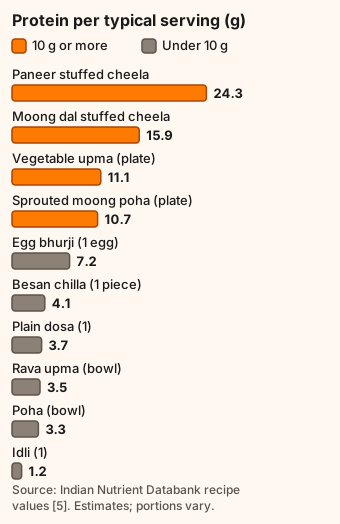
Figure 3. Protein per typical serving, as calculated in the Indian Nutrient Databank.[5] Recipe values vary with portion size and oil.
Three simple recipes {#recipes}
Quantities here are our coaches' suggestions. The protein figures are our own sums from the cited tables for the raw ingredients, so they are estimates. Cooking oil, onions and spices add calories and a little protein that we have not counted.
Pesarattu (serves 2)
- Ingredients: 100 g whole green gram (pesalu), soaked for 6-8 hours; 1 green chilli; a small piece of ginger; 1 teaspoon cumin seeds; salt; water; a little oil for the pan.
- Method: Drain the soaked pesalu. Grind it with the chilli, ginger, cumin and a splash of water to a pourable batter. Pour a ladle onto a hot non-stick pan and spread it thin. Drizzle a little oil around the edge. Cook until golden on both sides. Serve with ginger or peanut chutney.
- Protein: the 100 g of dry whole green gram has about 22.5 g protein,[4] so about 11 g per serving of two pesarattu.
Besan chilla with a cottage cheese filling (serves 1)
- Ingredients: 40 g besan, about 80 ml water, salt, a pinch of turmeric, chopped onion, coriander and green chilli; 113 g (half a cup) of low-fat cottage cheese; a little oil.
- Method: Whisk the besan, water, salt and turmeric into a smooth, lump-free batter. Stir in the onion, coriander and chilli. Cook two thin chillas on a hot non-stick pan with a little oil. Fill with the cottage cheese, fold and serve.
- Protein: 40 g of besan has about 9.0 g protein,[11] and 113 g of low-fat cottage cheese has about 14.0 g.[9] That is about 23 g in total, and about 236 kcal before oil. The Databank lists a besan chilla piece at about 4.1 g, but piece sizes differ, so we use the flour weight here.[5]
Tofu bhurji (serves 1)
- Ingredients: 81 g firm tofu; half an onion, chopped; half a tomato, chopped; 1 green chilli; 1/2 teaspoon cumin seeds; a pinch of turmeric; salt; a little oil.
- Method: Press the water out of the tofu and crumble it. Fry the cumin, onion and chilli in a little oil. Add the tomato, turmeric and salt and cook until soft. Add the tofu and stir for 3-4 minutes. Serve with a phulka (thin oil-free roti) or toast.
- Protein: 81 g of firm tofu has about 14 g protein and 117 kcal.[8]
High-protein Indian vegetarian breakfasts from a US supermarket {#quick}
These are examples of what common foods add up to. They are not prescriptions. For more vegetarian protein foods, see our guide to high-protein Indian vegetarian foods.
- Greek yogurt, oats and peanuts bowl. A 170 g tub of plain nonfat Greek yogurt has about 17 g protein and 100 kcal.[6] Add about 27 g of dry oats (roughly 1/3 cup; about 3.6 g protein and 102 kcal)[12] and 25 g of raw peanuts (about 6.5 g protein and 142 kcal)[31] for roughly 27.4 g protein and 344 kcal in total. This is our own sum.
- Tofu bhurji and cottage cheese "paneer" bhurji. Tofu bhurji is in the recipes above. Half a cup (113 g) of low-fat cottage cheese, cooked like paneer bhurji, has about 14 g protein and 81 kcal.[9]
- Besan chilla. See the recipe above. It is modest on its own, so fill it or serve it with yogurt.
- Moong dal cheela and paneer cheela. A moong dal stuffed cheela has about 15.9 g protein and 352 kcal, and a paneer stuffed cheela about 24.3 g and 436 kcal.[5] In the Databank, pesarattu is a separate dish from the stuffed cheela.
- Sprouted moong poha. One plate has about 10.7 g protein and 369 kcal.[5] Cook the sprouts well. The FDA says children, older adults, pregnant women and people with weakened immune systems (diabetes is one example it gives) are more vulnerable to foodborne illness. It advises avoiding raw or lightly cooked sprouts of any kind, mung bean sprouts included.[30]
If you eat eggs
- Egg bhurji (spiced scrambled eggs). Each egg bhurji portion made from one egg has about 7.2 g protein and 109 kcal, so two eggs give about 14.4 g.[5] Cook eggs until the yolk and white are firm.[29] If you have high cholesterol or heart disease, ask your doctor how many eggs suit you.
Make-ahead tips from our coaches (our practical advice, not from a study): soak the dal the night before and cook the batter fresh where you can. If you keep batter, store it chilled and check how it looks and smells before cooking. If in doubt, throw it out. Freeze cooked chilla in a flat stack and reheat in a pan. For more weekly prep ideas, see Indian meal prep for the week.
7-day high-protein Indian breakfast chart {#chart}
Print this page from your browser if you want a copy for the fridge. The numbers are estimates from food tables. Portions, oil and brands change them, so check your pack labels.
| Day | Plate | Protein (g) | kcal | Source of the numbers |
|---|---|---|---|---|
| Mon | Moong dal stuffed cheela | 15.9 | 352 | Indian Nutrient Databank[5] |
| Tue | 3 idli + 1 bowl sambar + 2 tbsp peanut chutney | 17.2 | 461 | Databank, added up by us[5] |
| Wed | 170 g Greek yogurt + 27 g dry oats + 25 g raw peanuts | 27.4 | 344 | USDA, added up by us[6][12][31] |
| Thu | 2 besan chilla (40 g besan) + 1/2 cup low-fat cottage cheese | 23.0 | 236 | USDA, added up by us (no oil)[11][9] |
| Fri | 2-egg bhurji + 1 cup soymilk | 21.4 | 298 | Databank and USDA, added up by us[5][13] |
| Sat | Sprouted moong poha (cook the sprouts) + 1 boiled egg | 17.4 | 438 | Databank, added up by us[5] |
| Sun | Paneer stuffed cheela | 24.3 | 436 | Indian Nutrient Databank[5] |
These plates range from about 16 g to about 27 g of protein. The Sunday figure is for a paneer cheela. If you swap in crumbled firm tofu, the protein will differ, so check your own recipe.
If you want the full calorie comparison of South Indian tiffin items, read idli, dosa, upma and pesarattu compared.
Who should be careful {#careful}
Higher-protein breakfasts suit many people, but not everyone. Check with your doctor or a dietitian if any of these apply.
- Kidney disease. The KDIGO 2024 guideline suggests maintaining 0.8 g per kg per day of protein in adults with chronic kidney disease (CKD) stages G3-G5 (a weak, grade 2C recommendation). It also advises avoiding high protein intake, above 1.3 g per kg per day, in adults with CKD at risk of progression.[26] The American Diabetes Association also does not recommend cutting protein below 0.8 g per kg in CKD.[25] Get your target from your doctor or a renal dietitian.
- Diabetes. The ADA says protein goals should be individualised and gives a general range of about 0.8-1.5 g per kg a day.[25] Carbohydrate portions still matter: the cheela, poha and oats plates above all contain carbohydrate, which we have not counted here. If you use insulin or a sulfonylurea, talk to your care team before changing breakfast, because the ADA advises people on fixed insulin doses to keep carbohydrate intake consistent in timing and amount.[25] Your care team knows your medicines.
- Thyroid medicine. Levothyroxine works best on an empty stomach, about 60 minutes before a meal.[27] The same review suggests keeping soy and high-fibre foods about an hour apart from the tablet, though evidence is limited.[27] It also found that calcium and iron supplements can reduce absorption, with some studies separating calcium carbonate from the tablet by several hours.[27] That finding is about supplements, so ask your doctor whether calcium-rich foods such as fortified soymilk or dairy need spacing too. A meta-analysis of 18 trials of soy protein or isoflavone supplements found no significant change in free T3 or free T4, and a small rise in TSH of unclear meaning.[28] Ask your doctor before changing anything.
- Pregnancy, breastfeeding, older adults, young children, or low immunity. Avoid raw or lightly cooked sprouts, and cook them thoroughly.[30] Keep eggs at 40°F (4°C) or below, and do not leave cooked eggs out for more than 2 hours.[29] In pregnancy, the FDA says to avoid unpasteurised milk and unpasteurised milk products, so our coaches suggest checking that your paneer, cottage cheese and yogurt say pasteurised on the label.[33] Protein needs for children and older adults differ from the adult figures above, so ask your doctor or dietitian.
- Allergies and intolerances. The FDA lists nine major food allergens: milk, eggs, fish, crustacean shellfish, tree nuts, peanuts, wheat, soybeans and sesame.[32] Peanuts, soy, milk, eggs and wheat (in semolina) all appear in this guide, so swap based on what is safe for you. If you avoid gluten, skip rava (semolina), which is made from wheat. Our coaches suggest buying oats labelled gluten-free if you avoid gluten, because of possible cross-contact.
See your doctor if you notice:
- unexplained weight loss
- nausea or reflux that keeps coming back after high-protein meals
- swelling, foamy urine, or a known kidney problem
- big swings in blood sugar
- pregnancy or breastfeeding, with diet changes planned
- any history of an eating disorder
How to fit this into your week {#week}
This is our coaches' approach, based on how we work with clients, not on a study.
- Change one breakfast first. Pick the one you already make most often.
- Keep the foods you love. Add protein before you cut anything.
- Notice how you feel for a week: energy, hunger, and how your stomach copes.
- Add a second change only when the first feels easy.
When you are ready, work out your daily number with the free protein intake calculator, and see what your usual plates add up to in the meal calorie calculator. If you would like help adapting this to your own routine, medicines and food habits, book a free 30-minute consultation with a Flexcellence nutritionist.
Numbers are estimates from food tables, and recipes vary.
Common questions
How much protein should an Indian woman eat at breakfast?
ICMR gives a daily RDA of 45.7 g for a 55 kg woman and no separate breakfast number. Some research says about 25-30 g per meal may help appetite, but that is not an official target. Our coaches suggest making sure one clear protein food is on your breakfast plate.
Is idli high in protein?
No. One idli has about 1.2 g protein and 34 kcal. Serve it with sambar and peanut chutney, and our coaches suggest adding an egg or yogurt on the side.
What can I use instead of paneer in the US?
Firm tofu has 17.3 g protein per 100 g and low-fat cottage cheese has 12.4 g, against 18.9 g for paneer. Check pack labels, because brands vary.
Are high-protein Indian breakfasts good for weight loss?
The research is mixed. A meta-analysis found that eating breakfast does not by itself lead to weight loss (and the trials were low quality), and higher-protein meals give only a modest fullness effect. We make no weight-loss promises.
Can I eat these if I have diabetes, thyroid problems or kidney disease?
Talk to your doctor first. The ADA has no single protein target for diabetes, levothyroxine should be taken about 60 minutes before a meal, and people with kidney disease need a target from their doctor or renal dietitian.
What is a good egg-free high-protein Indian breakfast?
Moong dal cheela or pesarattu, a Greek yogurt bowl, or tofu bhurji. A moong dal stuffed cheela has about 15.9 g protein, and 81 g of firm tofu about 14 g.
Reviewed by
Not yet reviewed by a Flexcellence coach.
Sources
ICMR-National Institute of Nutrition, Hyderabad. A Brief Note on Nutrient Requirements for Indians: RDA and EAR (2020).
ICMR-National Institute of Nutrition, Hyderabad. Dietary Guidelines for Indians (Revised 2024), Guideline 8: protein (2024).
ICMR-National Institute of Nutrition (Longvah T, Ananthan R, Bhaskarachary K, Venkaiah K). Indian Food Composition Tables 2017 (2017).
Current Developments in Nutrition (Vijayakumar A, Dubasi Y, Awasthi A, Jaacks LM). Development of an Indian Food Composition Database (INDB); dish values are recipe-calculated, from the recipe file INDB.xlsx in the project GitHub repository (2024).
USDA Agricultural Research Service, FoodData Central (SR Legacy). Yogurt, Greek, plain, nonfat (FDC 170894) (2019).
USDA Agricultural Research Service, FoodData Central (SR Legacy). Egg, whole, raw, fresh (FDC 171287) (2019).
USDA Agricultural Research Service, FoodData Central (SR Legacy). Tofu, raw, firm, prepared with calcium sulfate (FDC 172475) (2019).
USDA Agricultural Research Service, FoodData Central (SR Legacy). Cheese, cottage, lowfat, 1% milkfat (FDC 173417) (2019).
USDA Agricultural Research Service, FoodData Central (SR Legacy). Peanut butter, smooth style, without salt (FDC 172470) (2019).
USDA Agricultural Research Service, FoodData Central (SR Legacy). Chickpea flour (besan) (FDC 174288) (2019).
USDA Agricultural Research Service, FoodData Central (SR Legacy). Cereals, oats, regular and quick, not fortified, dry (FDC 173904) (2019).
USDA Agricultural Research Service, FoodData Central (SR Legacy). Soymilk (all flavors), unsweetened, with added calcium, vitamins A and D (FDC 175215) (2019).
British Journal of Nutrition (Swaminathan S, Vaz M, Kurpad AV). Protein intakes in India (2012).
Public Health Nutrition (Talegawkar SA et al., MASALA study). Dietary intakes among South Asian adults differ by length of residence in the USA (2016).
Journal of Nutrition (Mamerow MM et al.). Dietary protein distribution positively influences 24-h muscle protein synthesis in healthy adults (2014).
American Journal of Clinical Nutrition (Leidy HJ et al.). Beneficial effects of a higher-protein breakfast on the appetitive, hormonal, and neural signals controlling energy intake regulation in overweight/obese, breakfast-skipping, late-adolescent girls (2013).
Obesity (Leidy HJ, Hoertel HA, Douglas SM, Higgins KA, Shafer RS). A high-protein breakfast prevents body fat gain, through reductions in daily intake and hunger, in "breakfast skipping" adolescents (2015).
Advances in Nutrition (Gwin JA, Leidy HJ). A Review of the Evidence Surrounding the Effects of Breakfast Consumption on Mechanisms of Weight Management (2018).
BMJ (Sievert K et al.). Effect of breakfast on weight and energy intake: systematic review and meta-analysis of randomised controlled trials (2019).
American Journal of Clinical Nutrition (Leidy HJ et al.). The role of protein in weight loss and maintenance (2015).
Journal of the International Society of Sports Nutrition (Jager R et al.). International Society of Sports Nutrition Position Stand: protein and exercise (2017).
Journal of Food Science and Technology (Shakappa D, Naik R, Sobhana PP; ICMR-NIN Hyderabad). Glycemic carbohydrates, glycemic index, and glycemic load of commonly consumed South Indian breakfast foods (2022).
American Diabetes Association (Diabetes Care). 5. Facilitating Positive Health Behaviors and Well-being to Improve Health Outcomes: Standards of Care in Diabetes-2025 (2025).
Kidney Disease: Improving Global Outcomes (KDIGO), Kidney International. KDIGO 2024 Clinical Practice Guideline for the Evaluation and Management of CKD, chapter 3.3.1 (Recommendation 3.3.1.1, Practice Point 3.3.1.1); Kidney Int 105(4S):S117-S314, doi 10.1016/j.kint.2023.10.018 (2024).
Pharmaceuticals (Wiesner A, Gajewska D, Pasko P). Levothyroxine Interactions with Food and Dietary Supplements: A Systematic Review (2021).
Scientific Reports (Otun J et al.). Systematic Review and Meta-analysis on the Effect of Soy on Thyroid Function (2019).
US Food and Drug Administration. What You Need to Know About Egg Safety (2024).
US Food and Drug Administration. Selecting and Serving Produce Safely (2024).
USDA Agricultural Research Service, FoodData Central (SR Legacy). Peanuts, all types, raw (FDC 172430) (2019).
US Food and Drug Administration. Food Allergies (2024).
US Food and Drug Administration. Listeria (Listeriosis) (2024).