Best Indian breakfasts for diabetes (10 ideas with carbs)
10 Indian breakfasts for diabetes with carbs per serving, GI of Hyderabad dishes like pesarattu and idli, safety tips, and when to see your doctor.
The short answer
Good Indian breakfasts for diabetes pair a modest portion of carbohydrate (idli, dosa, upma, poha) with protein and vegetables: pesarattu, besan chilla, egg bhurji or vegetable upma are examples. Carbs vary by recipe. Ask your doctor first if you take insulin or tablets that can cause low sugar.
Work out your own numbers
Calculate meal calories from common Indian food portions.
Free, takes a minute, and uses the same formulas our coaches use.
Open the Meal Calorie CalculatorOn this page
The best breakfast for diabetes in an Indian home is usually a modest portion of carbohydrate with protein and vegetables on the same plate. Our four top picks are pesarattu (green gram dosa), besan chilla (gram flour pancake), egg bhurji (spiced scrambled egg) and vegetable upma (savoury semolina or broken-wheat porridge). The plate rule behind them is simple: about half vegetables, a quarter protein and a quarter carbohydrate.[1]
You do not have to give up idli and dosa. This guide gives 10 Indian breakfasts with grams of carbohydrate per serving, the measured glycaemic index (GI) where it exists, and a clear safety section. Every item is marked vegetarian or egg-based.
This is general information for adults with type 2 diabetes, not a diet prescription. Your doctor or dietitian knows your medicines and readings, so ask them first, especially if you take insulin or sulfonylurea tablets. Planning for pregnancy-related diabetes? Start with our gestational diabetes diet guide. All food numbers are recipe-book estimates, so your own plate may differ.
The 10 best Indian breakfasts for diabetes at a glance
| # | Breakfast | Carbs | Protein | Measured GI | Our suggested portion | Type |
|---|---|---|---|---|---|---|
| 1 | Pesarattu | 8.5 g per small piece | 3.3 g | 60.69 | 2 to 3 pieces | Vegetarian |
| 2 | Idli with sambar | 7.1 g per idli, 27.2 g per bowl of sambar | 1.2 g per idli, 8.6 g per bowl | 68.69 | 2 idli, 1 small bowl sambar | Vegetarian |
| 3 | Besan chilla | 11.0 g per chilla | 4.1 g | not measured | 2 chillas | Vegetarian |
| 4 | Vegetable upma | 38.8 g per plate | 11.1 g | 51.7 (plain broken wheat upma, a different recipe) | a bowl, not a heaped plate | Vegetarian |
| 5 | Egg bhurji or boiled egg | 0.9 g or 0.2 g per egg | 7.2 g or 6.7 g | not measured | ask your doctor how many eggs | Egg-based |
| 6 | Jowar or foxtail millet dosa | 13.4 g per jowar dosa | 2.8 g | 59.25 (foxtail millet dosa) | 1 to 2 dosa | Vegetarian |
| 7 | Methi thepla with curd | 15.1 g per thepla | 3.3 g | not measured | 1 to 2 thepla | Vegetarian |
| 8 | Plain rolled-oats porridge | 34.9 g per bowl | 10.3 g | not measured | a small bowl | Vegetarian |
| 9 | Vegetable poha | 21.1 g per bowl | 4.8 g | not measured | a small bowl with a protein side | Vegetarian |
| 10 | Sprouts upma | 42.9 g per plate | 9.1 g | not measured | a bowl, not a heaped plate | Vegetarian |
Carbs and protein: Indian Nutrient Databank (INDB) recipe values.[31] Rows 4 and 6 pair carbohydrate and GI from different recipes (see the notes below). GI: Hyderabad study of 10 healthy adults for pesarattu and idli with sambar,[8] a Chennai study for broken wheat upma,[9] and a 10-woman GI test within the foxtail millet dosa trial.[10] Portions are our coaches' ideas, not research findings.
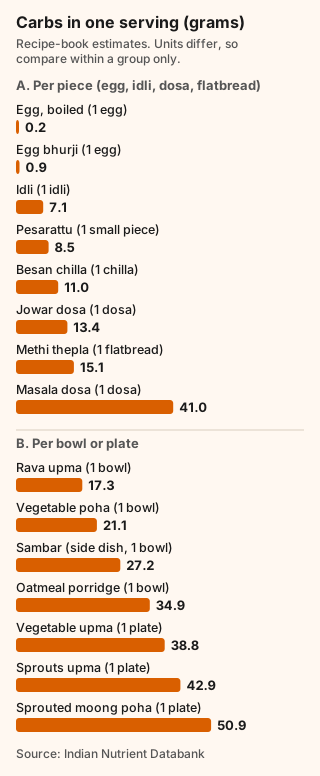
Carbohydrate per serving in grams. The units differ, so compare within each group only.[31]
1. Pesarattu (green gram dosa) with ginger chutney
One small piece has about 8.5 g carbohydrate, 3.3 g protein and about 76 kcal.[31] Its measured GI was 60.69. MLA pesarattu, which is pesarattu stuffed with upma (savoury semolina porridge), was higher at 72.85, so the filling changes the result.[8] Vegetarian.
Our coaches suggest 2 to 3 plain pieces with vegetables mixed into the batter, and no upma filling. See the calories of pesarattu and other tiffins in idli, dosa, upma and pesarattu.
2. Idli with sambar
One idli has about 7.1 g carbohydrate and 1.2 g protein. A bowl of sambar (lentil and vegetable stew) has about 27.2 g carbohydrate, 8.6 g protein and 9.1 g fibre.[31] In our reading, that carbohydrate comes mainly from the dal and vegetables, so a big bowl adds up. By our own arithmetic, 2 idli plus one bowl of sambar is about 41 g carbohydrate. For scale, a US CDC sample day shows about 65 g at breakfast, an example and not a target for you.[28] Idli with sambar had a GI of 68.69.[8] Vegetarian.
Our coaches suggest 2 idli, one small bowl (katori) of vegetable-heavy sambar rather than seconds, and an egg or plain curd on the side.
3. Besan chilla (gram flour pancake)
One chilla has about 11.0 g carbohydrate, 4.1 g protein and 2.2 g fibre.[31] A moong dal stuffed version has about 44.2 g carbohydrate and 15.9 g protein, so check the filling.[31] Vegetarian.
Our coaches suggest adding methi (fenugreek leaves) or spinach to the batter and cooking with a little oil. It suits busy mornings.
4. Vegetable upma (and plain broken wheat upma)
Plain broken wheat (dalia) upma had a low GI of 51.7 in a Chennai study of 15 healthy volunteers.[9] That is a different recipe from the databank's vegetable upma, whose grain the databank entry does not specify here, so the GI is a hint, not a measurement of that dish. A plate of vegetable upma has about 38.8 g carbohydrate, 11.1 g protein and 9.9 g fibre, while a bowl of plain rava (semolina) upma has about 17.3 g carbohydrate.[31] The "plate" is a big serving, so size matters more than the grain. Vegetarian.
Our coaches suggest a bowl-sized serving loaded with vegetables, and a small handful of groundnuts at most.
5. Egg bhurji or boiled eggs
A boiled egg has about 0.2 g carbohydrate and 6.7 g protein. An egg bhurji has about 0.9 g carbohydrate and 7.2 g protein per egg.[31] Egg-based.
In a trial of 128 adults with prediabetes or type 2 diabetes (a 3-month weight-loss diet, then 6 months of follow-up), eating 12 or more eggs a week made no difference to glucose or HbA1c compared with fewer than 2 a week.[21] In another trial, 23 adults with type 2 diabetes ate a very-low-carb omelette breakfast (5 g carbohydrate) one day and an oats, fruit and yogurt breakfast (82 g) another day. Their 24-hour incremental area under the after-meal glucose curve was 32% lower with the omelette, although mean 24-hour glucose did not differ significantly. The omelette meal also contained cheese and margarine. It was a short study and people on insulin were left out.[17]
Do not read that as "go very low carb". A very-low-carb eating plan can lower glucose quickly, and a practitioner may need to reduce insulin and other glucose-lowering medicines to prevent lows.[2] If you have high LDL cholesterol or heart disease, or your doctor has set an egg limit, follow it. Our coaches suggest cooking in little oil and adding onion, tomato or spinach.
6. Jowar or foxtail millet dosa
A jowar (sorghum) dosa has about 13.4 g carbohydrate and 2.8 g protein.[31] The trial used a different grain: in 105 people with type 2 diabetes on oral medicines, a foxtail millet dosa breakfast raised after-meal glucose less than a rice dosa, while fasting glucose did not change significantly. The GI figures came from a separate test in 10 healthy women: 59.25 for foxtail millet dosa against about 78 for rice dosa (the paper gives 77.96 in the abstract and 77.86 in the results).[10] Vegetarian.
Do not assume every millet dish is safe. A stiff ragi ball (mudda or sangati, a thick finger-millet dumpling) had a GI of 98.2 in the Chennai study.[9]
7. Methi thepla (fenugreek flatbread) with plain curd
One thepla has about 15.1 g carbohydrate and 3.3 g protein.[31] Plain curd (yogurt) adds protein on the side. One caution: in three US cohorts of about 194,000 adults, more yogurt was linked to a lower risk of developing type 2 diabetes (hazard ratio 0.83 per daily serving).[23] That says nothing about managing diabetes you already have, so we use curd here as a protein side only. Vegetarian.
Our coaches suggest this pair for an office tiffin box, because it travels well.
8. Plain rolled-oats porridge (not flavoured instant packets)
A bowl of oatmeal porridge has about 34.9 g carbohydrate and 10.3 g protein.[31] A review pooling 14 controlled trials in people with type 2 diabetes found oats lowered HbA1c by 0.42% compared with control diets. The authors say further research is needed.[22] The ICMR-NIN guidelines list packaged breakfast cereals among ultra-processed foods.[4] Vegetarian.
Our coaches suggest plain rolled oats with nuts or seeds and no added sugar.
9. Vegetable poha (flattened rice) with peanuts
A bowl of vegetable poha has about 21.1 g carbohydrate and 4.8 g protein, so plain poha is quick but light on protein.[31] A plate of sprouted moong poha has about 50.9 g carbohydrate, 10.7 g protein and 6.0 g fibre, which is a lot of carbohydrate in one sitting.[31] Vegetarian.
Our coaches suggest a small bowl with sprouts, peanuts or a side egg, and half the plate portion of the sprouted version.
10. Sprouts upma
A plate of sprouts upma has about 42.9 g carbohydrate, 9.1 g protein and 6.8 g fibre.[31] Like vegetable upma, the plate is big. Vegetarian.
Our coaches suggest a bowl-sized serving with extra vegetables and a boiled egg or curd.
Is idli or dosa better for diabetes? What measured GI says
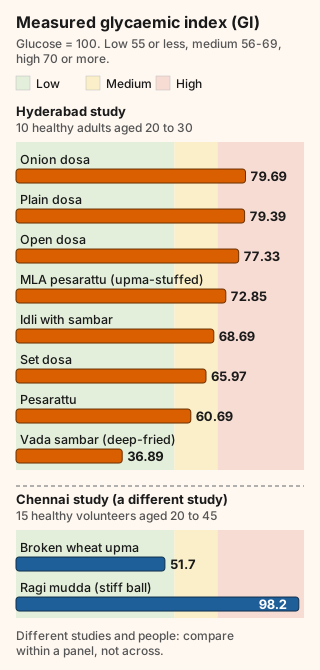
Measured GI. Orange bars: Hyderabad study in 10 healthy adults.[8] Blue bars: a separate Chennai study.[9] Bands: GI 55 or less is low, 56 to 69 medium, 70 or more high.[12] Compare within a panel.
GI describes how strongly a food raises blood glucose. In the Hyderabad study, which tested 23 ready-to-eat breakfast foods collected across Greater Hyderabad in 10 healthy adults aged 20 to 30, plain dosa (79.39) and onion dosa (79.69) were in the high band. Idli with sambar was 68.69, set dosa 65.97 and pesarattu 60.69. The lowest was vada sambar (36.89), but vada is a deep-fried lentil fritter, so we do not suggest it as a swap. The authors report that rice-based breakfasts had higher GI than legume-based ones, but the ranges overlapped and no statistical test was reported.[8] So between idli and dosa, idli with sambar measured slightly lower than plain dosa, but the plate, not the dish, decides your carbohydrate. Our coaches suggest adding vegetables, protein or legumes, or swapping some rice for millets.
Keep the limits in mind. Those tests were in healthy adults and may not match people with diabetes (our caveat, not a finding of the study). Being a whole grain does not guarantee a low GI, because processing and food structure also matter.[9] A 2019 ADA consensus called the GI evidence mixed,[2] while a later review of 22 trial comparisons in 1,502 people with type 1 or type 2 diabetes found low-GI or low-GL diets lowered HbA1c by 0.31%, a small gain over a median of 12 weeks.[12] A meta-analysis of millet studies found a mean GI of 52.7 for millets against 71.7 for milled rice.[11]
Build the plate, not just the dish
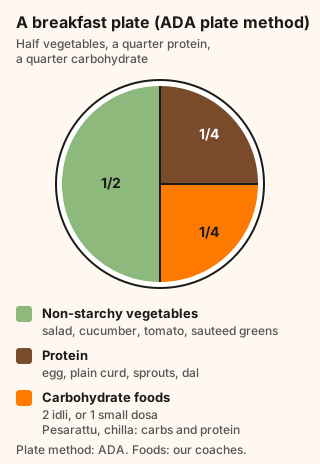
The ADA plate method.[1] The breakfast examples are our coaches' ideas.
The American Diabetes Association plate method is half non-starchy vegetables, one quarter protein, one quarter carbohydrate foods. It also advises at least 14 g of fibre per 1,000 kcal and more plant-based protein such as legumes, nuts and seeds.[1] For a Telugu breakfast, one example is vegetable-rich sambar, pesarattu or an egg, and 2 idli. A few small extras, each with limits:
- Pulses: in a review of 41 trials, pulses eaten on their own (11 trials) lowered fasting glucose.[13]
- Order of eating: in 11 adults with type 2 diabetes on metformin, eating vegetables and protein first and carbohydrate 15 minutes later gave lower glucose at 30 and 60 minutes. It was a tiny single-meal study, so treat it as a curiosity.[19]
- Nuts: tree nuts lowered HbA1c by only 0.07% in 12 short trials with 450 people, mostly of poor quality.[24]
- Drinks: the ADA advises water over sugary drinks, including fruit juice.[1] A meta-analysis of cohort studies linked higher fruit juice intake to a 7% higher risk of developing type 2 diabetes (95% CI 1% to 14%) after adjusting for body fat, but the authors say the link was not significant when diabetes was objectively confirmed and may involve bias.[25] Sweeteners are a topic for your dietitian: the WHO advises against them for weight control (people with existing diabetes are an exception), and the ADA allows them in moderation and for the short term.[27][1]
A sample week of breakfasts
These are our coaches' ideas, not research findings, and portions should be adjusted with your dietitian.
| Day | Breakfast |
|---|---|
| Monday | 2 to 3 pesarattu pieces, ginger chutney, cucumber and tomato salad |
| Tuesday | 2 idli, 1 small bowl vegetable sambar, 1 boiled egg or plain curd |
| Wednesday | 2 methi besan chillas with plain curd |
| Thursday | 1 bowl vegetable upma with a boiled egg |
| Friday | 1 to 2 jowar dosa with tomato chutney and sambar |
| Saturday | Egg bhurji with vegetables and 1 methi thepla |
| Sunday | 1 small bowl sprouts upma with plain curd |
Chutney matters too: coconut chutney is about 67 kcal per tablespoon, peanut chutney about 54 and tomato-ginger about 7.[31] For busy mornings, soak and grind pesarattu or chilla batter the night before, boil eggs at the start of the week, and pressure-cook vegetable upma with chopped vegetables.
A short walk after eating helps too. In a 2-week-each crossover trial of 41 adults with type 2 diabetes, a 10-minute walk after each main meal lowered the incremental area under the post-meal glucose curve by about 12% (ratio of means 0.88) compared with one 30-minute daily walk.[20] If you sit at a desk, the ADA suggests breaking up long sitting at least every 30 minutes.[1]
Living abroad? Whole green moong or split yellow moong dal and besan from an Indian store replace pesarattu and chilla batter; plain rolled oats and plain unsweetened yogurt are easy swaps. Read labels on ready batters and instant mixes for added sugar and refined flour.
Breakfasts to eat rarely
Not forbidden, just less often and in smaller portions:
- Plain, onion and masala dosa. A masala dosa has about 345 kcal and 41.0 g carbohydrate,[31] and plain dosa had a GI of 79.39.[8]
- Poori (puffed deep-fried bread) and vada (deep-fried lentil fritter), which are fried. ICMR-NIN advises pressure or steam cooking rather than deep frying.[4]
- Sugary drinks, including sweetened tea or coffee and fruit juice. The ADA advises water over sugar-sweetened drinks.[1]
- Packaged ready cereals, which the ICMR-NIN guidelines list among ultra-processed foods.[4]
- Jaggery, honey and added sugar. The 2024 ICMR-NIN guidelines advise keeping added sugar low (under 5% of energy);[4] a 2019 review summarising older ICMR advice said to avoid sugar, honey and jaggery.[3]
- Large portions of white rice. Our coaches suggest keeping rice small at breakfast.
Do I have to eat breakfast with diabetes?
There is no rule that says everyone with diabetes must eat at a fixed time. Here is what research does and does not show.
- Across 6 long-term studies that followed 96,175 adults, people who skipped breakfast had a higher risk of developing type 2 diabetes (relative risk 1.33, or 1.22 in 4 studies after adjusting for BMI). This is about getting diabetes, not managing it.[14]
- In a crossover trial of 22 adults with type 2 diabetes, glucose after a 700 kcal lunch was 36.8% higher on the day they skipped breakfast. It covered single test days only.[15]
- If you take insulin or other diabetes medicines such as gliclazide or glimepiride (sulfonylureas), missing or delaying a meal, or not eating enough carbohydrate, raises the risk of low blood sugar,[29] so speak to your doctor before changing when or how much you eat.
Our coaches suggest a steady breakfast time that fits your day and your medicines.
How we picked and read the numbers
Carbohydrate, protein and fibre per serving come from the Indian Nutrient Databank (INDB), an open database of 1,014 recipes. The per-serving values come from the databank's recipe spreadsheet,[31] and the paper describing it explains that recipes were built by matching ingredients to 1,095 food items derived from ICMR-NIN's Indian Food Composition Tables 2017.[7] Serving sizes differ by recipe and oil used, so read every figure as "about". GI values come from the studies named above.
Quick glossary: mudda or sangati is a stiff ragi (finger millet) ball; katori is a small bowl; dalia is broken wheat; bhurji is a spiced scramble; chilla is a savoury pancake; thepla is a spiced flatbread; curd or dahi is plain yogurt.
Safety: when breakfast changes could be unsafe
Check your own response. GI varies from person to person, and the GI data here come from healthy adults. If your doctor has given you a glucose meter or sensor, our coaches suggest checking before breakfast and again 1 to 2 hours after trying a new one, then sharing the readings with your doctor. The ADA consensus says guidance should be individualised.[2]
Medicines. If you take insulin or sulfonylureas, a smaller or later breakfast could raise your risk of low blood sugar (our coaches' caution; see the NHS on missed or delayed meals).[29] People on fixed insulin doses need to keep carbohydrate consistent in timing and amount.[1] Flexcellence coaches do not prescribe or change medicines.
Low blood sugar. Signs include hunger, sweating, shaking, dizziness, heart palpitations, blurred vision and confusion. Severe lows can cause seizures or loss of consciousness.[29] Follow the plan your doctor gave you for treating lows.
High blood sugar. Signs include feeling very thirsty, passing urine often, tiredness, blurred vision and weight loss. Get emergency help if high sugar comes with vomiting or stomach pain, fast breathing, drowsiness, fruity-smelling breath, confusion or high ketones.[30]
When to see a doctor
See your doctor if:
- your readings stay above the target your doctor set for more than a few days after breakfast changes (a coach rule of thumb; your doctor may set a different limit)
- you notice any of the low or high sugar signs above
- you have type 1 diabetes, are pregnant with high sugar, or have kidney disease, because protein, potassium and carbohydrate limits are individual
- you have a food allergy
- you take diabetes medicines and want to change meal times or cut carbs
Your next step
Swap one breakfast this week, for example plain dosa for pesarattu, and keep the portion steady. Try our free meal calorie calculator to see the calories in your usual plate; it does not replace your doctor's advice. For a full-day plan, read our diabetes diet chart for Indians and is rice good for diabetes. For more protein ideas, see high-protein Indian breakfasts.
If you would like a person to look at your day, you can book a free 30-minute call with a Flexcellence coach at /book. Flexcellence has a Diabetes Management plan, but it supports your doctor's care and does not replace it. We do not promise results, and your medicines stay between you and your doctor.
Common questions
What is the best South Indian breakfast for diabetics?
There is no single best one, but pesarattu (green gram dosa) had a GI of 60.69 against 79.39 for plain dosa in a Hyderabad study of 10 healthy adults. Pair it with vegetables and a protein such as egg or plain curd, and keep portions modest. Ask your doctor or dietitian what suits your medicines.
Is idli good for diabetics?
Idli is small in carbs per piece, about 7 g in one recipe database, but the plate matters more than one piece. In a Hyderabad study of 10 healthy adults, idli with sambar had a GI of 68.69, which is medium. Our coaches suggest 2 idli with a small bowl of sambar, plus an egg or curd. Check portions with your doctor or dietitian.
Is dosa safe for diabetes? Which dosa is best?
Plain and onion dosa had GI values near 79 in the Hyderabad study of 10 healthy adults, which is high. In a trial of 105 people with type 2 diabetes, a foxtail millet dosa gave lower after-meal glucose than a rice dosa (not the same as jowar dosa). Pesarattu (green gram dosa) had a lower GI of 60.69. Ask your doctor what suits you.
Is pesarattu good for diabetes?
Pesarattu had a GI of 60.69 in the Hyderabad study, lower than plain dosa. One small piece has about 8.5 g carbs and 3.3 g protein per a recipe database. But MLA pesarattu, stuffed with upma, had a GI of 72.85. What goes inside matters, so choose vegetables over upma stuffing.
Can I skip breakfast if I have type 2 diabetes?
Studies point both ways on risk, but none say skipping is a good plan. In a small crossover trial of 22 adults with type 2 diabetes, glucose after lunch was 36.8% higher on the day breakfast was skipped. If you take insulin or sulfonylurea tablets, skipping a meal can cause low sugar. Talk to your doctor before changing meal timing.
Are oats good for diabetics?
A review pooling 14 controlled trials in people with type 2 diabetes found oats lowered HbA1c by 0.42% compared with control diets, and the authors say more research is needed. Choose plain rolled oats, add nuts or seeds, and skip added sugar. Check portions with your care team.
How many carbs should a diabetic have at breakfast?
There is no single number that fits everyone, and nutrition plans should be individual. For a sense of scale, one carb serving is about 15 g, and a US sample day shows about 65 g at breakfast as an example, not a target. Get a personal carb target from your doctor or dietitian.
Reviewed by
Not yet reviewed by a Flexcellence coach.
Sources
American Diabetes Association (Diabetes Care). 5. Facilitating Positive Health Behaviors and Well-being to Improve Health Outcomes: Standards of Care in Diabetes-2025 (2025).
Diabetes Care (ADA consensus report; Evert AB et al.). Nutrition Therapy for Adults With Diabetes or Prediabetes: A Consensus Report (2019).
Advances in Therapy (RSSDI-affiliated expert authors; Viswanathan et al.). Insights on Medical Nutrition Therapy for Type 2 Diabetes Mellitus: An Indian Perspective (2019).
ICMR-National Institute of Nutrition. Dietary Guidelines for Indians (Revised Edition 2024) (2024).
Indian Nutrient Databank (Vijayakumar et al., Current Developments in Nutrition). Development of an Indian Food Composition Database (Indian Nutrient Databank, INDB) (2024).
Journal of Food Science and Technology (ICMR-NIN, Hyderabad; Shakappa, Naik, Sobhana). Glycemic carbohydrates, glycemic index, and glycemic load of commonly consumed South Indian breakfast foods (2022).
Indian Journal of Medical Research (Shobana et al., Madras Diabetes Research Foundation). Carbohydrate profiling & glycaemic indices of selected traditional Indian foods (2022).
Indian Journal of Medical Research (Narayanan et al.). Postprandial glycaemic response of foxtail millet dosa in comparison to a rice dosa in patients with type 2 diabetes (2016).
Frontiers in Nutrition (Anitha et al., ICRISAT). A Systematic Review and Meta-Analysis of the Potential of Millets for Managing and Reducing the Risk of Developing Diabetes Mellitus (2021).
BMJ (Chiavaroli et al.). Effect of low glycaemic index or load dietary patterns on glycaemic control and cardiometabolic risk factors in diabetes: systematic review and meta-analysis of randomised controlled trials (2021).
Diabetologia (Sievenpiper JL et al.). Effect of non-oil-seed pulses on glycaemic control: a systematic review and meta-analysis of randomised controlled experimental trials in people with and without diabetes (2009).
The Journal of Nutrition (Ballon A, Neuenschwander M, Schlesinger S). Breakfast Skipping Is Associated with Increased Risk of Type 2 Diabetes among Adults: A Systematic Review and Meta-Analysis of Prospective Cohort Studies (2019).
Diabetes Care (Jakubowicz D et al.). Fasting until noon triggers increased postprandial hyperglycemia and impaired insulin response after lunch and dinner in individuals with type 2 diabetes: a randomized clinical trial (2015).
American Journal of Clinical Nutrition (Chang CR, Francois ME, Little JP). Restricting carbohydrates at breakfast is sufficient to reduce 24-hour exposure to postprandial hyperglycemia and improve glycemic variability (2019).
Diabetes Care (Shukla AP et al.). Food Order Has a Significant Impact on Postprandial Glucose and Insulin Levels (2015).
Diabetologia (Reynolds AN et al.). Advice to walk after meals is more effective for lowering postprandial glycaemia in type 2 diabetes mellitus than advice that does not specify timing: a randomised crossover study (2016).
American Journal of Clinical Nutrition (Fuller NR et al.). Effect of a high-egg diet on cardiometabolic risk factors in people with type 2 diabetes: the Diabetes and Egg (DIABEGG) Study-randomized weight-loss and follow-up phase (2018).
Nutrients (Hou Q et al.). The Metabolic Effects of Oats Intake in Patients with Type 2 Diabetes: A Systematic Review and Meta-Analysis (2015).
BMC Medicine (Chen M et al.). Dairy consumption and risk of type 2 diabetes: 3 cohorts of US adults and an updated meta-analysis (2014).
PLoS One (Viguiliouk E et al.). Effect of tree nuts on glycemic control in diabetes: a systematic review and meta-analysis of randomized controlled dietary trials (2014).
BMJ (Imamura F et al.). Consumption of sugar sweetened beverages, artificially sweetened beverages, and fruit juice and incidence of type 2 diabetes: systematic review, meta-analysis, and estimation of population attributable fraction (2015).
World Health Organization. WHO advises not to use non-sugar sweeteners for weight control in newly released guideline (2023).
US Centers for Disease Control and Prevention. Carb Counting to Manage Blood Sugar (2024).
NHS (UK). Low blood sugar (hypoglycaemia) (2023).
NHS (UK). High blood sugar (hyperglycaemia) (2026).
Indian Nutrient Databank (open dataset; INDB.xlsx recipe sheet). Indian Nutrient Databank (INDB): recipe nutrient values per 100 g and per serving (2024).