Is Rice Good for Diabetes? Portions, Types, Meal Order
Can people with type 2 diabetes eat rice? What studies say, how much cooked rice is one portion, which rice types matter and how to eat it.
The short answer
Rice is not off-limits with diabetes, but the amount matters. Large daily amounts of white rice are linked to more type 2 diabetes, most strongly in South Asians. If you already have diabetes, our coaches suggest a measured portion with vegetables and dal, then checking your readings. Your doctor or dietitian sets your number.
Work out your own numbers
Calculate daily carbohydrate targets from training demands and calories.
Free, takes a minute, and uses the same formulas our coaches use.
Open the Carb Intake CalculatorAlso useful
On this page
Yes, most people with diabetes can keep eating rice. How much you eat, and what sits next to it on the plate, matters more than cutting rice out. Our coaches suggest starting with about one cup (150 g) of cooked rice per meal, or less if your doctor has given you a lower carbohydrate range, then checking how your readings respond. Your doctor or dietitian sets your final amount. For a full day of meals, see our diabetes diet chart for Indians.
This is general information from a nutrition and fitness coaching team, not medical advice. Do not change your medicines without talking to your doctor. The portions here are for adults with type 2 diabetes working with their care team. They are not for pregnancy (gestational) diabetes, type 1 diabetes, kidney disease, children or frail older adults, who need an individual plan.
Words used below: kura is a vegetable curry, pappu is dal (cooked lentils), sambar is a lentil and vegetable stew, and a katori is a small steel bowl.
How much rice can a diabetic eat? Cups, bowls and carbs
Raw milled rice has about 356 kcal and 78 g of carbohydrate per 100 g (Indian food tables, kcal converted from kJ).[6] Cooked white rice has about 130 kcal and 28 g of carbohydrate per 100 g, because cooking adds water.[7] Always check whether a number on a label or a website is for raw or cooked rice.
The PURE study counted 150 g of cooked rice as one cup.[12] With the USDA values, one such cup holds about 42 g of carbohydrate and 195 kcal (our calculation).[7][12] In carb counting, one carb serving is about 15 g of carbohydrate.[8] That is roughly a third of a cup of cooked rice (our calculation from the USDA values).[7][8]
| Cooked white rice | Weight | Carbohydrate (about) | Calories (about) |
|---|---|---|---|
| ⅓ cup | 50 g | 14 g | 65 kcal |
| ½ cup | 75 g | 21 g | 98 kcal |
| 1 cup | 150 g | 42 g | 195 kcal |
| 2 cups | 300 g | 85 g | 390 kcal |
| 3 cups | 450 g | 127 g | 585 kcal |
Calculated from USDA values for cooked white rice (28.2 g carbohydrate and 130 kcal per 100 g), with 1 cup = 150 g as in PURE.[7][12]
At home, most of us serve rice with a katori or a ladle. Our coaches suggest measuring your usual katori of cooked rice once, so you know what your "one cup" really is, then using the same bowl every day for a week while the rest of the plate stays steady.
Use the plate as well as the cup. The American Diabetes Association (ADA) plate method uses a 9-inch plate: half non-starchy vegetables, a quarter protein, and a quarter carbohydrate foods such as rice. In one trial, both the plate method and carb counting helped improve HbA1c (your average blood sugar over about 3 months).[1] The ADA gives the split but not a cup size, so check your own quarter-plate against your measured cup.
Our coaches suggest these starting points. They are examples, not prescriptions, and they count only the rice carbohydrate from the table above (dal, vegetables and curd add some more):
| Meal | Rice part | Rest of the plate |
|---|---|---|
| Lunch | 1 cup cooked rice (150 g, about 42 g carbohydrate) | Kura filling half the plate, a bowl of pappu, a spoon of curd |
| Lighter dinner | ½ cup (75 g, about 21 g carbohydrate) | Extra kura, pappu and a cucumber or carrot side |
| Pulihora (tamarind rice) day | Measure the cooked pulihora in your cup and count it as the rice | Raita (curd with vegetables) or a salad |
How carbohydrate fits across your day depends on you. Guidance from RSSDI (the Research Society for the Study of Diabetes in India), as summarised by Indian experts, suggests 45 to 65% of calories from carbohydrate, at least 130 g a day, mostly from low-GI sources.[3] The ICMR-NIN dietary guidelines say cereals should be limited to 45% of total energy.[4] The ADA says there is no ideal percentage of calories from carbohydrate, protein or fat, so plans should fit the person.[1] Keeping the carbohydrate amount similar from meal to meal can help steady blood sugar, though the CDC says this is not necessary if you use an insulin pump or multiple daily injections.[8] If you are on a fixed daily insulin dose, keep the timing and amount of carbohydrate steady too.[1]
Checking your readings. Ask your doctor whether and when to check your sugar after meals, and which after-meal and HbA1c targets suit you. Targets differ between people, so a number from the internet is not your number.
Find your number: the free carb intake calculator gives you a daily carbohydrate range, splits it across meals and shows how many cups of rice fit. For mixed dishes such as biryani, try the meal calorie calculator.
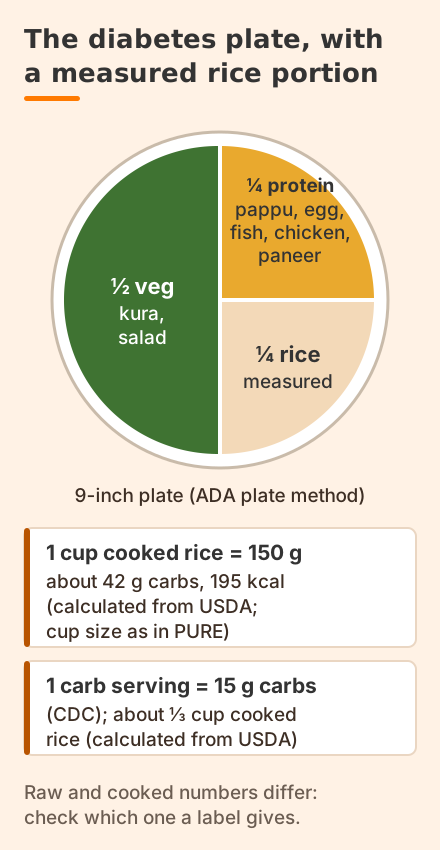
Plate split from the ADA plate method;[1] rice numbers calculated from USDA values with 1 cup = 150 g;[7][12] carb serving from the CDC.[8] Kura is a vegetable curry; pappu is dal, cooked lentils.
Does eating rice cause diabetes? What the research says
This is a different question from "can I eat rice now that I have diabetes". The evidence comes from observational studies, which follow large groups for years and record what people eat without changing anyone's diet.
- A review of 7 cohort analyses (352,384 people) found that each extra daily serving of white rice was linked to 11% higher risk of type 2 diabetes.[11]
- In PURE (132,373 adults aged 35 to 70 in 21 countries, followed for about 9.5 years), eating 450 g or more of cooked white rice a day (3 cups or more), compared with under 150 g, was linked to 20% higher risk overall and 61% higher risk in South Asia. In China there was no significant link.[12]
- In the ICMR-INDIAB diet survey of 18,090 Indian adults, carbohydrates gave about 62% of daily energy, much of it from low-quality sources such as white rice, milled whole grains and added sugar. The highest carbohydrate group had 30% higher odds of newly found type 2 diabetes than the lowest group.[10]
These studies show that large amounts of white rice go along with more diabetes, most strongly in South Asians. They do not prove that rice is the cause.[11][12] Context: in a study of 2,042 adults in urban Chennai, refined grains gave about 47% of total calories,[27] and the ICMR-INDIAB national survey of 113,043 adults aged 20 and over found a weighted diabetes prevalence of 11.4%.[9] More in why South Asians face higher diabetes risk.
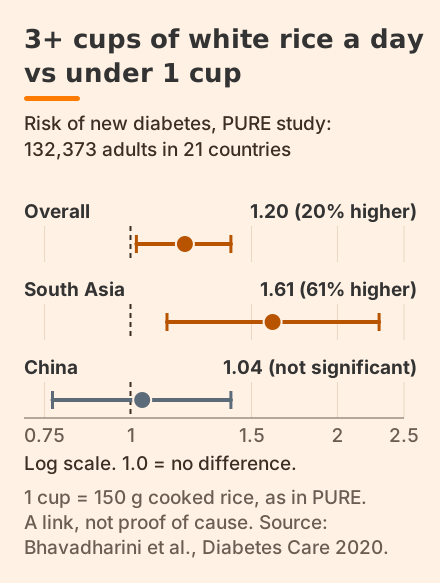
PURE study, 132,373 adults in 21 countries: 450 g or more of cooked white rice a day compared with under 150 g (1 cup). Linked with, not proven to cause.[12]
Once you have diabetes, the question changes. Now what matters is your sugar after meals and your HbA1c. Diabetes UK says the total amount of carbohydrate you eat has the biggest effect on blood glucose after meals.[28] An ADA consensus report found that reducing overall carbohydrate has the most evidence for improving blood sugar, and that this can fit many eating patterns.[2] So rice can stay on the plate. The size of the portion and what sits around it do most of the work.
Which rice is best for diabetes? Sona Masuri, brown, parboiled
Sona Masuri, Ponni, Surti Kolam: all high GI
GI (glycaemic index) shows how fast a food raises blood sugar compared with pure glucose. A GI of 55 or less counts as low.[19] Indian researchers tested three common white rice varieties in healthy volunteers, using portions with 50 g of available carbohydrate. Sona Masuri scored 72.0, Ponni 70.2 and Surti Kolam 77.0. The differences were not significant, and all three are high-GI rice.[17] The National Institute of Nutrition lists rice at 78.2 and cooked green gram (moong) at 42.5.[4]
Worldwide, rice comes in high-, medium- and low-GI versions, so a name on the bag does not tell you the GI.[18] Does GI matter at all? A 2021 review covered 29 trial comparisons with 1,617 people who had type 1 or type 2 diabetes. In the 22 comparisons that measured HbA1c (1,502 people), low-GI or low-GL diets (GL, glycaemic load, also counts portion size) lowered HbA1c by 0.31% on average, a small average drop.[19] The 2019 ADA consensus report described the GI evidence in diabetes as mixed, but it predates this review, which rated the certainty of the HbA1c result as high.[2][19] Our coaches suggest that the amount of rice and the plate around it come first, and the variety second.
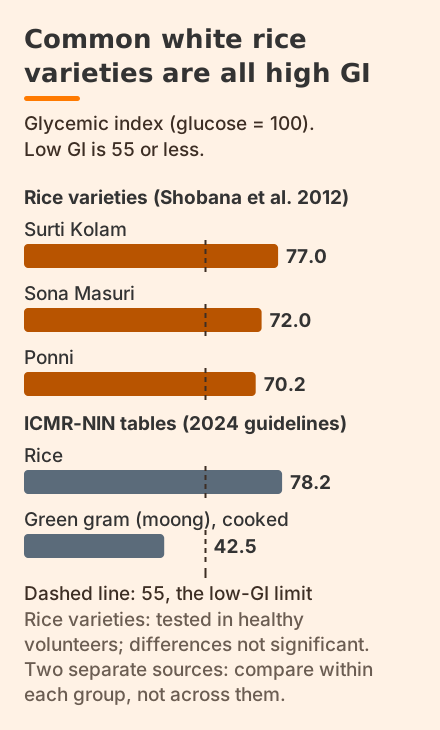
Sona Masuri, Ponni and Surti Kolam were tested in healthy volunteers and the differences were not significant.[17] Rice and green gram are from the ICMR-NIN tables.[4] Low GI is 55 or less.[19] Two separate sources, so compare within each group.
Is brown rice better for diabetes?
Brown and parboiled rice (rice steamed in the husk before milling) have more fibre than milled white rice: 4.43 g and 3.74 g per 100 g raw, against 2.81 g. Calories are almost the same.[6] Does that change blood sugar? In 7 trials with 417 adults who had prediabetes or type 2 diabetes, brown rice did not change HbA1c or fasting glucose compared with white rice.[14] In a Chennai trial of 166 overweight adults, 3 months on parboiled brown rice made no overall difference to glucose or HbA1c.[15]
Long-term studies link higher brown rice intake to 11% lower risk of developing type 2 diabetes.[13] So brown or parboiled rice adds fibre, but Diabetes UK points out that even wholegrains are carbohydrate, so portion size still matters.[28] For weight questions, see is rice bad for weight loss.
Roti, millets or rice?
NIN lists the GI of chapati from a 2022 breakfast-foods study (62.4) and of rice from a separate 2017 study (78.2), so the two numbers are not a like-for-like comparison.[4] A trial in 10 healthy adults found a dal and bhindi (okra) meal with 2 chapatis (whole-wheat flatbreads) had nearly the same meal GI as the same meal with rice: 85.5 and 83.6, each giving 50 g of carbohydrate.[26] In ICMR-INDIAB, swapping refined cereals for whole wheat or millet flour without cutting total carbohydrate was not linked to lower diabetes odds.[10] Atta (whole-wheat flour), ragi (finger millet) and jowar (sorghum) do have about 10 to 11 g of fibre per 100 g, against 2.81 g in milled rice.[6] The takeaway: switching grain helps little unless the total carbohydrate also comes down.
How to eat rice with diabetes: 5 habits
Our coaches suggest that portion and plate matter most, and the type of rice least. These habits are the practical part, with their evidence and what that evidence does not show.
1. Vegetables and protein first, rice last
- In 11 adults with type 2 diabetes taking metformin, eating vegetables and protein before carbohydrate gave lower after-meal glucose at 30, 60 and 120 minutes than the same meal in a different order. The gap was largest at 60 minutes (36.7% lower per the paper's text; its table gives 37.0%).[21]
- In 16 adults with type 2 diabetes, eating carbohydrate last (10 minutes after protein and vegetables) lowered the glucose rise by 53% compared with carbohydrate first.[22]
Both were single-meal studies and measured sugar after the meal, not HbA1c. Our coaches suggest starting with the kura and pappu, then the rice.
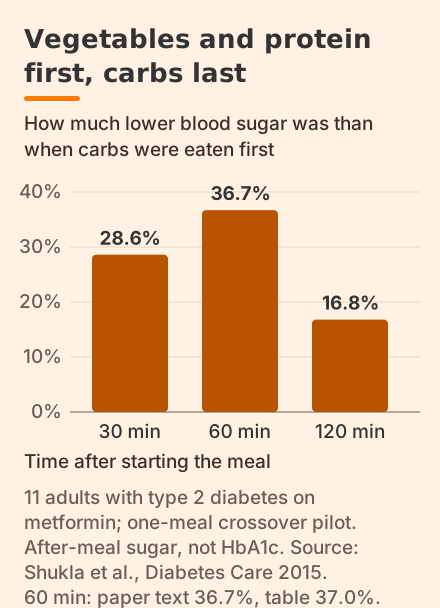
One meal, 11 adults with type 2 diabetes on metformin. Shows after-meal glucose, not HbA1c.[21]
2. Add dal or other pulses
Across 41 randomised trials of pulses (dals, beans, chickpeas), in people with or without diabetes, pulses on their own lowered fasting glucose, and within low-GI diets they lowered HbA1c or a similar marker. Effects varied between studies.[20] A 5-day trial of 15 overweight Asian Indians without diabetes found 22.9% lower 24-hour glucose response (daily incremental area under the glucose curve) on brown rice with 50 g a day of legumes than on white rice. It was too small and short to tell us about HbA1c.[16] Our coaches suggest a bowl of pappu or sambar with every rice meal.
3. Walk for 10 minutes after meals
In 41 adults with type 2 diabetes, a 10-minute walk after each main meal lowered post-meal glucose by 12%, compared with one 30-minute walk a day. The paper also reports a larger drop after the evening meal.[23] The ADA advises at least 150 minutes a week of moderate-to-vigorous activity and breaking up sitting at least every 30 minutes.[1]
4. Cook, cool and reheat
Rice cooled for 24 hours in a fridge and then reheated had 1.65 g of resistant starch per 100 g, against 0.64 g in fresh rice. In 15 healthy adults, it gave a lower glucose response than fresh rice.[24] That is one small study in healthy people, not people with diabetes, so treat it as a possible small help. For safety, the NHS says to cool cooked rice within 1 hour, keep it in the fridge, eat it within 24 hours, reheat it until steaming hot and never reheat it more than once.[31]
5. Do not cook rice to a mush
A 2021 review of crossover trials, mostly in healthy people and mainly on non-rice foods such as wheat, found that less gelatinised starch (less thermal processing) and larger intact particles lowered after-meal glucose.[25] That is extrapolated to rice, so our coaches suggest it only as a possible small help: cook rice so the grains stay separate. The ADA also asks for minimally processed, high-fibre carbohydrate foods, at least 14 g of fibre per 1,000 kcal.[1]
Rice on a Telugu plate: idli, pongal, curd rice, biryani
Much of the rice we eat arrives as idli (steamed rice and lentil cake), dosa (rice and lentil crepe), pongal (rice and moong dal porridge) or upittu (upma, a savoury semolina porridge). A review by Indian experts on diabetes diets lists GI values for common Indian foods including idli, dosa and upittu.[3] Fermentation, as in idli and dosa, improves digestibility and the availability of micronutrients.[4] That is not the same as lowering blood sugar.
The table shows NIN glycaemic index values for some breakfast foods.[4] Read it with care: GI says nothing about portion size, these values are averages from ten participants whose health status is not stated, and vada (a deep-fried lentil doughnut) has the lowest GI but is fried in oil. Do not read the table as "vada is the best choice".
| Food (NIN data) | GI |
|---|---|
| Plain dosa | 79.39 |
| MLA pesarattu (green gram dosa with upittu) | 72.85 |
| Idli with sambar | 68.69 |
| Set dosa | 65.97 |
| Vegetable dosa | 63.97 |
| Chapati | 62.43 |
| Pesarattu (green gram dosa) | 60.69 |
| Vada sambar | 36.89 |
Source: ICMR-NIN Dietary Guidelines for Indians 2024, annex.[4] Values originate from Devindra et al. 2022 (J Food Sci Technol), as reprinted by NIN.
Here is how our coaches suggest handling common rice meals, as starting points to check against your own readings.
- Idli, dosa and pongal: the batter is mostly rice, so count it as the rice part of the meal. Ask for extra sambar and a vegetable side.
- Pulihora and biryani: both are easy to over-serve. Keep to a measured cup and add raita or a salad. Restaurant plates can be much bigger than a home bowl, so share one or take half home.
- Perugu annam (curd rice) at night: keep the rice portion measured and add a vegetable side such as cucumber or carrot.
- Lunch box: rice in a small measured container, curry and dal in larger ones, a cucumber or carrot side, and a 10-minute walk after lunch (see habit 3).
- NRIs and parents visiting abroad: the name on the bag does not tell you the GI,[18] so buy the rice you know and measure it at home.
For breakfast detail, see best Indian breakfasts for diabetes.
Taking insulin or sugar tablets? Change your rice safely
Cutting rice sharply is not risk-free if you take diabetes medicines.
- Missing or delaying meals, or eating too little carbohydrate, can bring on low blood sugar in people with diabetes.[29] Our coaches ask you not to skip meals or rice if you take insulin or sulfonylureas (tablets that push the body to release more insulin) without talking to your doctor first.
- If you plan a very low-carbohydrate plan, the ADA consensus report says a knowledgeable practitioner should lower insulin and other glucose-lowering medicines at the start to prevent lows.[2]
- If your medicine can cause lows, Diabetes UK says to check your blood glucose regularly when you cut carbohydrate.[28]
- Any diabetes medicine may need a doctor conversation before big carbohydrate cuts. Our coaches say: tell your doctor, and do not change doses yourself.
- On a fixed daily insulin dose, keep the timing and amount of carbohydrate steady.[1]
Signs of a low include hunger, sweating, trembling, dizziness, a racing heartbeat, blurred vision and confusion. The NHS says to treat a low with something sugary such as juice, a sugary drink or glucose tablets, then recheck after 10 to 15 minutes.[29] Our coaches suggest making one change at a time.
See your doctor if...
- You have symptoms of low blood sugar. A severe low can cause seizures or loss of consciousness, which is an emergency.[29]
- You feel very thirsty, pass urine often, feel weak or tired, have blurred vision, or are losing weight.[30]
- High sugar comes with vomiting, stomach pain, fast breathing, drowsiness, fruity-smelling breath, confusion or high ketones. Get emergency help.[30]
- Your HbA1c or readings stay above the target your doctor set, you have foot sores or numbness, or you have lost weight without meaning to. Our coaches ask you to see your doctor.
- You plan to cut rice or carbohydrate a lot, plan to stop or lower any medicine, are pregnant, or have kidney disease. Our coaches ask you to speak with your doctor or dietitian first.
Where to go from here
- Measure your usual bowl of cooked rice once, so you know your real cup.
- Fill half the plate with vegetables and a quarter with dal or another protein.
- Eat the vegetables and dal first, the rice last.
- Take a short walk after the meal.
- Ask your doctor about your readings and targets, and tell them before you change medicines.
Start with the free carb intake calculator. If you would like help turning the numbers into meals your family will eat, book a free consultation with our nutrition coaches. We work alongside your doctor, not instead of them, and we cannot promise any result.
Common questions
Can diabetics eat rice at night?
Our sources do not test the clock, so the amount and the rest of the plate matter more than the time. In 41 adults with type 2 diabetes, a 10-minute walk after the evening meal lowered the after-meal sugar rise by 22%, compared with one 30-minute walk a day. Keep dinner rice measured and walk afterwards.
Is brown rice better than white rice for sugar patients?
Brown rice has more fibre than milled white rice, 4.43 g against 2.81 g per 100 g raw. But in 7 trials with 417 adults who had prediabetes or type 2 diabetes, brown rice did not change HbA1c (average blood sugar over about 3 months) or fasting glucose. Diabetes UK notes that wholegrains are still carbohydrate, so the portion still matters.
Is Sona Masuri rice good for diabetes?
Sona Masuri is a high-GI rice. In healthy volunteers it scored a GI of 72, close to Ponni at 70.2 and Surti Kolam at 77.0, and the differences were not significant. People with diabetes can still eat it. Measure the cooked portion and fill the rest of the plate with vegetables and dal.
Roti or rice: which is better for diabetes?
When carbohydrate was matched at 50 g, a dal and bhindi meal with chapatis had about the same meal GI as the same meal with rice, in 10 healthy adults. In an Indian survey of 18,090 adults, swapping refined cereals for whole wheat or millet flour, without cutting total carbohydrate, was not linked to lower diabetes odds.
Can a diabetic patient eat rice every day?
Many people with type 2 diabetes keep rice in daily meals. The amount, the rest of the plate and your medicines decide how well it works. Our coaches suggest a measured portion with vegetables and dal, then checking your readings with your doctor. If you take insulin or sulfonylureas, tell your doctor before cutting rice.
How many cups of rice can a diabetic eat in a day?
There is no single number for everyone. One cup of cooked rice (150 g) holds about 42 g of carbohydrate, calculated from USDA data. Our coaches suggest starting with about one cup per meal, less if your doctor gave you a lower carbohydrate range, and checking your readings. Try the free carb intake calculator, then agree a number with your doctor or dietitian.
Can eating rice cause diabetes?
Studies show a link, not proof of cause. In the PURE study of 132,373 adults in 21 countries, eating 450 g or more of cooked white rice a day was linked to a 20% higher chance of developing diabetes than under 150 g a day, and 61% higher in South Asia. The studies are observational.
Reviewed by
Not yet reviewed by a Flexcellence coach.
Sources
American Diabetes Association (Diabetes Care). 5. Facilitating Positive Health Behaviors and Well-being to Improve Health Outcomes: Standards of Care in Diabetes-2026 (2026).
American Diabetes Association (Diabetes Care). Nutrition Therapy for Adults With Diabetes or Prediabetes: A Consensus Report (Evert AB et al.) (2019).
Advances in Therapy (RSSDI-affiliated expert authors). Insights on Medical Nutrition Therapy for Type 2 Diabetes Mellitus: An Indian Perspective (Viswanathan et al.) (2019).
ICMR-National Institute of Nutrition. Dietary Guidelines for Indians (Revised Edition 2024) (2024).
ICMR-National Institute of Nutrition. Indian Food Composition Tables 2017 (Longvah T, Ananthan R, Bhaskarachary K, Venkaiah K) (2017).
USDA Agricultural Research Service, FoodData Central. Rice, white, long-grain, regular, enriched, cooked (SR Legacy FDC 168878), data record (2019).
US Centers for Disease Control and Prevention. Carb Counting to Manage Blood Sugar (2024).
The Lancet Diabetes & Endocrinology. Metabolic non-communicable disease health report of India: the ICMR-INDIAB national cross-sectional study (ICMR-INDIAB-17) (2023).
Nature Medicine. Dietary profiles and associated metabolic risk factors in India from the ICMR-INDIAB survey-21 (Anjana RM et al.) (2025).
BMJ. White rice consumption and risk of type 2 diabetes: meta-analysis and systematic review (Hu EA et al.) (2012).
American Diabetes Association (Diabetes Care). White Rice Intake and Incident Diabetes: A Study of 132,373 Participants in 21 Countries (PURE; Bhavadharini B et al.) (2020).
BMJ Open. White rice, brown rice and the risk of type 2 diabetes: a systematic review and meta-analysis (2022).
PeerJ. The effect of a brown-rice diets on glycemic control and metabolic parameters in prediabetes and type 2 diabetes mellitus: a meta-analysis (2021).
British Journal of Nutrition (Cambridge University Press). Substituting brown rice for white rice on diabetes risk factors in India: a randomised controlled trial (2019).
Diabetes Technology & Therapeutics. Effect of brown rice, white rice, and brown rice with legumes on blood glucose and insulin responses in overweight Asian Indians: a randomized controlled trial (2014).
International Journal of Food Sciences and Nutrition. Glycaemic index of three Indian rice varieties (Shobana S et al.) (2012).
The American Journal of Clinical Nutrition. International tables of glycemic index and glycemic load values 2021: a systematic review (Atkinson FS et al.) (2021).
BMJ. Effect of low glycaemic index or load dietary patterns on glycaemic control and cardiometabolic risk factors in diabetes: systematic review and meta-analysis of RCTs (Chiavaroli et al.) (2021).
Diabetologia. Effect of non-oil-seed pulses on glycaemic control: a systematic review and meta-analysis of randomised controlled experimental trials (Sievenpiper et al.) (2009).
American Diabetes Association (Diabetes Care). Food Order Has a Significant Impact on Postprandial Glucose and Insulin Levels (Shukla AP et al.) (2015).
BMJ Open Diabetes Research & Care. Carbohydrate-last meal pattern lowers postprandial glucose and insulin excursions in type 2 diabetes (Shukla AP et al.) (2017).
Diabetologia. Advice to walk after meals is more effective for lowering postprandial glycaemia in type 2 diabetes mellitus than advice that does not specify timing: a randomised crossover study (Reynolds AN et al.) (2016).
Asia Pacific Journal of Clinical Nutrition. Effect of cooling of cooked white rice on resistant starch content and glycemic response (Sonia S et al.) (2015).
The American Journal of Clinical Nutrition. The impact of starchy food structure on postprandial glycemic response and appetite: a systematic review with meta-analysis of randomized crossover trials (2021).
Indian Journal of Endocrinology and Metabolism. Glycemic Index of Wheat and Rice are Similar When Consumed as Part of a North Indian Mixed Meal (2020).
Metabolism: Clinical and Experimental (Elsevier). Refined grain consumption and the metabolic syndrome in urban Asian Indians (CURES-57) (2009).
Diabetes UK. Carbohydrates and diabetes (2024).
NHS (UK). Low blood sugar (hypoglycaemia) (2023).
NHS (UK). High blood sugar (hyperglycaemia) (2026).
NHS (UK). Starchy foods and carbohydrates (2023).