South Asian diabetes risk: why it's higher and what to do
Why South Asians face higher diabetes risk at a normal BMI, how to check your waist-to-height ratio, and a South Indian diet and meal plan to start.
The short answer
South Asians living in high-income countries typically develop type 2 diabetes 5 to 10 years earlier and at a lower BMI than white Europeans, often with more belly fat and less muscle. Measure your waist-to-height ratio, ask your doctor about testing, and start with food, movement and sleep. This is education, not diagnosis.
Work out your own numbers
Screen metabolic risk using waist-to-height ratio thresholds.
Free, takes a minute, and uses the same formulas our coaches use.
Open the Waist-to-Height Ratio CalculatorOn this page
Type 2 diabetes is two to four times more likely in people of South Asian descent, says Diabetes UK.[16] You can look slim, eat home food, and still carry that higher risk. This higher risk is reported for South Asian groups in the UK, the US and India, so it is worth taking seriously wherever your family lives.
This article shows how big the gap is, why a "normal" BMI can mislead, and how to check your own number with a tape measure (the waist-to-height step takes two minutes). It also covers testing, a South Indian diet and meal plan to start with, and the signs that mean you should see a doctor.
This is education, not a diagnosis. Our coaches work alongside your doctor, never instead of one.
Start this week
- Measure your waist and height, then use our waist-to-height ratio calculator.
- Ask your doctor which blood test suits you, and when.
- Change one dinner: more vegetables, a protein, and a measured portion of rice or roti.
- Walk for 10 minutes after one meal a day.
- Read the warning signs in "When to see a doctor" below.
What "higher risk" means: the size of the gap
Each study below used different people and different criteria, so read each number on its own. Do not compare percentages across studies.
- US adults: in a national survey of 7,575 adults (NHANES, 2011 to 2016), age- and sex-adjusted total diabetes was 23.3% in South Asian adults, 14.0% in East Asian adults and 12.1% in non-Hispanic white adults. The South Asian group was small, so its range is wide (95% confidence interval 15.6% to 30.9%).[7]
- US, midlife and older: the MASALA study compared 799 South Asian adults with 6,784 adults from four other groups, all aged 44 to 84. Age-adjusted diabetes was 23% in South Asians and 6% in white adults. The usual risk factors did not explain the gap.[6]
- London, over 20 years: SABRE followed a cohort (a group of people tracked over time). 34% of first-generation Indian migrants (282 of 839) developed diabetes, against 14% of European adults (196 of 1,354).[8]
- India: ICMR-INDIAB, a survey that sampled 113,043 adults across India, found diabetes in 11.4% and prediabetes in 15.3% (WHO criteria; each figure comes from a slightly smaller group with complete test results, about 107,000). Abdominal obesity (extra fat around the waist, using the WHO Asia-Pacific definition) was found in 39.5%.[9] An earlier survey of 15 states (not all of India; 57,117 people tested with a glucose tolerance test, WHO criteria) found diabetes in 11.2% of urban and 5.2% of rural residents.[10]
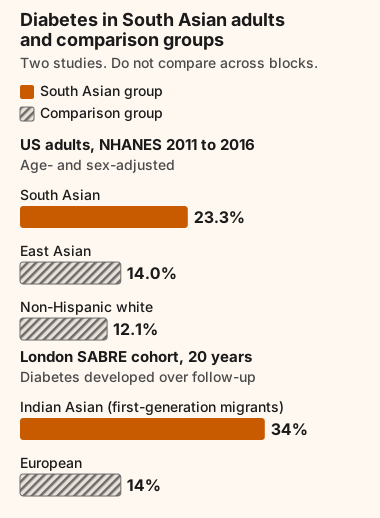
Figure 1. Diabetes in South Asian adults and comparison groups. The two blocks come from different studies and should not be compared with each other. Sources: US NHANES 2011 to 2016, age- and sex-adjusted;[7] London SABRE cohort, 20-year follow-up.[8]
South Asians who live in high-income countries typically develop type 2 diabetes 5 to 10 years earlier and at a lower BMI than white Europeans.[4] In the US survey, undiagnosed diabetes was 7.5% in non-Hispanic Asian adults (all Asian groups together) and 3.9% in non-Hispanic white adults.[7]
Why risk is higher even at a "normal" weight
BMI (weight divided by height squared) was built mostly on white populations. At the same BMI, the risk is not the same for everyone.
- In English family-doctor records (1,472,819 adults, 75,956 of them South Asian), the diabetes risk seen at BMI 30 in white adults was reached at BMI 23.9 in South Asian adults.[1]
- In UK Biobank (490,288 adults, 9,631 of them South Asian), the diabetes level seen at BMI 30 in white adults matched BMI 22.0 in South Asian adults.[2] This study looked at one point in time, so it shows a match, not a cause.
So the range is around BMI 22 to 24, depending on the study and the method. A WHO expert group also found raised risk below BMI 25 in many Asian populations and named BMI 23 as a point for public-health action.[11] A 2025 Indian expert consensus treats BMI above 23 as the starting point for obesity in Asian Indians living in India, then uses waist size and health checks to judge how serious it is.[12]
Researchers have not found one single cause. These are the better-supported pieces:
- Body fat pattern. At the same BMI, South Asians tend to have a higher body-fat percentage, more deep belly fat (fat packed around the organs), less muscle and lower fitness.[4][5]
- Insulin resistance. Insulin is the hormone that moves sugar from blood into cells. In MASALA, South Asians had more insulin resistance and lower beta-cell function (how well the pancreas cells make insulin) than other groups of the same age and body fat.[6]
- Lifestyle change. A review of south Asia points to economic change, city living, poorer diet quality, less physical activity and more sitting.[3]
- Genes. A review of migrant South Asians found no clear evidence that genes explain most of the extra risk.[4]
Check your own number: waist, waist-to-height and BMI
You do not need a lab for a first look. A tape measure is enough. The steps are our coaches' practical method. The cut-offs come from the sources.
- Stand straight and breathe out normally. Wrap the tape around your belly just above the hip bone, snug but not tight. Note the waist in cm.
- Measure your height in cm.
- Divide waist by height. A waist of 84 cm and a height of 160 cm gives 84 ÷ 160 = 0.525.
- Compare with 0.5, a widely used screening line (keep your waist under half your height).[13] Older Older Indian guidance (Misra and Khurana 2011) counts a waist of 80 cm or more in women and 90 cm or more in men as abdominal obesity.[5] The 2025 Indian consensus uses waist size or waist-to-height ratio together with BMI, but its abstract does not give the centimetre values.[12]
You can skip the maths with our free waist-to-height ratio calculator.
Why this ratio? A review of 31 studies with over 300,000 adults found that waist-to-height ratio picked up risk factors for heart and blood-sugar problems better than BMI or waist alone.[13]
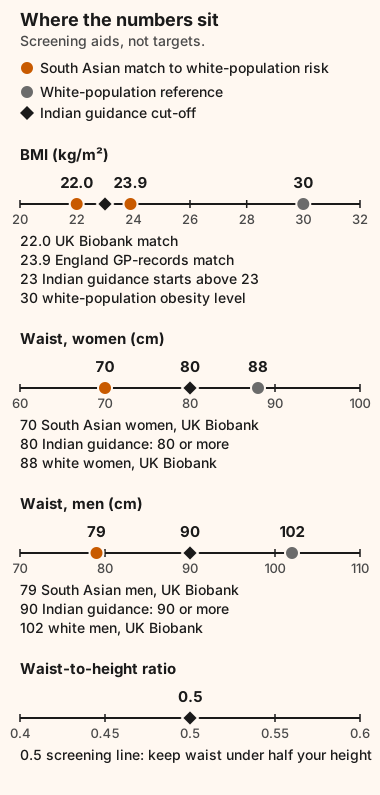
Figure 2. Where the numbers sit. BMI matches from England family-doctor records[1] and UK Biobank;[2] waist matches from UK Biobank (a white woman's 88 cm matched 70 cm in South Asian women, and a white man's 102 cm matched 79 cm in South Asian men);[2] Indian cut-offs for BMI above 23,[12] waist 80 cm (women) and 90 cm (men),[5] and the 0.5 waist-to-height screening line.[13] These are screening aids, not targets.
A tape measure is a screening tool, not a diagnosis. Only a blood test can tell you if you have prediabetes or diabetes. None of the numbers in Figure 2 are targets to chase.
When to get tested, and what the numbers mean
Testing advice differs by country, so ask your own doctor what fits you.
- India (RSSDI-ESI 2020): Indian diabetes experts suggest a doctor check your diabetes risk every year from age 30. This is expert opinion. The method has two steps: a risk questionnaire first, then a glucose test. HbA1c should not be the only screening test.[32] The best-known questionnaire is the Indian Diabetes Risk Score. It scores age, waist, family history and physical activity, and a score of 60 or more points to an OGTT (oral glucose tolerance test, a blood test taken 2 hours after a sugar drink).[33]
- ADA (US) 2025: test adults with overweight who have at least one more risk factor. For this, overweight means BMI 25 or more, or 23 or more in people of Asian ancestry. For everyone else, start at age 35. If results are normal, repeat at least every 3 years.[14]
- Diabetes UK: risk starts earlier in South Asian people, over 25 compared with over 40 for white people. A parent, brother, sister or child with type 2 diabetes makes it 2 to 6 times more likely.[16]
- Pregnancy history: across 20 cohort studies (675,455 women), women who had gestational diabetes (high sugar first found in pregnancy) had about 7.4 times the risk of type 2 diabetes later.[22] If this is you, ask your doctor how often to test.
The US and UK ages above are not the same as Indian advice, so use them as context, not as a rule for you. If a family history, gestational diabetes or a high waist-to-height ratio applies to you, it is reasonable to ask your doctor about starting earlier.
The ranges below are the ones used by the ADA, in mg/dL (the unit used in India and the US):[14]
| Test | Prediabetes | Diabetes |
|---|---|---|
| HbA1c (average sugar over about 3 months) | 5.7 to 6.4% | 6.5% or more |
| Fasting blood glucose | 100 to 125 mg/dL | 126 mg/dL or more |
| 2-hour glucose after a sugar drink (OGTT) | 140 to 199 mg/dL | 200 mg/dL or more |
Three cautions. HbA1c can be unreliable in some people, for example with anaemia (low haemoglobin) or certain haemoglobin variants, so your doctor may use a fasting or 2-hour glucose test instead.[14] Diabetes is usually confirmed with a second abnormal test, not one reading.[14] If you have prediabetes, the ADA says to test every year.[14] Your doctor reads your results with your history. A single number in a table is not a verdict.
South Asian diabetes prevention: what the trials show
Several trials show that lifestyle change lowered the chance of developing diabetes in people with raised blood sugar. None of them is a promise for any one person.
- India (IDPP-1): 531 Asian Indians with impaired glucose tolerance (blood sugar above normal but below the diabetes range; mean age 45.9, mean BMI 25.8) were followed for about 30 months. Within 3 years, 55.0% of the control group and 39.3% of the lifestyle group developed diabetes, a 28.5% lower relative risk.[17]
- US (Diabetes Prevention Program): in 3,234 adults with raised blood sugar, a lifestyle programme cut new diabetes by 58% compared with a dummy pill over 2.8 years on average. Its goals were at least 7% weight loss and 150 minutes of activity a week.[19] This was a mixed US group, not an Indian one.
- Text messages in India: among 537 working men aged 35 to 55 with impaired glucose tolerance, frequent lifestyle messages led to diabetes in 18%, against 27% with one-time advice. Men only.[18]
South Asian diabetes diet: what to change first
This section mixes sourced facts with our coaches' practical ideas. Ours are labelled.
Rice and portions
In the PURE study (132,373 adults in 21 countries, followed for 9.5 years on average), eating 450 g or more of cooked white rice a day was linked to more diabetes than eating under 150 g a day. The study counted one cup of cooked rice as 150 g, so 450 g is three cups. The link was strongest in South Asia (hazard ratio 1.61, against 1.20 overall; a hazard ratio compares how often diabetes appeared in two groups). This shows an association, not proof that rice caused it.[24]
A survey of 18,090 Indian adults (ICMR-INDIAB) found that people with the highest carbohydrate intake had higher odds of newly diagnosed diabetes (odds ratio 1.30) than those with the lowest. Swapping refined flour for whole wheat or millet flour, without eating less carbohydrate overall, showed no clear lower risk, although that result was uncertain.[35] Our reading is that the amount of carbohydrate matters, not only the type of grain.
Our coaches suggest weighing your cooked rice once on a kitchen scale, because katori (small steel bowl) sizes vary. A common starting plate is about 1 cup (150 g) of cooked rice, or 2 phulka, per meal, then adjust with your dietitian. Do not cut rice sharply or skip meals. If you take diabetes medicines, sudden cuts can push blood sugar too low, so change food with your doctor's advice. See our guide to rice and diabetes.
Plate shape
The ICMR National Institute of Nutrition (NIN, Hyderabad) "My Plate" for a 2,000 kcal day lists raw weights: cereals including millets 250 g, pulses (dals) 85 g, vegetables including greens 400 g, fruit 100 g, nuts and seeds 35 g, and fats and oils 27 g for the whole day (roughly 6 teaspoons, our own conversion). Vegetables and fruit make up about half the plate, and whole fruit is preferred to juice.[27] The 2024 Indian dietary guidelines also say cereals should be limited to 45% of energy and added sugar kept under 5%.[26]
Glycaemic index
GI (glycaemic index) ranks how fast a food raises blood sugar in lab tests. Lower is slower. The guidelines annex lists these values. They come from different tables in the annex, so they mix studies and methods; the annex gives other values for some foods (chapati is 65.7 in one table and 62.4 in another, and we use 62.4):[26]
- green gram (listed as green gram; we assume it is the whole bean): 42.5
- pesarattu (green gram dosa): 60.7
- chapati (thin wheat flatbread; phulka is a similar, oil-free version): 62.4
- idli (steamed rice-and-lentil cake) with sambar (lentil-vegetable stew): 68.7
- rice (the table does not say which type): 78.2
- plain dosa (fermented rice-and-lentil crepe): 79.4
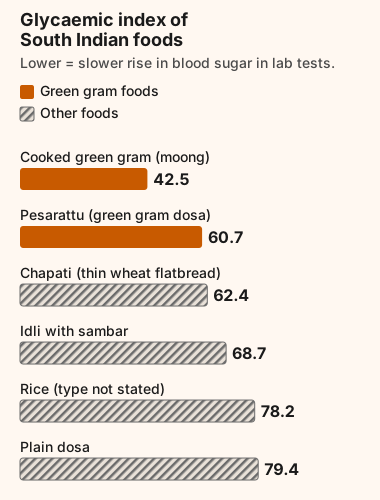
Figure 3. Glycaemic index of South Indian foods, as printed in the ICMR-NIN guidelines annex, which mixes values from different tables.[26] These are lab values. Real meals differ, and portion size matters as much as GI.
The Telugu plate: extras to count in
These are our coaches' ideas, not study results. Some foods sit outside the plate rules above: biryani and pulao (rice-heavy, often with extra oil), fried snacks such as punugulu (fried batter balls) and mirchi bajji (fried chilli fritters), sweets, mango and banana season, sweet chai and alcohol. We suggest counting them in instead of banning them. Keep them for occasions, take a smaller rice portion alongside, and add salad or curd. Ragi sangati (finger millet ball) and jonna roti (sorghum flatbread) can replace rice at some meals, but portion size still matters. For non-veg gravies, ask for less oil and keep the protein.
Drinks and cooking
In a review of 17 cohorts, each daily serving of a sugar-sweetened drink was linked to 18% higher type 2 diabetes (13% after allowing for body fat).[25] The guidelines favour lower-oil cooking methods such as steaming and pressure cooking over deep frying and advise against reusing heated oil.[26]
Our coaches suggest changing one meal at a time, usually dinner, and building the plate in this order: vegetables first, then a protein (dal, egg, curd, fish or paneer), then rice or roti. We do not claim any food "controls" or "reverses" blood sugar.
A South Asian diabetes meal plan for one day (South Indian style)
This is an example of structure, not a prescription. Portions are our coaches' ideas and depend on age, weight, medicines and your doctor's advice.
| Meal | Vegetarian option | Egg or fish option |
|---|---|---|
| Breakfast | 2 small pesarattu (green gram dosa) with ginger chutney and a vegetable side | 2 idli with sambar and 1 boiled egg |
| Mid-morning | 1 whole fruit, such as guava or apple | Small handful of roasted chana (roasted Bengal gram) |
| Lunch | 1 cup (150 g) cooked rice, 1 katori dal, a vegetable curry, curd and salad | Same plate, with fish curry in place of dal |
| Evening | 1 small bowl of sundal (boiled chickpea snack) and unsweetened tea | Ragi malt (finger millet drink) made without sugar |
| Dinner | 2 phulka (thin oil-free roti) with a paneer (Indian cottage cheese) or tofu curry and vegetables | 2 phulka with fish curry and vegetables |
| After meals | A 10-minute walk | A 10-minute walk |
Weekend or biryani day: keep the same 1 cup of rice for the main meal, add raita (spiced curd) and a large salad, and skip the separate rice at the other meal. Pregnant or breastfeeding? This plan is not for you. Talk to your doctor first.
For a full week, see our diabetes diet chart and meal plan guide and our prediabetes diet.
Movement, muscle and sleep
Walking after meals
In a small crossover study (each person tried both plans) of 41 adults with type 2 diabetes, a 10-minute walk after each main meal lowered post-meal glucose by 12% overall (22% after dinner), compared with one 30-minute daily walk. It was tested in people who already had diabetes, not as prevention.[29] For adults with prediabetes and overweight, the ADA suggests at least 150 minutes a week of moderate activity such as brisk walking.[15] An Indian consensus group recommends 60 minutes of activity a day for healthy Asian Indians: at least 30 minutes of moderate aerobic activity, 15 minutes of work-related activity and 15 minutes of muscle strengthening.[20]
Muscle and strength
Lower muscle mass is one of the differences listed in South Asians.[4] A review of prospective studies and trials linked more physical activity to lower diabetes risk, and its abstract notes an inverse link for resistance exercise too. This is mostly observational.[21] Our coaches suggest two short strength sessions a week (bodyweight squats, wall push-ups or resistance bands) and a protein source at every meal. Check with your doctor first if you are older or have joint, heart or kidney problems.
Sleep
In a review of 10 studies (107,756 people), short sleep (5 to 6 hours or less) was linked to a 28% higher risk, and long sleep (more than 8 to 9 hours) to a 48% higher risk. This is observational.[23]
South Asian diabetes risk for NRIs, women and families
If you live abroad. Early onset and diabetes at a lower BMI are seen in South Asian migrants.[4] That does not mean moving causes diabetes. Our piece on weight gain after moving to the USA looks at the food and routine side.
If you work at a desk. More sitting is listed among the drivers,[3] so a short walk after meals is an easy place to start.
If a parent has diabetes. Family history makes type 2 diabetes 2 to 6 times more likely.[16] Our coaches suggest older parents change food gradually and never skip meals, with their doctor guiding any medicine. See our guide on caring for parents with diabetes from abroad.
If you have PCOS. PCOS is on the ADA's list of conditions that call for diabetes testing.[14] Ask your doctor about testing.
If you take diabetes medicines. Cutting carbohydrates, skipping meals or adding more exercise can lower blood sugar too far on some medicines. Talk to your doctor before you change food or activity. Do not change or stop medicines because of an article.
If you are pregnant, breastfeeding, or under 18. Do not start a restrictive plan on your own. Your care team plans food in pregnancy, and gestational diabetes is managed by your clinic. Children and teens need a doctor-led plan.
When to see a doctor
See a doctor if you have any of these:[30]
- unusual tiredness
- peeing more than usual
- constant thirst
- losing weight without trying
- blurred vision
- cuts that heal slowly
- genital itching or repeated thrush (a yeast infection)
Symptoms can develop gradually, and some people with type 2 diabetes have none.[30] So also book a test if you are in a higher-risk group: a parent or sibling with diabetes, past gestational diabetes, PCOS, a waist-to-height ratio of 0.5 or more, or you have reached the testing age your doctor advises.[14][16][22]
Get medical help straight away if high blood sugar comes with vomiting, stomach pain, unusual sleepiness or confusion, breath that smells sweet or fruity, or fainting. These can be signs of diabetic ketoacidosis (a build-up of acids in the blood), a serious emergency. If you have these symptoms and no diagnosis or no meter, do not wait.[34]
In short
- South Asians can have higher diabetes risk at a lower BMI and waist size, so a "normal" BMI does not rule out risk.
- Measure your waist-to-height ratio, ask your doctor about a blood test, then start with one dinner, a measured portion of rice and a 10-minute walk.
- See your doctor for symptoms, pregnancy, or before changing food if you take diabetes medicines.
How Flexcellence coaches work with your doctor
At Flexcellence, a nutritionist plans meals around the food you actually eat and your lab reports. Your doctor stays in charge of diagnosis and medicines. We do not promise outcomes, we help you build habits you can keep.
Two easy next steps:
- Use the free waist-to-height ratio calculator to get your number.
- Book a free 30-minute consultation to talk through your food, your reports and your questions.
Common questions
Why are South Asians at higher risk of type 2 diabetes?
Researchers have not found one single cause. Studies (Sattar and Gill 2015; Hills 2018) point to more belly fat and less muscle at the same BMI, more insulin resistance, and lifestyle change such as city living, less activity and more sitting. A review found no clear evidence that genes explain most of the extra risk.
Can I get diabetes if my BMI is normal?
Yes. Indian guidance treats BMI 18.5 to 22.9 as normal, but risk can still be higher below BMI 23. In UK studies (Caleyachetty 2021; Ntuk 2014), the diabetes risk seen at BMI 30 in white adults appeared at BMI 22 to 24 in South Asian adults. Measure your waist and ask your doctor about a blood test.
At what age should South Asians get tested for diabetes?
It depends on your country and risk factors, so ask your doctor. Indian guidance (RSSDI-ESI 2020) suggests a yearly risk check from age 30. US ADA guidance (Standards of Care 2025) says to test from age 35, or earlier if BMI is 23 or more in people of Asian ancestry plus another risk factor. Diabetes UK says risk starts over 25 in South Asian people. The US and UK ages are not Indian advice.
What is a healthy waist size for Indian women?
Older Indian guidance (Misra and Khurana 2011) counts a waist of 80 cm or more in women, and 90 cm or more in men, as abdominal obesity. A waist-to-height ratio of 0.5 or more is a common screening line (Ashwell 2012 review). Our method: measure just above the hip bone after a normal breath out. This is a screening check, not a diagnosis.
Is rice bad if I have a higher diabetes risk?
Not as a single food. In the PURE study of 132,373 adults, eating 450 g or more of cooked white rice a day was linked to more diabetes, most strongly in South Asia. That shows an association. Portion size and what you eat with rice both matter.
What are the signs I should see a doctor?
The NHS (symptoms page) lists tiredness, peeing more than usual, constant thirst, unintentional weight loss, blurred vision, slow-healing cuts and genital itching or repeated thrush. Some people have no symptoms, so test if you are in a higher-risk group. If high blood sugar comes with vomiting, stomach pain, confusion, unusual sleepiness or fruity-smelling breath, get medical help straight away.
Reviewed by
Not yet reviewed by a Flexcellence coach.
Sources
The Lancet Diabetes & Endocrinology (Caleyachetty R et al.). Ethnicity-specific BMI cutoffs for obesity based on type 2 diabetes risk in England: a population-based cohort study (2021).
Diabetes Care (Ntuk UE, Gill JM, Mackay DF, Sattar N, Pell JP). Ethnic-specific obesity cutoffs for diabetes risk: cross-sectional study of 490,288 UK Biobank participants (2014).
The Lancet Diabetes & Endocrinology (Hills AP, Khunti K, Yajnik CS et al.). Epidemiology and determinants of type 2 diabetes in south Asia (2018).
The Lancet Diabetes & Endocrinology (Sattar N, Gill JM). Type 2 diabetes in migrant south Asians: mechanisms, mitigation, and management (2015).
International Journal of Obesity (Misra A, Khurana L). Obesity-related non-communicable diseases: South Asians vs White Caucasians (2011).
Diabetes Care (Kanaya AM et al.; MASALA and MESA). Understanding the high prevalence of diabetes in U.S. south Asians compared with four racial/ethnic groups: the MASALA and MESA studies (2014).
JAMA (Cheng YJ et al., CDC). Prevalence of Diabetes by Race and Ethnicity in the United States, 2011-2016 (2019).
Diabetes Care (Tillin T et al.; SABRE cohort). Insulin resistance and truncal obesity as important determinants of the greater incidence of diabetes in Indian Asians and African Caribbeans compared with Europeans: the SABRE cohort (2013).
The Lancet Diabetes & Endocrinology (ICMR-INDIAB; Anjana RM et al.). Metabolic non-communicable disease health report of India: the ICMR-INDIAB national cross-sectional study (ICMR-INDIAB-17) (2023).
The Lancet Diabetes & Endocrinology (ICMR-INDIAB; Anjana RM et al.). Prevalence of diabetes and prediabetes in 15 states of India: results from the ICMR-INDIAB population-based cross-sectional study (2017).
The Lancet (WHO Expert Consultation). Appropriate body-mass index for Asian populations and its implications for policy and intervention strategies (2004).
Diabetes & Metabolic Syndrome: Clinical Research & Reviews (Misra A et al.). Revised definition of obesity in Asian Indians living in India (2025).
Obesity Reviews (Ashwell M, Gunn P, Gibson S). Waist-to-height ratio is a better screening tool than waist circumference and BMI for adult cardiometabolic risk factors: systematic review and meta-analysis (2012).
Diabetes Care (American Diabetes Association Professional Practice Committee). 2. Diagnosis and Classification of Diabetes: Standards of Care in Diabetes-2025 (2025).
Diabetes Care (American Diabetes Association Professional Practice Committee). 3. Prevention or Delay of Diabetes and Associated Comorbidities: Standards of Care in Diabetes-2025 (2025).
Diabetes UK. Diabetes risk factors (2026).
Diabetologia (Ramachandran A et al.). The Indian Diabetes Prevention Programme shows that lifestyle modification and metformin prevent type 2 diabetes in Asian Indian subjects with impaired glucose tolerance (IDPP-1) (2006).
The Lancet Diabetes & Endocrinology (Ramachandran A et al.). Effectiveness of mobile phone messaging in prevention of type 2 diabetes by lifestyle modification in men in India: a prospective, parallel-group, randomised controlled trial (2013).
New England Journal of Medicine (Diabetes Prevention Program Research Group). Reduction in the incidence of type 2 diabetes with lifestyle intervention or metformin (2002).
Diabetes Technology & Therapeutics (Misra A et al., Physical Activity Consensus Group). Consensus physical activity guidelines for Asian Indians (2012).
European Journal of Epidemiology (Aune D et al.). Physical activity and the risk of type 2 diabetes: a systematic review and dose-response meta-analysis (2015).
The Lancet (Bellamy L, Casas JP, Hingorani AD, Williams D). Type 2 diabetes mellitus after gestational diabetes: a systematic review and meta-analysis (2009).
Diabetes Care (Cappuccio FP, D'Elia L, Strazzullo P, Miller MA). Quantity and quality of sleep and incidence of type 2 diabetes: a systematic review and meta-analysis (2010).
Diabetes Care (PURE study; Bhavadharini B et al.). White Rice Intake and Incident Diabetes: A Study of 132,373 Participants in 21 Countries (2020).
BMJ (Imamura F et al.). Consumption of sugar sweetened beverages, artificially sweetened beverages, and fruit juice and incidence of type 2 diabetes: systematic review and meta-analysis (2015).
ICMR-National Institute of Nutrition. Dietary Guidelines for Indians (Revised Edition 2024) (2024).
ICMR-National Institute of Nutrition, Hyderabad. Policy Brief: Promotion of 'My Plate for the Day' and physical activity (2024).
Diabetologia (Reynolds AN et al.). Advice to walk after meals is more effective for lowering postprandial glycaemia in type 2 diabetes mellitus than advice that does not specify timing: a randomised crossover study (2016).
NHS (UK). Type 2 diabetes: symptoms (2025).
Indian Journal of Endocrinology and Metabolism (Chawla R et al.; RSSDI-ESI Consensus Group). RSSDI-ESI Clinical Practice Recommendations for the Management of Type 2 Diabetes Mellitus 2020 (2020).
Indian Journal of Medical Research (Mohan V et al.). Screening with OGTT alone or in combination with the Indian diabetes risk score or genotyping of TCF7L2 to detect undiagnosed type 2 diabetes in Asian Indians (2011).
Diabetes UK. Diabetic ketoacidosis (DKA) (2026).
Nature Medicine (ICMR-INDIAB survey-21). Dietary profiles and associated metabolic risk factors in India from the ICMR-INDIAB survey-21 (2025).