Parents' Diabetes Care From the USA or Abroad: A Guide
NRI guide to helping parents with diabetes from the USA or abroad: weekly check-ins, yearly tests, low-sugar steps, red flags and food they will eat.
The short answer
You cannot manage a parent's diabetes for them, but you can run a steady system from afar: one shared medicine list, a weekly check-in, a yearly test calendar, a low-sugar plan the local helpers know, and clear red flags. The doctor decides medicines and targets. Reviews of trials found small average HbA1c falls with telemedicine, and the largest review found the effect shrank over time.[^9]
On this page
The phone rings at 2 a.m. your time. Your mother says Appa felt dizzy and sweaty this evening, "but he is fine now." You are 12,000 km away, you cannot see his sugar chart, and you do not know whether to worry.
Here is the short plan: keep one shared medicine list, one weekly call, one local helper, a yearly test calendar and a written low-sugar plan. The rest of this article shows how. It is general education, not a plan for any one parent, and it does not replace your parent's doctor.
The need is large. In the ICMR-INDIAB survey of 113,043 Indian adults aged 20 and above (2008 to 2020), about 11.4% had diabetes.[22] The WHO reports that in 2022, about 59% of adults aged 30 and above with diabetes worldwide were not taking diabetes medicine.[23] We focus on type 2 diabetes in older adults. Type 1 diabetes, pregnancy and kidney failure need a specialist plan.
1. Long-distance caregiving: what you can and cannot do
Your job is support and coordination
You are not the prescriber. The doctor decides medicines, doses and targets. Your job is to make sure the doctor gets good information, visits happen on time, and the people near your parent know what to do. The ADA says telehealth should complement in-person visits, not replace them.[7] It also describes care partners as important for support and shared decision-making.[1]
Why distance makes this hard
A review of 16 studies of long-distance caregivers found that distance can make it harder to talk about a parent's health and care needs, and can add to caregiver stress.[16] If you feel stretched, that is normal. A simple, repeatable routine takes some pressure off you.
2. Set up the basics: medicine list, weekly check-in, local helper
The shared medicine list
Make one list that everyone can see, for example a shared note or spreadsheet. For each medicine, write the name as printed on the strip, the dose, the time, what it is for, and who prescribed it. Keep a photo of each strip in a shared album. Our coaches suggest updating the list after every doctor visit, so that old and new tablets never get mixed up.
Our coaches often see missed tablets as a gap for children who live far away. They suggest a weekly pill box, or a phone alarm at each dose time. The ADA also advises screening older adults for polypharmacy (taking many medicines) at least once a year, so ask the doctor whether every tablet on the list is still needed.[1]
The weekly 10-minute check-in
Pick a fixed day and time, and keep the call short. Our coaches suggest this sheet. It is our own practical tool, not a clinical form.
| Ask or note | Example |
|---|---|
| Fasting sugar readings this week | Three readings from the glucometer log |
| Any low-sugar symptoms (shaky, sweaty, dizzy, confused) | "Tuesday evening, felt shaky" |
| Meals skipped | Two skipped lunches |
| Feet checked daily? Any sore, blister or colour change | Yes / no, with a note |
| Medicines missed | Evening tablet missed on Friday |
| Walk or light movement | 20 minutes, four days |
| Mood, sleep, any falls or forgetfulness | Low, slept badly |
Beyond sugar: falls, memory and mood
The ADA advises screening older adults with diabetes at least once a year for falls and other geriatric syndromes, and screening adults aged 65 and above for mild cognitive impairment or dementia.[1] It also lists screening for depression, anxiety and diabetes distress (feeling worn out by the daily work of diabetes) in the regular evaluation.[3] You cannot do these tests by phone, but you can notice changes and raise them with the doctor.
Choose a local helper
This can be a sibling, relative, neighbour, paid carer or the family doctor's clinic staff. Ask your parent for consent before you share their health information with anyone. If you use an app that shares glucose data online, check its privacy and sharing settings, as the ADA advises for such platforms.[6]
A card for the wallet and the fridge
Our coaches suggest one card your parent carries and a copy on the fridge: name, diagnosis, medicine list, allergies, the doctor's phone number, the helper's number and your number. A paramedic or a casualty doctor can then act fast.
3. The yearly check-up calendar (and who books it)
A calendar makes sure the important checks do not get missed. This table follows the ADA Standards of Care 2025, a US guideline. Indian clinics may use slightly different intervals, so treat it as a list of questions for your parent's doctor.
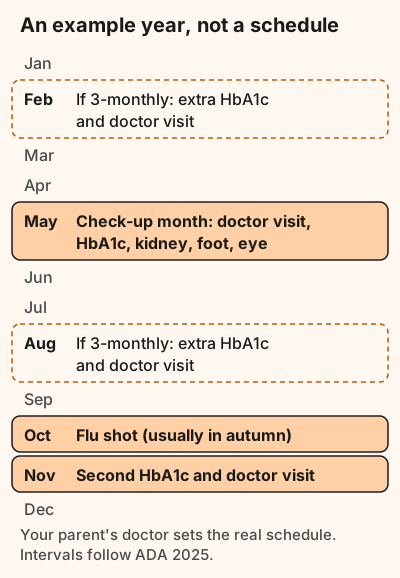
An example year for a stable parent, based on ADA 2025 intervals. The months are only an example. Your parent's doctor sets the real schedule.[2][3][4][5]
| Test or visit | How often (ADA 2025) |
|---|---|
| HbA1c (average sugar of the past 2 to 3 months) | About twice a year if stable and at goal; about every 3 months if not at goal or treatment changed[2] |
| Doctor follow-up visit | Every 3 to 6 months, individualised, and at least once a year[3] |
| Kidney tests: urine albumin-to-creatinine ratio (UACR, a urine test for kidney damage) and eGFR (a blood test of kidney function) | At least once a year[5] |
| Dilated eye exam | At diagnosis; then yearly if any retinopathy (eye damage from diabetes). If there is none and glucose is on target, every 1 to 2 years may be considered[4] |
| Full foot exam with a 10-g monofilament (a thin nylon filament that tests feeling) | At least once a year, plus a daily self-check at home[4] |
| Blood pressure | Ask the doctor for your parent's target and how often to check it |
| Vitamin B12 | Regular labs include B12 for people on metformin for more than 5 years[3] |
| Flu vaccine | Every year[3] |
Pick one month each year
Choose a fixed month, for example the time you usually visit India, and book the whole set together. Our coaches suggest keeping all reports in one shared folder and reading the numbers aloud with the doctor, not alone. Then everyone hears the same advice.
A note on HbA1c targets for older parents
A lower number is not always better in older age. The ADA gives different goals by health status.[1] The doctor sets the goal for your parent. It is not a number for the family to chase.
| Health status | ADA HbA1c goal |
|---|---|
| Healthy older adult (few stable illnesses, thinking and daily activity intact) | Below 7.0 to 7.5% |
| Complex or intermediate health | Below 8.0% |
| Very complex or poor health | Strict goals give little benefit. Focus on avoiding low sugar and symptomatic high sugar |
The ADA also warns that overtreatment is common in older adults.[1]
4. Low sugar: the one emergency you can prepare for
Low blood sugar (hypoglycaemia) is the emergency a helper can most easily prepare for. The ADA defines three levels. Level 1 is glucose below 70 mg/dL and at or above 54 mg/dL. Level 2 is below 54 mg/dL. Level 3 is a severe episode that needs another person's help, at any glucose value.[2] The NHS describes low sugar as usually below 4 mmol/L.[24] That is about 72 mg/dL by our own conversion.
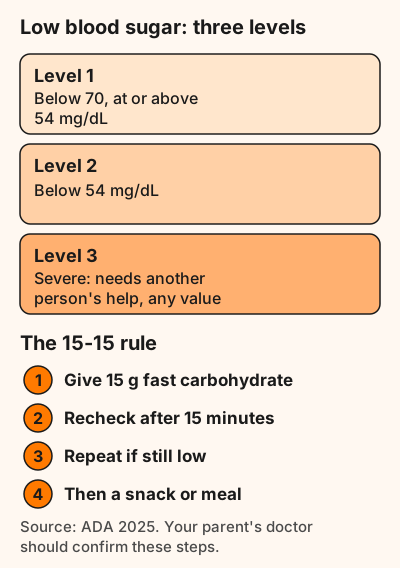
Low-sugar levels and the 15-15 rule (ADA). Your parent's doctor should confirm the steps.[2]
Signs a helper should know
Common signs are hunger, sweating, shaking, dizziness, tingling lips, a racing heart, blurred vision, irritability and confusion. Severe cases can bring a seizure or loss of consciousness.[24] Parents on sulfonylureas or meglitinides (types of tablet that push the body to make more insulin) or on insulin are at higher risk. The ADA says low-sugar episodes should be asked about and addressed at routine visits.[1] So tell the doctor about every episode, even a mild one.
What to do
Your parent's doctor should confirm the exact steps for your parent. As general first aid, if your parent is awake and can swallow:
- Give 15 g of fast-acting carbohydrate, for example glucose tablets.[2] The NHS also names fruit juice and glucose gel.[24]
- Recheck after about 15 minutes, and repeat if still low.[2] The NHS says to recheck after 10 to 15 minutes.[24]
- Once recovered, follow with a longer-acting snack or meal.[24]
Glucose tablet packs differ, so follow the grams printed on the label. A "small glass of juice" is not a precise amount, so ask the doctor to write down the exact home option for your parent. Our coaches suggest keeping glucose tablets at home and at the bedside, and asking the doctor in advance whether a household option such as sugar in water is acceptable if tablets run out.
Call emergency services if your parent is unconscious or not responding and glucagon is not available.[24] Glucagon is an emergency medicine that raises blood sugar. The ADA says family and caregivers should know where it is kept and how to give it, if it has been prescribed.[2]
Who calls whom in India
India's single emergency number is 112, run through state emergency response centres, according to a 2020 government release.[30] Ask your local helper to confirm which number works in your parent's town, and note any local ambulance number too. Our coaches suggest agreeing three things in advance: who makes the call, which hospital to go to (ideally where your parent's records are), and who goes along. Keep the card from section 2 in the bag.
Why this matters beyond the moment
In one US cohort of 16,667 people with type 2 diabetes (mean age 65), severe lows that needed hospital care were linked with a higher risk of dementia. This is an association and does not prove cause.[19] It is a good reason to treat lows seriously.
5. Red flags: when to call the doctor or go to hospital
Use this as a guide, not a diagnosis. When in doubt, call the doctor or go to the nearest hospital.
Emergency: go to hospital or call an ambulance
- Unconscious, seizure or not responding.[24]
- Chest pain, sudden breathlessness, or signs of a stroke such as a drooping face, a weak arm or slurred speech. These are general emergency warning signs, not specific to diabetes.
- High sugar with vomiting or stomach pain, fast breathing, drowsiness, fruity-smelling breath or confusion.[25]
- Unable to keep fluids down when unwell.[26]
- A serious infection, such as gastroenteritis or an infection needing IV antibiotics, or a sudden worsening of an organ problem. Indian physicians list these as needing in-person or emergency care.[17]
Urgent: see a doctor without delay
- An open foot sore, or a foot that is swollen, red or warm. The ADA says such feet should be referred urgently to a foot care specialist.[4]
See the doctor soon
- Strong thirst, passing urine often, tiredness, blurred vision or unexplained weight loss.[25]
- Repeated low-sugar episodes, including unexplained lows at night. Our coaches suggest telling the doctor at once, since the treatment may need review. The ADA says to ask about and address low sugar at routine visits.[1]
- A new foot blister or colour change. Our coaches suggest reporting this early, before it becomes a sore.
Routine: mention at the next visit and keep a note in the weekly sheet.
Sick-day rules in one line each
These come from Diabetes UK. If your parent uses insulin, or has other health problems, ask the doctor for an individual sick-day plan.
- Keep taking diabetes medicines even if not eating, unless the doctor says otherwise.[26]
- If testing at home, check sugar at least every 4 hours, including overnight, or as advised.[26]
- Drink plenty of sugar-free fluids.[26]
- Some newer diabetes tablets (SGLT2 inhibitors) may need a temporary stop during illness, so call the care team.[26]
Ask the doctor or pharmacist how to store insulin, how to adjust it when unwell, and what to do about travel and heat. Do not guess.
6. Food your parents will actually eat, and moving a little
Start with one kind change at a time. The ADA's plate method is half non-starchy vegetables, one quarter protein and one quarter carbohydrate foods.[8] The ADA also says there is no ideal split of carbohydrate, protein and fat, and plans should be individualised. Medical nutrition therapy from a registered dietitian is linked to A1C falls of 0.3 to 2.0% in type 2 diabetes.[8] The WHO advises adults to eat less than 5 g of salt a day, just under a teaspoon.[28]
Gentle swaps
Our coaches suggest these swaps. They are ideas to try with the doctor's agreement, not a diet plan:
- A smaller katori (small steel bowl) of rice, with more pappu (lentil dal) and vegetables.
- Ragi (finger millet) or jonna rotte (sorghum flatbread) on some days instead of rice. Millets are still carbohydrate, so keep the portion modest.
- Curd or buttermilk instead of sweet drinks.
- Less sugar in tea, cut a little every week.
- Go easy on pickle and papad (a thin fried or roasted lentil wafer), which are salty.
One sample day
This is our coaches' example of a plate for a parent on tablets, not a prescription. Portions depend on your parent's size, activity, medicines and the doctor's advice.
| Meal | Example |
|---|---|
| Breakfast | 2 small pesarattu (green gram dosa) with a spoon of chutney |
| Lunch | Half the plate vegetables or salad, 1 katori cooked rice or 2 phulkas (thin oil-free roti), 1 katori pappu, a small bowl of curd |
| Evening | Tea with less sugar, and a handful of roasted chana (chickpeas) |
| Dinner | 1 or 2 phulkas or a ragi roti, a vegetable curry, a small katori of dal |
Festivals and family functions
Our coaches suggest not banning sweets, since a ban often backfires. Instead, one small piece after a meal rather than on an empty stomach, normal medicine timings, and a sugar check before and after if your parent tests at home. Ask the doctor before any festival or religious fast, especially if your parent takes insulin or sulfonylureas. Alcohol can also cause low sugar with some medicines, so ask the doctor about it.
For more, read our diabetes diet chart for Indians, the Telugu diabetes diet chart, is rice good for diabetes? and best Indian breakfasts for diabetes. Please do not start a strict diet or fasting for a parent who takes insulin or sulfonylureas without the doctor.
Herbal remedies, supplements and kidney function
Families often suggest karela, methi, ayurvedic powders or "sugar cure" supplements. We have no evidence to cite that these are safe alongside diabetes tablets. Some may affect sugar levels or interact with medicines, so our coaches suggest your parent tells the doctor or pharmacist before taking any of them. Also ask the doctor whether your parent's kidney function affects medicine doses or the sick-day plan.
Walking and light movement
For adults, the ADA advises 150 minutes or more a week of moderate-to-vigorous activity over at least 3 days.[8] The WHO says activity in short bouts counts toward the weekly target.[29] A short walk after meals is an easy start. If your parent has foot problems or a heart condition, ask the doctor before starting anything new.
7. Talk about food and checks without a fight
In a mixed-methods study (focus groups with 45 adults and a survey of 61 adults with type 2 diabetes), nonsupportive family behaviour was linked with lower medicine adherence.[15] A review of 26 studies of family-based interventions found that family involvement improved knowledge, perceived support, self-efficacy and self-care. Effects on HbA1c were hard to judge because the studies differed so much.[13] A review of 22 studies linked family support with healthier diet and better control in people with uncontrolled type 2 diabetes.[14]
Scripts our coaches suggest:
- Ask "What was hardest this week?" instead of "Did you take your tablets?"
- Praise one small thing, like a walk or a skipped sweet.
- Offer to book the appointment yourself, so the parent does not have to chase it.
- Keep one call a week for health. Keep the other calls for family news and jokes.
The ADA says the person, their family and the care team should make the plan together.[3] Your parent has the final say on their own life. If a rule feels imposed, it will not last.
8. Remote tools: telemedicine and CGM
Several meta-analyses (studies that pool many trials) found small average HbA1c falls with remote support compared with usual care. The designs and follow-up times differ, so the bars are not directly comparable.
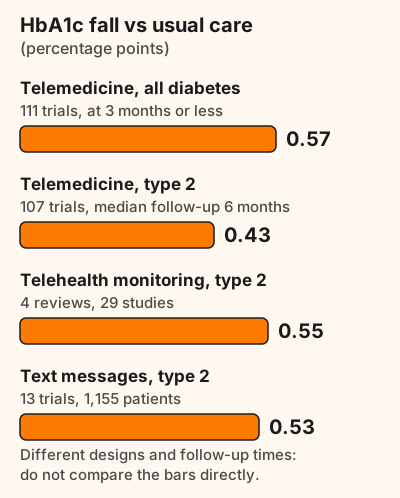
Average HbA1c fall versus usual care in four reviews: telemedicine in all diabetes (111 trials, 23,648 adults; at 3 months or less), telemedicine in type 2 (107 trials, 20,501 adults), telehealth monitoring in type 2 (a pooled analysis of four reviews covering 29 studies) and brief text messages in type 2 (13 trials, 1,155 patients). Not a promise for any one person.[9][10][11][12]
The limits are real. The largest review found no convincing effect on quality of life, deaths or low sugar, and the effect shrank over time.[9] This evidence is not specific to older Indian parents.
India's 2020 telemedicine guidelines, as summarised in a 2020 commentary by Indian physicians, allow a caregiver to start a consult with the patient's consent and allow minor dose changes in a tele-follow-up. For new cases, starting insulin needs a face-to-face visit. The same paper notes that elderly or less tech-savvy patients may struggle with platforms, and that a physical exam cannot be done online.[17] Rules may have changed since 2020, so check with the clinic.
Does your parent need a CGM?
A CGM (continuous glucose monitor) is a small sensor worn on the body that reads glucose all day. The ADA recommends CGM for adults on insulin. For adults with type 2 diabetes on non-insulin medicines, it says CGM may be used based on circumstances and preference.[6] Only the doctor decides whether your parent needs one. Please do not buy a device and ship it without the doctor's advice.
9. Practical logistics for NRI children
These are our coaches' practical tips, not medical guidance.
- Medicines: note each refill date on the shared calendar and keep about a month of buffer. Ask the doctor or pharmacist before switching to a generic version of any tablet.
- Glucometer strips: check the stock when you do the weekly call. Strips and lancets run out quietly.
- Insurance: find out what your parent's health policy covers, which hospitals offer cashless treatment, and where the policy papers are.
- Reports: photograph every report and prescription and keep them in one shared folder, so any doctor can see the history.
- Consent and legal: if you may need to speak to doctors or hospitals for your parent, ask your parent about written consent. For money or legal decisions, speak to a lawyer about a power of attorney.
10. Start this week
- Build the medicine list with a photo of each strip, and share it with one local helper.
- Fix a day and time for a 10-minute weekly call, and use the check-in sheet.
- Write the card and fridge sheet: doctor, helper, nearest hospital, 112 and the low-sugar steps.
- Ask the doctor which tests are due and what the low-sugar plan should be, then book them in one month.
When local help is not enough
If your family is stretched, there are options: a family doctor who knows your parent well, a home-care service, a diabetes educator or an online dietitian. The ADA recommends extra self-management support from lay health coaches or navigators when available.[7] To understand why diabetes is common in our families, see our guide to diabetes risk in South Asians. If you live abroad and want Indian-food guidance, see our page on online Indian dietitians in the USA.
Flexcellence offers a Diabetes Management plan with a nutritionist and fitness coach in our app. It works alongside your parent's doctor and does not replace them. If you would like to talk it through, you can book a free 30-minute consultation. You can also try our free health calculators at /tools.
A short note on safety and sources: this article is general information, not medical advice or a treatment plan. It has not yet been reviewed by a named doctor or diabetes educator, and we will add the reviewer once that happens. Most test intervals and goals come from US (ADA) guidance, so Indian clinics may differ, and we did not use Indian society guidance (such as RSSDI or ICMR) for targets. Numbers come from the sources listed below and were checked on 12 November 2026. Last updated 12 November 2026.
Common questions
How can I help my parents with diabetes from the USA?
Build a simple system: one shared medicine list, a short weekly check-in, a named local helper, and booked doctor visits and tests. The ADA says telehealth should add to in-person visits, not replace them, and that caregivers are included in care teams and shared decisions based on the person's wishes.[^7] The doctor still decides medicines and targets.
How can NRIs manage elderly parents' diabetes in India?
Our coaches suggest four steps: name a local helper such as a relative, neighbour or clinic staff; keep a shared medicine list and reports folder; hold a weekly call; and write a low-sugar and emergency plan with the doctor, including which hospital to go to and who calls 112, India's single emergency number.[^30] Time the yearly check-ups for when you visit.
How often should my parent's HbA1c be checked?
The ADA (US guidance) says about twice a year when diabetes is stable and at goal, and about every 3 months when it is not at goal or treatment has changed.[^2] Indian clinics may differ. Your parent's doctor decides the actual schedule, so ask the clinic and note the dates on a shared calendar.
What should a helper do if my parent's sugar is low?
If your parent is awake and can swallow, give 15 g of fast-acting carbohydrate, such as glucose tablets, and recheck after about 15 minutes. Repeat if still low.[^2] The NHS also lists a small glass of fruit juice or a sugary fizzy drink.[^24] Never give food or drink to someone who is unconscious or cannot swallow. Call emergency services if your parent is unconscious or not responding and glucagon is not available.[^24] The doctor should confirm this plan.
Does telemedicine really help diabetes?
On average, a little. A meta-analysis of 111 trials (23,648 adults) found HbA1c fell by 0.57 points at 3 months or less and 0.26 beyond 12 months, compared with usual care.[^9] Other reviews found similar small gains.[^10][^11] Effects on quality of life, deaths or low sugar were not convincing.[^9] This evidence is not specific to older Indian parents.
Can I change my parent's medicine dose over a video call?
No. Dose changes are for your parent's doctor. India's 2020 telemedicine guidelines, as summarised by physicians, allow minor changes in a tele-follow-up with the treating doctor, according to a 2020 physician commentary rather than the guideline itself. For new cases, starting insulin needs an in-person visit.[^17] Rules may have been updated, so check with the clinic.
Which tests and exams should an older person with type 2 diabetes have each year?
The ADA (US guidance, so Indian clinics may differ) lists follow-up visits at least yearly, kidney tests (a urine test and a blood test) at least yearly, and a full foot exam at least yearly.[^3][^4][^5] If there is no eye damage and glucose is on target, an eye exam every 1 to 2 years may be considered. With any eye damage, it should be yearly.[^4] Your parent's doctor sets the plan.
Reviewed by
Not yet reviewed by a Flexcellence coach.
Sources
American Diabetes Association (Diabetes Care). 13. Older Adults: Standards of Care in Diabetes-2025 (2025).
American Diabetes Association (Diabetes Care). 6. Glycemic Goals and Hypoglycemia: Standards of Care in Diabetes-2025 (2025).
American Diabetes Association (Diabetes Care). 4. Comprehensive Medical Evaluation and Assessment of Comorbidities: Standards of Care in Diabetes-2025 (2025).
American Diabetes Association (Diabetes Care). 12. Retinopathy, Neuropathy, and Foot Care: Standards of Care in Diabetes-2025 (2025).
American Diabetes Association (Diabetes Care). 11. Chronic Kidney Disease and Risk Management: Standards of Care in Diabetes-2025 (2025).
American Diabetes Association (Diabetes Care). 7. Diabetes Technology: Standards of Care in Diabetes-2025 (2025).
American Diabetes Association (Diabetes Care). 1. Improving Care and Promoting Health in Populations: Standards of Care in Diabetes-2025 (2025).
American Diabetes Association (Diabetes Care). 5. Facilitating Positive Health Behaviors and Well-being to Improve Health Outcomes: Standards of Care in Diabetes-2025 (2025).
CMAJ (Faruque LI et al.). Effect of telemedicine on glycated hemoglobin in diabetes: a systematic review and meta-analysis of randomized trials (2017).
Scientific Reports (Lee SWH et al.). Comparative effectiveness of telemedicine strategies on type 2 diabetes management: A systematic review and network meta-analysis (2017).
BMC Health Services Research (Lee PA, Greenfield G, Pappas Y). The impact of telehealth remote patient monitoring on glycemic control in type 2 diabetes: a systematic review and meta-analysis of systematic reviews of randomised controlled trials (2018).
Journal of Medical Internet Research (Arambepola C et al.). The Impact of Automated Brief Messages Promoting Lifestyle Changes Delivered Via Mobile Devices to People with Type 2 Diabetes: A Systematic Literature Review and Meta-Analysis of Controlled Trials (2016).
Annals of the New York Academy of Sciences (Baig AA et al.). Family interventions to improve diabetes outcomes for adults (2015).
Behavioral Sciences (Pamungkas RA et al.). A Systematic Review: Family Support Integrated with Diabetes Self-Management among Uncontrolled Type II Diabetes Mellitus Patients (2017).
Diabetes Care (Mayberry LS, Osborn CY). Family Support, Medication Adherence, and Glycemic Control Among Adults With Type 2 Diabetes (2012).
Journal of Gerontological Social Work (Cagle JG, Munn JC). Long-Distance Caregiving: A Systematic Review of the Literature (2012).
Diabetes & Metabolic Syndrome: Clinical Research & Reviews (Ghosh A, Gupta R, Misra A). Telemedicine for diabetes care in India during COVID19 pandemic and national lockdown period: Guidelines for physicians (2020).
JAMA (Whitmer RA et al.). Hypoglycemic Episodes and Risk of Dementia in Older Patients With Type 2 Diabetes Mellitus (2009).
The Lancet Diabetes & Endocrinology (ICMR-INDIAB; Anjana RM et al.). Metabolic non-communicable disease health report of India: the ICMR-INDIAB national cross-sectional study (ICMR-INDIAB-17) (2023).
World Health Organization. Diabetes (fact sheet) (2026).
NHS (UK). Low blood sugar (hypoglycaemia) (2023).
NHS (UK). High blood sugar (hyperglycaemia) (2026).
Diabetes UK. Managing diabetes when you're unwell (sick day rules) (2025).
World Health Organization. Salt reduction (fact sheet) (2026).
British Journal of Sports Medicine / World Health Organization. World Health Organization 2020 guidelines on physical activity and sedentary behaviour (2020).
Press Information Bureau, Government of India. Status of implementation of Emergency Response Support System (ERSS) (2020).