Online Indian Dietitian in the USA: 5 Checks to Make
Choosing an online Indian dietitian in the USA: credential, state licence, Telugu and Indian food skill, IST/EST hours, cost and red flags.
The short answer
Check five things: a credential you can verify, a licence valid in your US state, real skill with Indian food, hours that suit you, and a clear total cost. Our coaches suggest a US-licensed dietitian for diabetes or kidney care, and an India-based coach for daily food habits.
On this page
Your insurer lists a dietitian who says "just eat more vegetables" and has never heard of pappu (dal, usually toor dal) or ragi mudde (a ball of finger millet). The coach you trust is asleep when your lunch break starts. This guide gives you five checks for finding an online Indian dietitian or Indian nutritionist in the USA, plus a fair view of where each type of provider fits.
Flexcellence is an India-based coaching service and one of the options we describe; facts about our own service are company information, not independently checked. This is general education, not medical advice. If weight is already creeping up after a move, see why many Indians gain weight after moving to the USA.
Words used here: RDN is the registered dietitian nutritionist, the US credential. IST is India Standard Time. A katori is a small bowl, about 150 ml (this is the size our coaches use). Patel Brothers is an Indian grocery chain in the US. Medical nutrition therapy (MNT) means diet treatment for a medical condition, given by a qualified professional. Tadka is spices fried in hot oil and added to dal. Upma is a semolina porridge. Kura is a vegetable curry. Sabzi is a dry vegetable dish. Phulka is a thin roti cooked without oil. Roasted chana is dry-roasted chickpeas.
Dietitian, nutritionist or coach: who can help with what {#dietitian-nutritionist-coach}
In the US, "RD" or "RDN" is a registered credential kept by the Commission on Dietetic Registration (CDR). Since 1 January 2024, a graduate degree is needed to become eligible for the exam for the first time. People who were already registered are exempt.[15] The Academy of Nutrition and Dietetics has a public directory where you can search by location, specialty, language, and insurance or payment options.[17]
A credential is not the same as a licence. Most US states require a state licence or certification to practise or use a protected title, and the rules vary by state. In some states only licensed people may give medical nutrition therapy, while general nutrition education may not need a licence.[31] Because rules differ, ask any provider what their qualification is and how you can check it.
India has its own system. The Indian Dietetic Association runs India's Registered Dietitian exam.[27] That is a different credential from the US RD/RDN.
Our coaches suggest a simple rule of thumb. If you have a medical condition that needs treatment, such as diabetes, use a licensed US dietitian and keep your doctor in the loop. If you want help with daily food habits next to your doctor's care, a coach can fit. This is our view, not a study result.
The five checks at a glance {#five-checks}
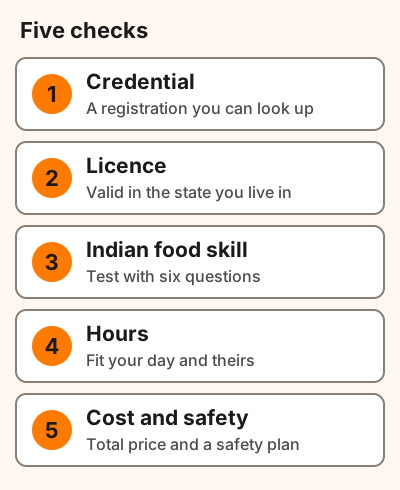
Figure 1. The five checks in this guide. This is our own checklist, built from the sources cited below.
- A credential you can look up.
- A licence that is valid where you live.
- Real skill with Indian and Telugu food.
- Hours that fit your day and theirs.
- A clear total cost and a safety plan.
Checks 1 and 2: credential and licence for telehealth in your state {#check-credential-licence}
How to check. Ask for the full name and credential, then look the person up in the Academy directory.[17] Ask for the state licence number too, and check it with your state licensing board. The CDR guidance points to a map where boards are listed.[31]
Where you live matters. According to CDR, the legal status of telehealth across state lines is generally decided by where the client is located. Some states let a provider who is licensed in at least one state treat you. Others need a licence in your state. CDR and the Academy recommend holding a licence in every state where clients are located, unless an exemption applies or the state has no requirement.[31] So ask the provider, in writing, how they are allowed to work with a client in your state.
This means you should not assume that someone licensed only in India may treat you as a patient in your state. Your state's rules decide, and we cannot give legal advice. If in doubt, ask your state board.
Insurance. Some insurers and Medicaid programmes require the RD credential or a state licence before they pay.[31] Medicare covers medical nutrition therapy for people with diabetes or kidney disease, or a kidney transplant in the last 36 months. A doctor must refer you, and the service comes from a registered dietitian or another qualified nutrition professional. You get 3 hours in the first calendar year, then 2 hours of follow-up in later years, but only if a change in your medical condition requires a diet change and your doctor refers you.[18] If you are under 65 with an employer plan, check with your insurer. Our coaches suggest asking before you book, not after.
Check 3: Indian nutritionist or Telugu dietitian in the USA? A 6-question test {#check-indian-food}
Why it matters
Culturally appropriate education helped blood sugar control (HbA1c, the 3-month average) and diabetes knowledge in ethnic minority groups for up to 24 months compared with usual care. This was an updated Cochrane review, and 28 trials had data for the pooled results.[9] A review of type 2 diabetes management in South Asians found that a language and communication mismatch with the provider was a significant barrier.[14] The American Diabetes Association says diabetes education should be culturally appropriate.[7] The US NIDDK tells you to ask whether staff are trained for different cultural backgrounds, and whether the plan changes for cultural foods.[22]
An honest limit. In the SAHELI trial, 549 South Asian adults in the Chicago area joined a 16-week programme adapted to their culture, run in English, Gujarati, Hindi and Urdu. At 12 months, weight and HbA1c were not significantly different from those of people given written materials.[12] Cultural tailoring helps, but it is not a guarantee. Look for follow-up, not only a menu in your language.
The six questions
These are our test, not a validated tool.
- "Which food tables do you use for Indian dishes?" A good answer names the Indian Food Composition Tables from ICMR-NIN, which cover 528 key foods and 151 food components,[28] or a similar reference, not only a US app database.
- "How would you count a katori of kandi pappu (toor dal), a dosa (thin fermented crepe) or a ragi mudde in my plan?" This tests portion sense for regional food. For reference, the tables list red gram dal (kandi pappu) at about 331 kcal and 21.7 g protein per 100 g raw.[28]
- "Can you work with a vegetarian or egg-eating plan, and with fasting days, festivals and weddings?"
- "Do you ask how I cook at home and what I can buy in the US?" Our list of Indian groceries to buy in the US can help here.
- "Do you speak Telugu, Hindi or the language I think in?" The Academy directory lets you filter by language.[17]
- "Do you use the ICMR My Plate idea or another method, and why?" ICMR gives My Plate as a general pattern for about 2,000 kcal a day: 250 g cereals including millets, 85 g pulses, 300 ml milk or curd, 400 g vegetables and greens, 100 g fruit, 35 g nuts and seeds, and 27 g fats and oils, in raw weights.[29] It is a starting point, so a good provider adjusts it for you.
Dishes to test them on
Here is how those questions look with common Andhra and Telangana food. These are our coaches' prompts, not rules:
| Dish | What it is | What a good provider should ask or know |
|---|---|---|
| Pesarattu | Green gram dosa | How many you eat, and what goes with it (ginger chutney, upma) |
| Pappu with kura | Dal with a vegetable curry | Dal quantity, oil in the tadka, and how much vegetable you really eat |
| Perugu or majjiga | Curd, or thin spiced buttermilk | Whether curd or buttermilk is part of the daily meals |
| Gongura | Sorrel leaves, a sour green | Our coaches' observation: it is often cooked with oil and salt, so ask about both |
| Ragi mudde | Finger-millet ball | Size of the ball, and what you eat it with |
| Pulihora | Tamarind rice | Portion, and whether it is a festival dish or a daily lunch |
| Sambar and phulka | Lentil-vegetable stew with thin oil-free roti | How many phulkas, and how much sambar versus rice |
One day on a US-adapted Telugu plate (example)
This is our coaches' example of how a provider might think, not a prescription and not cited research. Quantities depend on you.
- Breakfast: pesarattu with ginger chutney, or oats upma with vegetables, plus a cup of curd.
- Lunch: one katori of cooked rice or a ragi mudde, a katori of pappu, a larger katori of vegetable kura, and a salad. In the US, frozen green beans, spinach or bottle gourd from an Indian store can stand in for fresh Indian vegetables.
- Snack: roasted chana or a fruit, and buttermilk.
- Dinner: two phulkas with sambar and a vegetable, or dal and sabzi with a small portion of rice.
A good provider would also ask what you really eat at work lunches and on weekends, and build the plan around that.
Why South Asian context matters
In the US NHANES survey of 2011 to 2016, diabetes was found in about 23.3% of South Asian adults (95% confidence interval 15.6% to 30.9%, a wide range because the sample was small), compared with 12.1% of non-Hispanic white adults. The figures are adjusted so that age and sex are comparable.[24] The American Diabetes Association suggests testing adults with overweight who have another risk factor, from a BMI of 23 in people of Asian ancestry.[8] Read more in our guide on South Asian diabetes risk.
Food drift in the US
In the MASALA study of 874 South Asian adults, longer residence in the US went with less fibre, beans and lentils, and rice, and with more fat and mixed dishes such as pizza and pasta. This was a one-time snapshot survey, so it shows a link, not a cause.[25] A good dietitian helps you keep the dal-and-vegetable base of your meals. They should not just tell you to "eat American".
Check 4: IST, EST and PST hours {#check-time-zones}
IST is a fixed offset of UTC+05:30.[32] In the US, daylight saving time in 2026 runs from 8 March to 1 November, so the gap with India changes by one hour twice a year.[19]
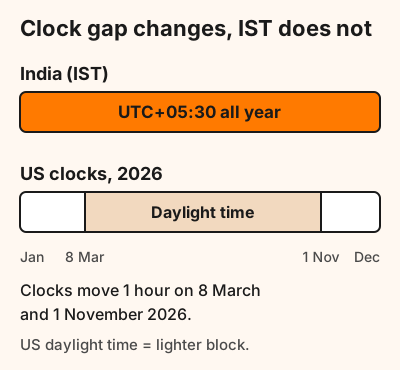
Figure 2. IST is fixed at UTC+05:30; US daylight saving time in 2026 runs from 8 March to 1 November.[32][19]
Here is an example of how a slot maps. It is simple arithmetic from the standard offsets (IST is UTC+05:30, US Eastern is UTC-5 in winter and UTC-4 in daylight time, US Pacific is UTC-8 and UTC-7). It is an example only, and it shifts with daylight saving:
| IST slot | US Eastern, winter (EST) | US Eastern, daylight time (EDT) | US Pacific, daylight time (PDT) |
|---|---|---|---|
| 8:00 pm | 9:30 am | 10:30 am | 7:30 am |
| 9:00 pm | 10:30 am | 11:30 am | 8:30 am |
| 6:30 am | 8:00 pm (previous day) | 9:00 pm (previous day) | 6:00 pm (previous day) |
For your own city and date, use a time converter, especially in the weeks around the March and November clock changes.
Our coaches suggest some practical points. A US evening is often early morning in India. Weekday lunch hours and Sunday afternoons in the US are often easier. Ask what days and hours the provider works, whether WhatsApp or app chat replies reach you in your daytime, and what happens during the clock changes.
For a sense of what a US telehealth session looks like, a survey of 2,016 US RDNs in April and May 2020 found that telehealth use rose from 37% to 78%. The median direct contact time per session was 30 minutes, and scheduling flexibility was named as a benefit by 50%.[20] That describes how care was delivered then. It does not say which format is best.
Check 5: total cost, what is included and safety {#check-cost-safety}
The NIDDK suggests asking about staff credentials, training and experience. Ask what is included: a meal plan or food log, changes for cultural foods and allergies, one-on-one or group sessions, and a maintenance plan. Ask for the total cost from start to finish. Also ask how safety is monitored and whether staff work with your own doctor.[22]
Prices differ a lot between US dietitians, insurers and India-based services, so we do not quote ranges. The usual pricing models are a fee per session, a package of sessions, a monthly plan, or an insurance copay. Ask for the full cost, how many sessions it covers, and what can be billed to insurance. If you pay in rupees to an India-based service, ask your insurer whether they reimburse it. Do not assume they will.
Red flags. The NIDDK lists very fast weight loss (its example is 30 pounds, about 13.6 kg, in a month), claims that you can eat anything, spot reduction of fat, and before-and-after photos that look too good to be true.[22] Our coaches add a few of their own: a provider who tells you to stop a medicine, one who makes supplements the main plan, or one who will not tell you how to check their licence.
US RDN, India-based coach, or an app? A fair comparison {#which-option}
This table is our own view, written to help you choose. It is not a ranking, and each option can be right for a different person. Flexcellence details are company information.
| US-licensed RDN (telehealth) | India-based nutrition coach on IST hours (for example Flexcellence) | Calorie or diet app | |
|---|---|---|---|
| Credential you can verify in the US | Yes, through the registry and your state board[16][31] | Certified coaches; not a US credential | Not applicable |
| Can bill US insurance | Often, depending on the plan[31] | Usually not; ask | Usually not |
| Medical nutrition therapy for diabetes or kidney disease | Yes[7][18] | No | No |
| Indian and Telugu food depth | Varies, so test with the six questions | Plans built on Indian food; test with the six questions | Varies |
| Hours | Usually US hours | IST; free call is on WhatsApp in IST | Any time |
| Follow-up | Depends on the provider | Weekly check-ins and app chat | Self-driven |
| Cost | Varies, so ask | Varies, so ask | Varies, so ask |
| Best when | You need treatment, referral or insurance cover | You want daily-habit support next to your doctor's care | You want to track on your own |
If you have diabetes or kidney disease, see your doctor and ask for a referral to a US-licensed dietitian. The American Diabetes Association recommends individualised medical nutrition therapy from an RDN for type 1, type 2, prediabetes and gestational diabetes (its strongest evidence grade, A).[7] Medicare covers MNT for diabetes and kidney disease with a doctor's referral.[18] Coaching can sit alongside that care, but it does not replace it.
A coach based in India is not a licensed US clinician. Our coaches say a coach should never advise you to change diabetes medicine, and you should not rely on an India-based service for a pregnancy complication. Those go to your own doctor.
What research says about remote and tailored nutrition care {#what-research-says}
The short picture: remote and tailored care can help, but average gains are modest. Most of these studies are about telehealth or coaching in general, not specifically about dietitians.
- Remote support. The POWER trial followed 415 US adults with obesity and at least one heart risk factor (63.6% women) for 24 months. Average weight change was -0.8 kg with self-directed care, -4.6 kg with remote-only support, and -5.1 kg with in-person plus remote support. Weight loss of at least 5% of starting weight was reached by 18.8%, 38.2% and 41.4% of people, in the same order. The remote support was by phone, website and email, not video visits with a dietitian.[4]
- Telehealth diet education. A review of 25 trials with 7,384 adults with chronic disease found about 1.04 more servings of fruit and vegetables a day, 2.97 mm Hg lower systolic blood pressure, and weight 0.80 kg lower (a borderline result that was only just statistically significant). Total fat and energy intake were not improved.[1] A Dietitians Australia position statement says telehealth-delivered dietetic care can have outcomes comparable to in-person care. That is an expert statement, not a new trial.[21]
- Diabetes. Across 111 trials with 23,648 people with diabetes, telemedicine lowered HbA1c by 0.57 percentage points at 3 months or less, 0.28 at 4 to 12 months and 0.26 beyond 12 months, compared with usual care. The gain is modest and shrinks over time. The same review found no convincing effect on quality of life.[3] A Cochrane review of 16 diabetes studies with 2,768 people, covering telemedicine in general, found HbA1c 0.31 percentage points lower.[2]
- Dietitian consultations. Combining 5 studies with 1,598 adults, one-to-one dietitian consultations led to 1.03 kg more weight loss than minimal or usual care, but the studies had weaknesses that make the result less certain.[5] In a review of 26 trials in primary care, 18 showed significant improvements in diet, body measures or clinical markers. None of the 3 trials that looked at blood pressure did.[6]
- South Asian programmes. A review of 24 trials in people of South Asian heritage found that, among the diabetes-prevention trials, people lost an extra 0.65 kg with lifestyle advice alone and 1.13 kg with supervised physical activity added, compared with control groups. It found no significant change in HbA1c, and its authors judged the impact modest and unlikely to reduce diabetes incidence.[11] With the SAHELI result above, the lesson is that average effects are modest. We make no promise of weight loss for any reader.
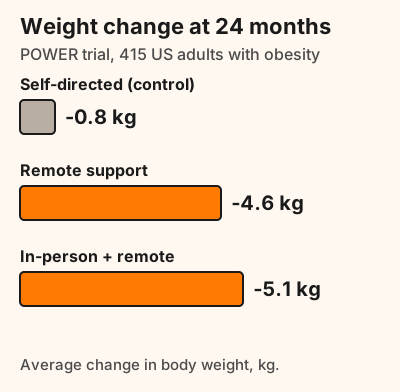
Figure 3. Average weight change at 24 months in the POWER trial of 415 US adults with obesity.[4]
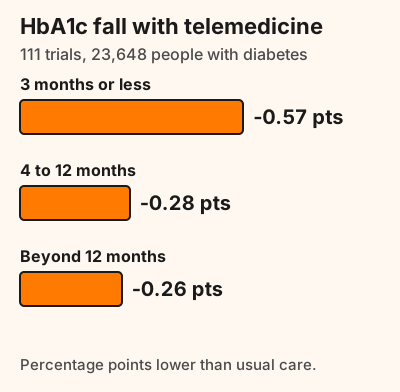
Figure 4. HbA1c change (percentage points) versus usual care with telemedicine in diabetes, 111 trials with 23,648 people.[3]
See your doctor if... {#see-your-doctor}
- You have diabetes, prediabetes or kidney disease, are pregnant or breastfeeding, or take medicines that may need to change when your food changes. Talk to your doctor first. Our coaches suggest asking for a referral to a US-licensed dietitian where insurance applies.[7][18] If you are arranging this for parents, see our guide on diabetes care for parents from abroad.
- You use insulin or a tablet such as a sulfonylurea, or you have kidney disease with protein or potassium limits. Changing food can change your blood sugar or your limits, so talk to your doctor before you change what you eat. This is our coaches' safety advice.
- You have had an eating disorder, or you are making food rules out of fear. A coach is not the right person for this. See your doctor.
- It is for a child or teenager. Ask your child's doctor first.
- You faint, feel very weak or confused, or your glucose readings are very high or very low. Contact your doctor or urgent care at once and do not wait for a coaching session.
- You are of South Asian ancestry with a BMI of 23 or more and another risk factor, or you are 35 or older and have never been tested. Ask for a diabetes test.[8]
- You keep losing weight without changing your diet or exercise, or weight loss comes with other symptoms.[30]
- A provider asks you to stop a prescribed medicine, promises a fixed result, or cannot show you a credential. Stop and check before going on.[22]
Before your first session: what to bring {#first-session}
Our coaches suggest bringing:
- A week of your normal meals (photos are fine).
- Recent lab reports and your medicine list.
- Your usual wake and sleep times in both time zones.
- Where you shop: Patel Brothers, Costco, an Indian store or a farmer's market.
- Who cooks at home, and any festivals or fasts coming up.
- Your top two goals.
For what a free first call usually covers, see our guide to the online dietitian consultation.
Next step
Recap: check that the credential can be looked up and the licence is valid in your state; test Indian and Telugu food skill with the six questions; confirm hours across IST and US time, the total cost, and who watches your safety.
Want a plan built on your own Indian food, with a coach on IST hours? You can book a free 30-minute consultation. The call is on WhatsApp, in IST. We are not a US dietitian practice, and your doctor leads for medical care.
Common questions
What is the difference between a dietitian and a nutritionist in the USA?
An RD or RDN is a registered credential kept by the Commission on Dietetic Registration. State rules on licences and titles vary, so ask any provider what their qualification is and how you can check it.
Can an Indian dietitian in India treat me online if I live in the USA?
The rules depend on the state where you live, because the Commission on Dietetic Registration says telehealth is generally decided by the client's location. Ask the provider in writing. Our coaches suggest a US-licensed dietitian for medical treatment.
Will US health insurance pay for an online dietitian?
Medicare covers medical nutrition therapy for diabetes or kidney disease with a doctor's referral. Other insurers vary, so ask before you book.
How much does an online Indian dietitian cost?
We do not quote prices, because they differ a lot. Common ways to pay are per session, a package of sessions, or an insurance copay. The US NIDDK advises asking for the total cost from start to finish and what it includes. Ask your insurer separately what it will pay.
How do I book across IST and US time zones?
India uses one fixed time, UTC+05:30, while US clocks move one hour in March and November. Use a time converter for your city and the exact date, and ask which hours the provider works.
How can I tell if a dietitian really understands Indian and Telugu food?
Ask which food tables they use, how they would count a katori of dal or a ragi mudde, and whether they speak your language. The Indian Food Composition Tables and the ICMR My Plate are Indian references to ask about.
Does online dietitian care work as well as visiting in person?
The POWER trial tested remote coaching by phone, website and email, not video visits with a dietitian, in 415 US adults with obesity. Its remote arm lost weight close to the in-person arm. Reviews of telehealth in general find modest gains that can shrink over time.
Reviewed by
Not yet reviewed by a Flexcellence coach.
Sources
The American Journal of Clinical Nutrition (Kelly JT et al.). Telehealth methods to deliver dietary interventions in adults with chronic disease: a systematic review and meta-analysis (2016).
Cochrane Database of Systematic Reviews (Flodgren G et al.). Interactive telemedicine: effects on professional practice and health care outcomes (2015).
CMAJ (Faruque LI et al.). Effect of telemedicine on glycated hemoglobin in diabetes: a systematic review and meta-analysis of randomized trials (2017).
New England Journal of Medicine (Appel LJ et al., POWER trial). Comparative effectiveness of weight-loss interventions in clinical practice (2011).
Healthcare (Basel) (Williams LT et al.). How Effective Are Dietitians in Weight Management? A Systematic Review and Meta-Analysis of Randomized Controlled Trials (2019).
Journal of the Academy of Nutrition and Dietetics (Mitchell LJ et al.). Effectiveness of Dietetic Consultations in Primary Health Care: A Systematic Review of Randomized Controlled Trials (2017).
American Diabetes Association (Diabetes Care). 5. Facilitating Positive Health Behaviors and Well-being to Improve Health Outcomes: Standards of Care in Diabetes-2025 (2025).
American Diabetes Association (Diabetes Care). 2. Diagnosis and Classification of Diabetes: Standards of Care in Diabetes-2025 (2025).
Diabetic Medicine (Creamer J, Attridge M, Ramsden M, Cannings-John R, Hawthorne K). Culturally appropriate health education for Type 2 diabetes in ethnic minority groups: an updated Cochrane Review of randomized controlled trials (2016).
Journal of Human Nutrition and Dietetics (Farhat G et al.). Effectiveness of lifestyle interventions/culturally bespoke programmes in South Asian ethnic groups targeting weight loss for prevention and/or remission of type 2 diabetes: a systematic review and meta-analysis of intervention trials (2024).
JAMA Cardiology (Kandula NR et al., SAHELI trial). Culturally Adapted Lifestyle Intervention for South Asian Adults With Cardiovascular Risk Factors: The SAHELI Randomized Clinical Trial (2024).
PLoS One (Sohal T, Sohal P, King-Shier KM, Khan NA). Barriers and Facilitators for Type-2 Diabetes Management in South Asians: A Systematic Review (2015).
Commission on Dietetic Registration (USA). Graduate Degree Requirement for the Registration Examination for Dietitians (2024).
Commission on Dietetic Registration (USA). Registry Statistics (2026).
Academy of Nutrition and Dietetics. Find a Nutrition Expert (directory) (2026).
Medicare.gov (US Centers for Medicare & Medicaid Services). Medical nutrition therapy services (2026).
US National Institute of Standards and Technology (NIST). Daylight Saving Time (DST) (2026).
Journal of the Academy of Nutrition and Dietetics (Rozga M et al.). Telehealth During the COVID-19 Pandemic: A Cross-Sectional Survey of Registered Dietitian Nutritionists (2021).
Nutrition & Dietetics (Kelly JT et al., Dietitians Australia). Dietitians Australia position statement on telehealth (2020).
US National Institute of Diabetes and Digestive and Kidney Diseases (NIDDK). Choosing a Safe & Successful Weight-loss Program (2025).
JAMA (Cheng YJ et al., CDC). Prevalence of Diabetes by Race and Ethnicity in the United States, 2011-2016 (2019).
Public Health Nutrition (Talegawkar SA et al.; MASALA study). Dietary intakes among South Asian adults differ by length of residence in the USA (2016).
Indian Dietetic Association (IDA). RD Eligibility (Registered Dietitian examination) (2026).
ICMR-National Institute of Nutrition (Longvah T et al.). Indian Food Composition Tables 2017 (2017).
ICMR-National Institute of Nutrition, Hyderabad. Dietary Guidelines for Indians 2024 (incl. My Plate for the Day) (2024).
NHS (UK). Unintentional weight loss (2024).
Commission on Dietetic Registration (USA). Practice Tips: CDR Certification vs State Licensure: What is the Difference? (2025).
Press Information Bureau, Government of India. Department of Consumer Affairs notifies Draft Legal Metrology (Indian Standard Time) Rules, 2025 (2025).