Prediabetes Diet Chart for Indians: 7-Day Plan
A South Indian prediabetes diet chart: foods, measured GI of idli and dosa, a 7-day vegetarian plan and red flags. Check with your doctor first.
The short answer
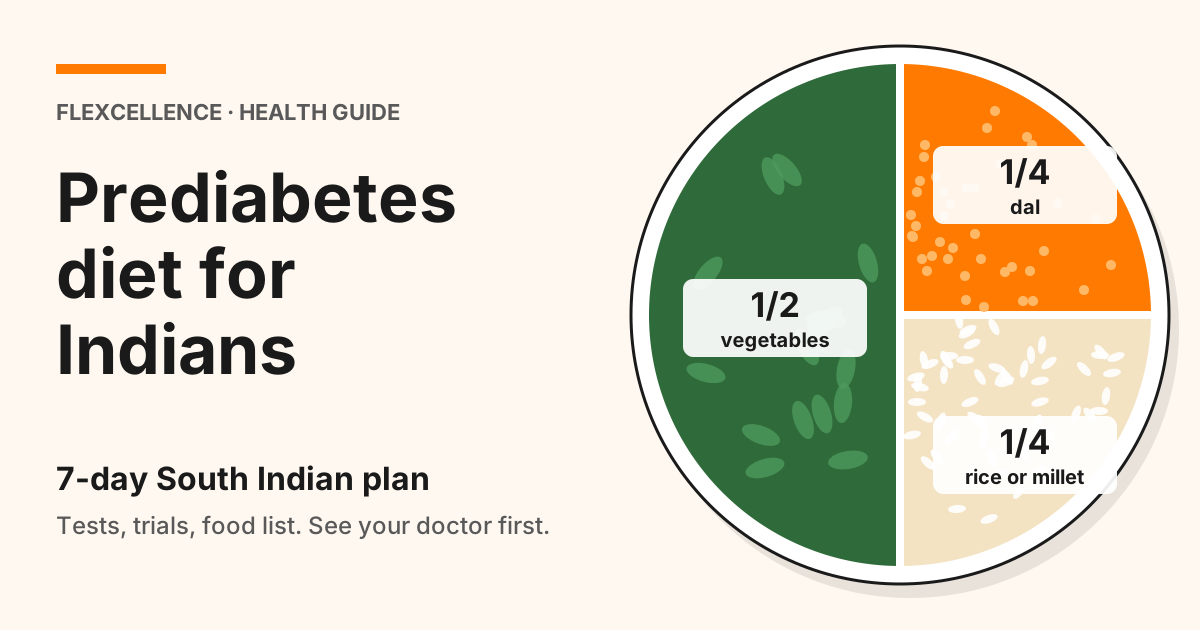
For prediabetes, our coaches suggest half the plate vegetables, a quarter dal or another protein, a quarter rice, millet or roti, fewer sweet drinks, and walking. Prediabetes means blood sugar above normal but below the diabetes range (HbA1c 5.7 to 6.4%). In trials, diet and activity changes lowered later diabetes risk. Confirm your plan with your doctor.
Work out your own numbers
Screen metabolic risk using waist-to-height ratio thresholds.
Free, takes a minute, and uses the same formulas our coaches use.
Open the Waist-to-Height Ratio CalculatorOn this page
If your health-check report says "prediabetes", the first question is usually what to eat tomorrow. This guide gives a prediabetes diet for Indians built around a South Indian plate: the test numbers, how rice, millets, idli (steamed rice-and-lentil cakes), dosa (thin fermented crepes) and dal (cooked lentils) compare, a quick food list, and a 7-day vegetarian chart with portions. Jump straight to the quick food list or the 7-day chart.
It is for you if you just saw the word on a report, cook Telugu food abroad, or are reading a parent's report. If you already have a diabetes diagnosis, read our diabetes diet chart instead. Dish names are explained at first use and in the glossary at the end.
This is general information from a nutrition and fitness coaching team, not medical advice. Do not start or stop any medicine because of this page. Talk to your doctor first.
What prediabetes means, and what the tests say
Prediabetes means your blood sugar is higher than normal but not yet in the diabetes range. Doctors use three tests, and any one of them in the prediabetes range counts.[1]
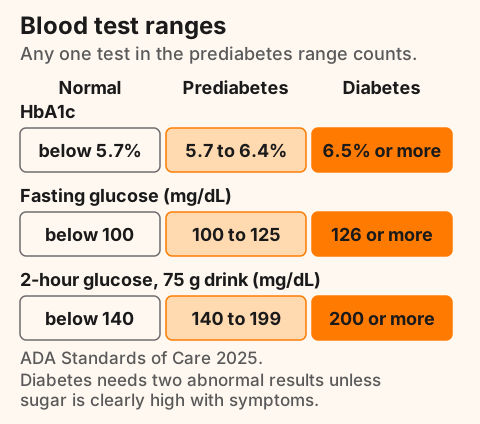
Test ranges from the American Diabetes Association. Source: ADA Standards of Care 2025.[1]
- HbA1c (the 2 to 3 month average): 5.7 to 6.4% (39 to 47 mmol/mol).[1]
- Fasting glucose: 100 to 125 mg/dL (5.6 to 6.9 mmol/L).[1]
- 2-hour glucose after a 75 g glucose drink (OGTT): 140 to 199 mg/dL.[1]
Diabetes starts at an HbA1c of 6.5% or more, a fasting glucose of 126 mg/dL or more, or a 2-hour glucose of 200 mg/dL or more.[1] Unless sugar is clearly high with classic symptoms, a diabetes diagnosis needs two abnormal results.[1]
The ADA says people with prediabetes should be checked for diabetes every year.[1][2] Results close to a cut-off can be repeated in 3 to 6 months.[1] Our coaches suggest treating one borderline report as a reason to repeat the test and talk to your doctor, not as a final verdict.
Testing starts earlier for people of Asian ancestry. The ADA advises testing adults with overweight and one or more risk factors, and for Asians the BMI cut-off for this advice is 23 kg/m2 or more, instead of 25.[1]
HbA1c can be unreliable in some people, for example with anaemia, and with some haemoglobin variants depending on the assay. Doctors then use a different assay or glucose tests.[1] If you have anaemia, ask your doctor which test suits you.
Check your waist
Waist size tells you something BMI can miss. A 2025 expert consensus (a Delphi process) on obesity in Asian Indians defines Stage 1 obesity by a BMI above 23, and adds waist measures and health complications to define Stage 2.[29] In a review of studies covering more than 300,000 adults, waist-to-height ratio picked out cardiometabolic risk better than waist alone or BMI.[30] Our coaches suggest measuring at the same spot each time, after a normal breath out, and asking your doctor to show you the right place. Try our free waist-to-height ratio calculator to see your ratio.
Why prediabetes matters for Indians
In the ICMR-INDIAB survey of 113,043 adults aged 20 and above, across 31 states and union territories between 2008 and 2020, the weighted prevalence of prediabetes was 15.3% (from 107,119 people tested), using WHO criteria.[3] The survey's definitions differ in places from the ADA ranges above, so the numbers are not directly comparable. Prediabetes was the only condition studied that was not more common in cities than in villages.[3] So this is not only an urban problem.
The Chennai CURES study followed 1,376 adults who had normal glucose or prediabetes at the start, for a median of 9.1 years. Of those who began with prediabetes, 58.9% had developed diabetes by the end.[4] That study only watched people. It shows what happened over time, not what diet changes can do.
You also do not need to be heavy to be at risk. The 531 Asian Indians with impaired glucose tolerance in the first Indian Diabetes Prevention Programme (IDPP-1) had a mean BMI of 25.8, and progression to diabetes was still high.[5]
Here is the hopeful part, stated carefully. In the US Diabetes Prevention Program follow-up (1,990 people analysed), those who returned to normal glucose at least once had 56% lower diabetes risk later than those who stayed in prediabetes.[11] But people who stayed in prediabetes despite intensive lifestyle change remained at high risk.[11] On this page, "reversal" only means a lab value going back to the normal range. It does not mean cured, and it does not mean you can stop checking.
The prediabetes plate in a South Indian home
The ICMR-National Institute of Nutrition (NIN) in Hyderabad publishes "My Plate for the Day" for a 2,000 kcal reference diet, in raw weights.[16]
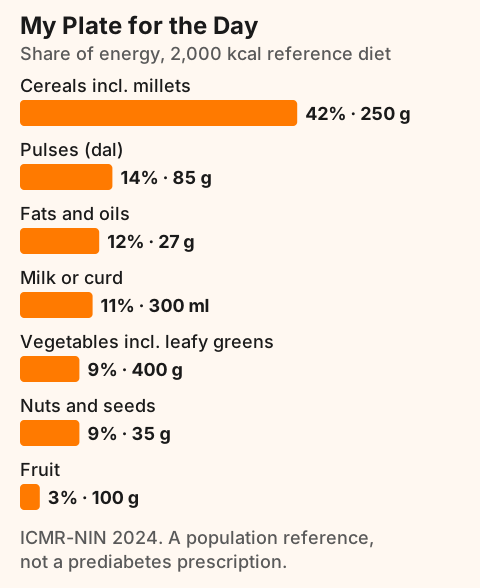
A population reference for healthy adults, not a prediabetes prescription. Your amounts depend on your needs. Source: ICMR-NIN policy brief 2024.[16]
| Food group | Amount a day | Share of energy |
|---|---|---|
| Cereals including millets | 250 g | 42% |
| Pulses | 85 g | 14% |
| Milk or curd | 300 ml | 11% |
| Vegetables including leafy greens | 400 g | 9% |
| Fruit | 100 g | 3% |
| Nuts and seeds | 35 g | 9% |
| Fats and oils | 27 g | 12% |
Vegetables, fruit and roots make up about half the plate, and the guide asks for foods from at least 8 to 10 food groups each day.[16] Eggs, fish and meat can replace part of the pulses.[16]
Two more points from the guidelines. The ICMR guidelines are written for the general population, not specifically for prediabetes. The ADA nutrition consensus says there is no single best split of carbohydrate, protein and fat for everyone. Across eating patterns it asks you to stress non-starchy vegetables, keep added sugar and refined grains low, and choose whole foods over highly processed ones, with at least 14 g of fibre per 1,000 kcal.[14] The ICMR guidelines say cereals should supply no more than 45% of energy.[15]
What this can look like at home. Our coaches suggest a simple thali (plate) split: half kura (vegetable curry) and salad, a quarter pappu (cooked dal) or egg, fish or paneer, and a quarter rice, millet or phulka (thin oil-free roti). If you now eat 2 or 3 cups of rice, start by trimming to about 1 cup cooked and filling the gap with vegetables. Then adjust using your own readings and your doctor's advice. For more on portions, see our guide on rice and diabetes.
Quick food list
Our coaches' starting points. They are not from a trial, and your amounts depend on your doctor's advice and readings.
| Choose more often | Starting portion (our suggestion) |
|---|---|
| Dals and pulses: pappu, sambar, chana, rajma, sprouts | 1 katori cooked at main meals |
| Leafy greens and non-starchy vegetables | 2 katori kura plus salad, half the plate |
| Millets and whole grains: jowar, korra, ragi, in place of part of the rice | 1 cup cooked, or 1 to 2 rotis |
| Curd, buttermilk, paneer | 1 katori perugu, 1 glass majjiga |
| Nuts | a small handful, about 6 almonds |
| Whole fruit instead of juice | 1 fruit at a time |
Go easy on: sugary drinks and fruit juice, sweets, jaggery and honey, fried snacks, maida (refined flour) bakery items, large portions of rice, and alcohol. Details are in Foods to limit.
7-day South Indian vegetarian prediabetes chart
These menus are Flexcellence's own suggestions, built on the food groups above. They are not from a trial. A katori is a small steel bowl of about 150 ml. Portions are a starting point.
| Day | Breakfast | Lunch | Evening | Dinner |
|---|---|---|---|---|
| 1 | 2 pesarattu (green gram dosa) with ginger chutney | 1 cup cooked rice, 1 katori pappu (dal), 2 katori beerakaya (ridge gourd) kura, salad, 1 katori perugu (curd) | 1 whole guava, small handful roasted chana | 2 phulka, 2 katori cabbage-carrot kura, 1 katori sambar, 1 katori perugu |
| 2 | 3 small vegetable idlis, 1 katori vegetable sambar, mint chutney, 1 boiled egg or 1 katori perugu | 1 jonna rotte (jowar flatbread), 1 katori pappu, 2 katori bendakaya (okra) kura, 1 katori perugu | 1 katori guggillu (boiled chickpeas) with onion and lemon | 1 cup cooked rice, 1 katori sambar, 2 katori beans kura, 1 katori perugu |
| 3 | 1.5 katori korra (foxtail millet) upma with vegetables, 1 boiled egg or 1 katori perugu | 1 cup cooked rice, 1 katori tomato pappu, 2 katori dondakaya (ivy gourd) kura, salad | 1 glass majjiga (spiced buttermilk), 1 apple | 2 phulka, 1 katori paneer-capsicum kura, cucumber salad |
| 4 | 2 ragi dosas (finger millet dosa) with 1 katori vegetable sambar, 1 boiled egg or 1 katori perugu | 1 cup cooked rice, 1 katori mudda pappu (soft-cooked dal), 2 katori spinach kura, 1 katori perugu | 1 katori sprouted green gram (moong) salad | 1 jonna rotte, 1 katori sorakaya (bottle gourd) kura, 1 katori sambar, 1 katori perugu |
| 5 | 1.5 katori vegetable oats upma, 1 katori perugu | 2 phulka, 1 katori chana dal (split chickpea) curry, 2 katori cabbage kura, salad | 1 katori papaya, 6 almonds | 1 cup cooked rice, 1 katori vegetable sambar, 1 katori perugu |
| 6 | 2 vegetable dosas, 1 katori sambar, tomato chutney, 1 boiled egg or 1 katori perugu | 1 cup cooked korra (foxtail millet) rice, 1 katori palakura pappu (spinach dal), 2 katori carrot-beans kura, salad | 1 katori guggillu or roasted chana, 1 glass majjiga | 2 phulka, 1 katori rajma (kidney bean) curry, cucumber-onion salad |
| 7 | 2 besan chilla (chickpea flour pancakes) with mint chutney | 1 cup cooked rice, 1 katori pappu, 2 katori mixed vegetable kura, 1 katori perugu | 1 whole fruit and a 10-minute walk | 1 jonna rotte or 2 phulka, 1 katori dal fry (tempered dal), 2 katori sauteed vegetables |
Rotate the dishes you like. Adjust to your readings, medicines and appetite with your doctor or dietitian. Walk for about 10 minutes after your main meals. We have not added calorie or carbohydrate totals, because they depend on how your family cooks each dish.
Why 1 cup of cooked rice? It is our coaches' starting point to fit a quarter of the plate, not a trial result. Rice is at lunch on 4 days; the other days use millet or roti. If your doctor has you test blood sugar after meals, use those readings to decide whether to go lower or higher.
Protein on vegetarian days. Dal alone can run thin. Our coaches suggest a protein food at every main meal: dal, curd, paneer, sprouts, chana or rajma, plus eggs if you eat them. The ICMR-NIN plate has 85 g raw pulses and 300 ml milk or curd a day for a 2,000 kcal diet.[16] Your own protein need depends on your weight and health, so ask your doctor or dietitian, especially with kidney disease.
Want help turning this into a plan for your own routine? Book a free 30-minute consultation with our coaches.
Rice, millets, tiffins and dal: what the numbers say
What Indian diet studies link to risk
These are observational studies. They show links, not cause.
- INDIAB diet survey (18,090 adults in this analysis): people eating more of their energy as carbohydrate were more likely to have newly diagnosed type 2 diabetes. The highest group had 30% higher odds than the lowest (OR 1.30). Replacing some carbohydrate with plant, dairy, egg or fish protein was linked to lower odds of diabetes and prediabetes, with dairy showing the strongest link. Swapping refined cereal for whole wheat or millet, on its own, was not linked to a clear drop in risk.[18]
- CURES-59 (1,843 adults in Chennai): people who ate the most refined grain were about five times as likely to have type 2 diabetes as those who ate the least (odds ratio 5.31). Those who ate the most fibre had roughly one third of the odds (odds ratio 0.31).[19]
- PURE (132,373 adults in 21 countries): eating 450 g or more of cooked white rice a day (roughly 3 cups, our approximate conversion) was linked to 20% higher diabetes risk than under 150 g a day. In South Asia the figure was 61% higher.[20]
Our reading: the amount and type of refined grain on your plate seems to matter more than the grain's name, and these studies cannot prove cause.
White rice, brown rice, whole grains
In a meta-analysis of 16 cohort studies, each 3 servings a day of whole grains was linked to a 32% lower risk of type 2 diabetes (RR 0.68).[21] Per 100 g raw, ragi (finger millet) has 11.18 g of fibre and raw milled rice has 2.81 g.[17]
Millets, honestly
A meta-analysis of studies found a mean glycaemic index (GI) of 52.7 for millets against 71.7 for milled rice. Ragi (finger millet) averaged 61.1.[24] The review reports that minimally processed millets lowered GI more than milled rice and refined wheat did.[24] GI is a score of how fast a food raises blood glucose compared with a reference. Millets have a lower average GI than milled rice, but the INDIAB result above is a reminder that swapping the grain alone is not a full plan. See also our guide to millets.
Idli, dosa, pesarattu, upma: measured GI
Researchers at ICMR-NIN tested 23 common Hyderabad breakfast foods in 10 healthy adults aged 20 to 30. Each portion gave 50 g of carbohydrate, and glucose was the reference.[23] These were not people with prediabetes, and the foods were commonly available ready-to-eat breakfasts sampled from wards of Greater Hyderabad, so your result may differ.[23]
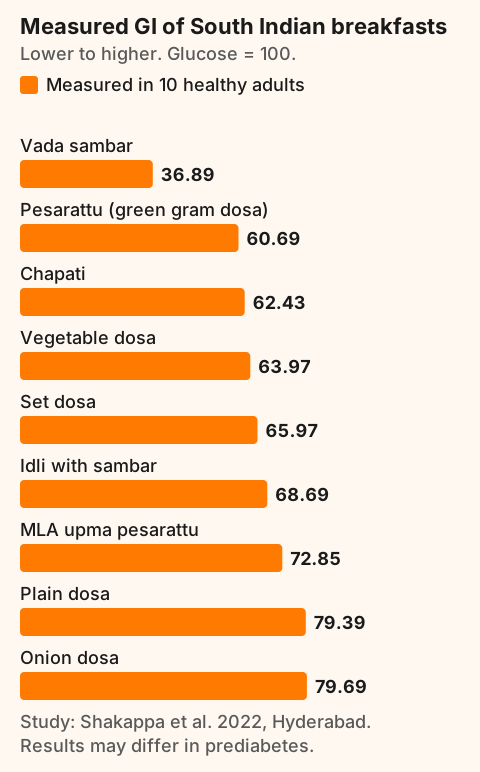
GI of breakfasts tested in 10 healthy adults aged 20 to 30 in Hyderabad.[23]
- Vada sambar (fried lentil doughnut with lentil stew): 36.89, the lowest.[23]
- Pesarattu (green gram dosa): 60.69.[23]
- Chapati (wheat flatbread): 62.43.[23]
- Vegetable dosa: 63.97. Set dosa: 65.97.[23]
- Idli with sambar (lentil and vegetable stew): 68.69.[23]
- MLA upma pesarattu (a Hyderabad dish: green gram dosa stuffed with upma, a savoury semolina porridge): 72.85.[23]
- Plain dosa: 79.39. Onion dosa: 79.69.[23]
The authors report that rice-based breakfasts tended to have a higher GI than legume-based ones, though the pattern is not clean: curd rice (64.94) sat close to pesarattu (60.69).[23] Fermented foods like idli and dosa are common in Indian cooking, and the ICMR guidelines say fermentation can improve digestibility and nutrient uptake.[15]
Our coaches suggest not giving up idli or dosa, and adding vegetables, protein or legumes, or trying millet in place of some rice. Keep the portion modest, fill the plate with sambar and vegetables, and add a protein such as a boiled egg, curd or guggillu (boiled chickpeas). Vada sambar has a low GI, but it is deep fried, so we would keep it occasional. For more ideas, see our list of Indian breakfasts for diabetes.
Dal and pulses
Trials show small but real effects of pulses and fibre. A meta-analysis of 41 randomised trials found that pulses alone lowered fasting blood glucose (11 trials), and pulses inside low-GI diets lowered HbA1c or fructosamine (19 trials). The effects varied between studies.[25] Another review of 42 trials in 1,789 adults with prediabetes, type 1 or type 2 diabetes found that more fibre lowered HbA1c by 2.00 mmol/mol and fasting glucose by 0.56 mmol/L, with high heterogeneity between trials.[26]
Foods to limit, not ban
- Sugary drinks. In a meta-analysis of 17 cohorts, each daily serving of sugar-sweetened drinks was linked to 18% higher type 2 diabetes incidence, or 13% after adjusting for body fat. The authors say neither diet drinks nor fruit juice are healthy swaps, though they note those findings may be biased.[22]
- Added sugar. ICMR asks to keep added sugar under 5% of daily energy.[15] If sugar is eaten, the NIN plate says to keep it to 25 to 30 g a day.[16] Our sources do not rank jaggery or honey above sugar, so treat sweets, jaggery and honey as added sugar and keep portions small.
- Fruit. Whole fruit is preferred to juice.[16] See our guide to fruits and diabetes.
- Fried snacks and rich rice dishes. Our coaches suggest bajji and punugulu (fried snacks), pulihora (tamarind rice) and biryani as occasional foods in a smaller portion, with vegetables first.
- Alcohol. If you drink at all, the ADA consensus says up to 1 drink a day for women and 2 for men.[14]
- Salt. Keep it under 5 g a day.[15]
- Cooking. Prefer steaming or pressure cooking to deep frying, and do not reuse heated oil.[15]
Non-veg swaps, office tiffin and NRI kitchens
For non-vegetarian days, eggs, fish and meat can replace part of the pulses on the plate.[16] Per 100 g, a whole egg has 13.28 g of protein and skinless chicken leg has 19.44 g.[17]
| Instead of | Try | Note |
|---|---|---|
| 1 katori pappu | 2 boiled eggs, or 1 katori fish curry | Keep the vegetable kura and salad |
| 1 katori paneer kura | 1 katori skinless chicken curry, less oil | Fry less, pressure cook or steam more |
| Fried fish | Fish curry or grilled fish | Match the rice portion to the plan |
Our coaches suggest these for work and for kitchens abroad (not studied in trials):
- Office tiffin: pack vegetables and dal first, rice or roti in a smaller box, and roasted chana in your bag instead of biscuits.
- NRI kitchens: brown or parboiled rice if you like it, frozen vegetables to make a kura quickly, Greek yogurt in place of perugu, and sprouts or boiled chana as snacks.
Read more in our guide to South Asian diabetes risk.
Eat in this order, then walk
In a small crossover study, 11 adults with type 2 diabetes on metformin each ate the same 628 kcal meal twice, once in each order, one week apart. When vegetables and protein came first and carbohydrate (bread and orange juice) 15 minutes later, glucose at 60 minutes was about 37% lower than when carbohydrate came first.[27] Each visit was a single meal followed for 2 hours, and it was not an Indian meal.[27]
In another crossover study of 41 adults with type 2 diabetes, a 10-minute walk after each main meal lowered the after-meal glucose rise by 12% overall, against one 30-minute walk a day. After the evening meal it was 22% lower.[28]
Both studies were in people with diabetes, not prediabetes. Our coaches still suggest a simple habit: vegetables and dal first, rice last, then a short walk. For the weekly target, the CDC suggests at least 150 minutes of activity, about 30 minutes on 5 days.[13] The WHO also advises muscle-strengthening activity on 2 or more days a week for adults, at moderate or greater intensity and involving all major muscle groups.[33] Ask your doctor what suits you if you have joint, heart or other health problems. Sleep and stress also matter for most people, but we have no prediabetes-specific figure to give here.
Can diet and lifestyle bring it back to normal? What the trials show
The best evidence comes from trials where people with raised glucose were randomly given lifestyle programmes or usual advice. Takeaway: in four of the five trials below, people who got lifestyle support developed diabetes less often than comparison groups. In the fifth, the Kerala peer-support programme, the difference was not statistically significant.
- US Diabetes Prevention Program (3,234 adults with raised glucose): goals were at least 7% weight loss and at least 150 minutes of activity a week. Over an average of 2.8 years, lifestyle change cut diabetes incidence by 58% compared with placebo.[8] At 10 years the reduction was 34%, smaller than at 2.8 years. The lifestyle group lost weight and then partly regained some, and diabetes incidence in the former placebo and metformin groups fell, so the gap narrowed.[9]
- Finnish Diabetes Prevention Study (522 overweight adults with impaired glucose tolerance): individual counselling on weight, fat, fibre and activity. Four-year diabetes incidence was 11% in the lifestyle group and 23% in controls.[12]
- IDPP-1 (531 Asian Indians with impaired glucose tolerance): three-year incidence was 39.3% with lifestyle change and 55.0% in controls.[5]
- Mobile phone messages (537 working men aged 35 to 55 in south-east India): diabetes developed in 18% (50 of 271) who got frequent text messages, against 27% (73 of 266) who got lifestyle advice only at the start. The study was in men only.[6]
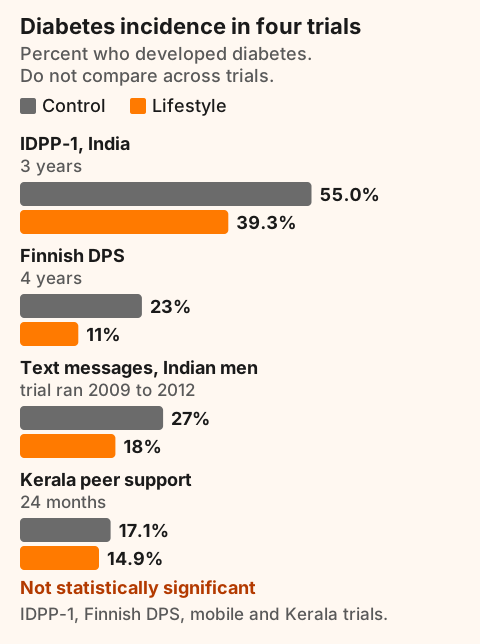
The four trials differ in people, length and design, so do not compare one panel with another. The Kerala result was not statistically significant. Sources: IDPP-1, Finnish DPS, mobile messaging and Kerala trials.[5][12][6][7]
What did not work as clearly: in the Kerala peer-support programme (1,007 adults aged 30 to 60, 47.2% women, 15 group sessions over 12 months), diabetes developed in 14.9% at 24 months with the programme and 17.1% with an education booklet. That difference was not statistically significant.[7] Our reading: results vary, and a programme is no guarantee. None of these trials promises a result for you.
How much weight to lose
Among 1,079 lifestyle-arm participants of the US trial (mean BMI 33.9), each kilogram lost was linked to 16% lower diabetes risk.[10] The targets quoted by different bodies are close but not the same:
- at least 7% of starting weight, for adults with overweight or obesity at high risk (ADA 2025)[2]
- about 5 to 7% (US CDC)[13]
- 7 to 10% for prediabetes (ADA nutrition consensus)[14]
We do not give kilograms-per-week targets, because none of these sources set one. If your weight is already in a healthy range, ask your doctor what to aim for. A doctor may also consider medicines such as metformin for some high-risk adults.[2]
Medicines, supplements and who needs extra care
- Metformin. A doctor may consider it for some high-risk adults. The ADA says long-term use may be linked to B12 deficiency and suggests considering periodic B12 checks, especially with anaemia or nerve problems.[2]
- Supplements. Routine vitamin or herbal supplements are not recommended without a deficiency.[14] We do not rely on karela, methi, cinnamon or amla "sugar control" claims, and our sources do not support them. Ask your doctor before using any of them, especially with diabetes medicine.
- Low blood sugar. If you take insulin or a tablet such as gliclazide or glimepiride, eating less carbohydrate or skipping meals can raise the risk of low blood sugar.[32] Ask your doctor before changing your diet.
- After gestational diabetes. If you had diabetes in pregnancy, the ADA advises lifelong screening every 1 to 3 years[1] and suggests more intensive prevention approaches.[2] Our coaches suggest checking with your doctor or dietitian before changing your diet while breastfeeding.
- Older adults and long-term conditions. Our coaches suggest having any new eating plan checked by your doctor first.
- Talk to your doctor or dietitian first if you are pregnant (see our gestational diabetes diet), have kidney disease (your doctor sets protein limits), have had an eating disorder, or take any glucose-lowering medicine.
When to see a doctor
- Your fasting glucose is 126 mg/dL or more, your HbA1c is 6.5% or more, or your 2-hour glucose is 200 mg/dL or more. That is the diabetes range and needs a doctor.[1]
- Your result is close to a cut-off, or you have not been retested in a year.[1][2]
- You feel very thirsty, pass urine often, feel very tired, have blurred vision, or are losing weight without trying. Get tested soon.[31]
- High sugar comes with vomiting, stomach pain, fast breathing, drowsiness, fruity-smelling breath or confusion. This needs emergency care.[31]
- You plan to change or stop a medicine. Never do this because of a blog.
A Flexcellence coach's role
A coach starts from your report, your medicines and your weekly routine, and changes one meal at a time. We work alongside your doctor and cannot promise any result.
Where to go from here
Start with your numbers: check your waist-to-height ratio with the free waist-to-height ratio calculator, repeat your blood test as your doctor advises, and change one meal this week. If you would like support, book a free consultation.
Glossary
- Pappu: cooked dal. Kura: vegetable curry. Perugu: curd. Majjiga: spiced buttermilk.
- Pesarattu: green gram dosa. Phulka: thin oil-free roti. Jonna rotte: jowar flatbread. Korra: foxtail millet.
- Guggillu: boiled chickpea or pulse snack. Pulihora: tamarind rice. Bajji, punugulu: fried snacks.
- Idli, dosa: steamed and pan-cooked fermented rice-and-lentil batter foods. Chapati: wheat flatbread. MLA pesarattu: a Hyderabad dish of green gram dosa stuffed with upma. Maida: refined wheat flour. Ragi: finger millet. Besan: chickpea flour. Upma: semolina or millet porridge. Sambar: lentil and vegetable stew. Katori: small steel bowl, about 150 ml.
Common questions
What is a normal, prediabetes and diabetes blood sugar level?
The ADA puts prediabetes at an HbA1c of 5.7 to 6.4%, a fasting glucose of 100 to 125 mg/dL, or a 2-hour glucose of 140 to 199 mg/dL after a 75 g glucose drink. Diabetes starts at 6.5%, 126 mg/dL and 200 mg/dL. Any one test in range counts, so your doctor may repeat it.
Can prediabetes be reversed with diet?
Some people do return to the normal range with diet, activity and weight change, but doctors avoid the word cure. In the US Diabetes Prevention Program follow-up, people who reached normal glucose at least once had 56% lower later diabetes risk than those who stayed in prediabetes. This is not a cure. Keep retesting with your doctor, because those who stayed in prediabetes remained at high risk.
Can I eat rice if I have prediabetes?
Usually yes, in a measured portion. In the PURE study, 450 g or more of cooked white rice a day (roughly 3 cups, our approximate conversion) was linked to 61% higher diabetes risk in South Asia than under 150 g. Our coaches suggest starting near 1 cup cooked, filling half the plate with vegetables, and adjusting with your doctor.
Are idli and dosa good for prediabetes?
They can fit with changes. In 10 healthy adults aged 20 to 30 in Hyderabad, idli (steamed rice-lentil cake) with sambar (lentil-vegetable stew) had a GI of 68.69, vegetable dosa (thin fermented crepe) 63.97 and plain dosa 79.39. Our coaches suggest keeping portions modest and filling the plate with sambar, vegetables and a protein. The study did not test people with prediabetes.
What is a good breakfast for prediabetes in India?
In the same Hyderabad study, pesarattu (green gram dosa) had a GI of 60.69 and vada sambar 36.89, though vada is deep fried. Our coaches suggest pesarattu, vegetable idli with sambar, or a foxtail millet upma with vegetables, plus a protein like an egg or curd. Vary through the week.
Do I need medicine for prediabetes?
That is your doctor's decision. The ADA says metformin can be considered for some high-risk adults, alongside lifestyle change. Long-term metformin may be linked to low vitamin B12, so the ADA suggests periodic B12 checks, especially with anaemia or nerve problems. Most people start with food, activity and weight changes. Never start or stop a medicine because of a blog.
Which fruits can I eat with prediabetes?
The ICMR-NIN My Plate includes about 100 g of fruit a day in a 2,000 kcal plan and prefers whole fruit to juice. Our coaches suggest one portion at a time, such as a guava or apple, with a meal or as an evening snack, and checking your readings with your doctor.
Reviewed by
Not yet reviewed by a Flexcellence coach.
Sources
American Diabetes Association (Diabetes Care). 2. Diagnosis and Classification of Diabetes: Standards of Care in Diabetes-2025 (2025).
American Diabetes Association (Diabetes Care). 3. Prevention or Delay of Diabetes and Associated Comorbidities: Standards of Care in Diabetes-2025 (2025).
The Lancet Diabetes & Endocrinology (ICMR-INDIAB; Anjana RM et al.). Metabolic non-communicable disease health report of India: the ICMR-INDIAB national cross-sectional study (ICMR-INDIAB-17) (2023).
Diabetes Care (Anjana RM et al., Madras Diabetes Research Foundation). Incidence of Diabetes and Prediabetes and Predictors of Progression Among Asian Indians: 10-Year Follow-up of the Chennai Urban Rural Epidemiology Study (CURES) (2015).
Diabetologia (Ramachandran A et al.). The Indian Diabetes Prevention Programme shows that lifestyle modification and metformin prevent type 2 diabetes in Asian Indian subjects with impaired glucose tolerance (IDPP-1) (2006).
The Lancet Diabetes & Endocrinology (Ramachandran A et al.). Effectiveness of mobile phone messaging in prevention of type 2 diabetes by lifestyle modification in men in India: a prospective, parallel-group, randomised controlled trial (2013).
PLOS Medicine (Thankappan KR et al.). A peer-support lifestyle intervention for preventing type 2 diabetes in India: A cluster-randomized controlled trial of the Kerala Diabetes Prevention Program (2018).
New England Journal of Medicine (Diabetes Prevention Program Research Group). Reduction in the incidence of type 2 diabetes with lifestyle intervention or metformin (2002).
The Lancet (Diabetes Prevention Program Research Group). 10-year follow-up of diabetes incidence and weight loss in the Diabetes Prevention Program Outcomes Study (2009).
Diabetes Care (Hamman RF et al., DPP Research Group). Effect of weight loss with lifestyle intervention on risk of diabetes (2006).
The Lancet (Perreault L et al., DPP Research Group). Effect of regression from prediabetes to normal glucose regulation on long-term reduction in diabetes risk: results from the Diabetes Prevention Program Outcomes Study (2012).
New England Journal of Medicine (Tuomilehto J et al., Finnish Diabetes Prevention Study). Prevention of type 2 diabetes mellitus by changes in lifestyle among subjects with impaired glucose tolerance (2001).
US Centers for Disease Control and Prevention. Prediabetes: Your Chance to Prevent Type 2 Diabetes (2024).
Diabetes Care (ADA consensus report; Evert AB et al.). Nutrition Therapy for Adults With Diabetes or Prediabetes: A Consensus Report (2019).
ICMR-National Institute of Nutrition. Dietary Guidelines for Indians (Revised Edition 2024) (2024).
ICMR-National Institute of Nutrition, Hyderabad. Policy Brief: Promotion of 'My Plate for the Day' and physical activity (2024).
ICMR-National Institute of Nutrition (Longvah T, Ananthan R, Bhaskarachary K, Venkaiah K). Indian Food Composition Tables 2017 (2017).
Nature Medicine (ICMR-INDIAB; Anjana, Sudha et al.). Dietary profiles and associated metabolic risk factors in India from the ICMR-INDIAB survey-21 (2025).
British Journal of Nutrition (Mohan V, Radhika G et al., Madras Diabetes Research Foundation). Dietary carbohydrates, glycaemic load, food groups and newly detected type 2 diabetes among urban Asian Indian population in Chennai, India (CURES-59) (2009).
American Diabetes Association (Diabetes Care). White Rice Intake and Incident Diabetes: A Study of 132,373 Participants in 21 Countries (PURE; Bhavadharini B et al.) (2020).
European Journal of Epidemiology (Aune D et al.). Whole grain and refined grain consumption and the risk of type 2 diabetes: a systematic review and dose-response meta-analysis of cohort studies (2013).
BMJ (Imamura F et al.). Consumption of sugar sweetened beverages, artificially sweetened beverages, and fruit juice and incidence of type 2 diabetes: systematic review, meta-analysis, and estimation of population attributable fraction (2015).
Journal of Food Science and Technology (ICMR-NIN, Hyderabad). Glycemic carbohydrates, glycemic index, and glycemic load of commonly consumed South Indian breakfast foods (Shakappa, Naik, Sobhana) (2022).
Frontiers in Nutrition (Anitha et al., ICRISAT). A Systematic Review and Meta-Analysis of the Potential of Millets for Managing and Reducing the Risk of Developing Diabetes Mellitus (2021).
Diabetologia. Effect of non-oil-seed pulses on glycaemic control: a systematic review and meta-analysis of randomised controlled experimental trials (Sievenpiper et al.) (2009).
PLOS Medicine (Reynolds AN, Akerman AP, Mann J). Dietary fibre and whole grains in diabetes management: Systematic review and meta-analyses (2020).
Diabetes Care (Shukla AP et al.). Food Order Has a Significant Impact on Postprandial Glucose and Insulin Levels (2015).
Diabetologia (Reynolds AN et al.). Advice to walk after meals is more effective for lowering postprandial glycaemia in type 2 diabetes mellitus than advice that does not specify timing: a randomised crossover study (2016).
Diabetes & Metabolic Syndrome: Clinical Research & Reviews (Misra et al.). Revised definition of obesity in Asian Indians living in India (2025).
Obesity Reviews (Ashwell M, Gunn P, Gibson S). Waist-to-height ratio is a better screening tool than waist circumference and BMI for adult cardiometabolic risk factors: systematic review and meta-analysis (2012).
NHS (UK). High blood sugar (hyperglycaemia) (2026).
NHS (UK). Low blood sugar (hypoglycaemia) (2026).
British Journal of Sports Medicine (Bull FC et al., WHO). World Health Organization 2020 guidelines on physical activity and sedentary behaviour (2020).