High Protein Indian Vegetarian Foods: List with Grams
Sourced high protein Indian vegetarian foods with grams, breakfast ideas, South Indian dishes, a sample day and when to see your doctor.
The short answer
Pulses (dals, chana, rajma), soya, paneer, groundnuts and seeds are the richest Indian vegetarian protein foods, at roughly 19 to 38 g per 100 g raw (rice and wheat have 8 to 11 g). A cooked bowl of dal gives about 7 to 8 g. Pairing dal with grain and milk or curd improves protein quality.
Work out your own numbers
Estimate optimal daily protein intake by weight and goal.
Free, takes a minute, and uses the same formulas our coaches use.
Open the Protein Intake CalculatorOn this page
If you want protein rich foods in a vegetarian Indian kitchen, you do not need exotic items. Most of the best ones are already in your pantry: dals (split lentils and pulses), chana (chickpeas), rajma (red kidney beans), soya, paneer (Indian cottage cheese), curd (plain yoghurt), groundnuts and seeds. This guide gives you a list with grams first, then food groups, breakfast ideas, South Indian dishes, one full day with calories, and clear safety notes. It is for vegetarians, busy working women and NRIs cooking Indian food abroad. It is general guidance and not a prescription.
Why does this question come up so often? In the ICMR-INDIAB survey of 18,090 adults, protein gave only about 12% of daily energy against a 15% guideline, while carbohydrate gave 62.3%.[6] A study of 2,042 urban adults in Chennai found a similar pattern: 12% protein and 64% carbohydrate.[7] But there is a second side. ICMR-NIN (the Indian government's National Institute of Nutrition) notes that many adults already eat 60 to 70 g of protein a day, and says the bigger challenge is protein quality, not quantity.[2] So the goal is not powders. It is better foods, spread well through the day.
The list at a glance: 10 foods with grams
One bowl here means a small steel bowl, roughly what the Indian Nutrient Databank (INDB) calls a bowl. Dish values are recipe-calculated estimates and your bowl may differ.[4] Raw foods are from the Indian Food Composition Tables 2017 (IFCT).[3]
| Food | Serving | Protein, g | Basis |
|---|---|---|---|
| Paneer stuffed cheela (savoury lentil pancake with paneer filling) | 1 cheela | 24.3 | INDB recipe |
| Paneer | 100 g | 18.9 | IFCT, raw |
| Moong dal stuffed cheela (green gram pancake) | 1 cheela | 15.9 | INDB recipe |
| Soyabean curry | 1 bowl | 12.5 | INDB recipe |
| Curd rice (perugu annam) | 1 plate | 12.4 | INDB recipe |
| Soya chunks korma (soya chunks in a mild creamy gravy) | 1 bowl | 9.6 | INDB recipe |
| Arhar dal with spinach (toor dal) | 1 bowl | 8.3 | INDB recipe |
| Toor dal, dry | 30 g raw | 6.5 | IFCT value times weight (our arithmetic) |
| Groundnuts (peanuts) | 25 g | 5.9 | IFCT value times weight (our arithmetic) |
| Cucumber raita (curd side dish) | 1 bowl | 6.2 | INDB recipe |
Do not add these up as if they were one meal. They show how foods compare, and the sections below explain raw versus cooked numbers.
Protein rich foods in Indian vegetarian diets, group by group
Read the numbers right: raw, cooked and per serving
This is where most protein lists mislead. In this article we use two kinds of numbers, and we label each one.
- Per 100 g raw. From IFCT 2017. Values are per 100 g of the edible portion, raw unless stated.[3]
- Per serving. From INDB, which calculates protein for a standard recipe serving. These are estimates and change with portion, oil and recipe.[4]
Here is why it matters. Raw toor dal (kandi pappu) has 21.7 g protein per 100 g.[3] By our own arithmetic (raw weight times the value, divided by 100), 30 g of raw toor dal gives about 6.5 g protein. A recipe-calculated bowl of whole moong dal has 7.7 g, and arhar dal with spinach has 8.3 g.[4] Cooked dal is mostly water, so a bowl does not look like "24 g per 100 g".
Our coaches' simple rule: always check which weight a number is for. Raw, cooked and dry are not the same thing, and we never mix them in one column below.
Dals and pulses: the everyday base
Pulses (dried lentils, beans and peas) are the base of Indian vegetarian protein. On average, pulses have 22.8 g protein and 323 kcal per 100 g raw.[2] Telugu names are in the table, with Hindi in brackets where useful.
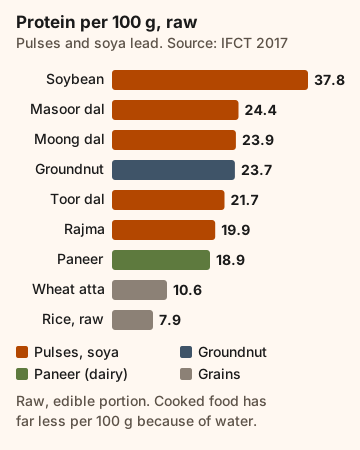 Figure 1. Protein per 100 g raw weight for common Indian vegetarian foods. Source: IFCT 2017.[3]
| Food (English / Telugu) | Protein, g per 100 g raw | kcal per 100 g raw | 30 g raw gives (our arithmetic), g protein |
|---|---|---|---|
| Masoor dal (red lentil) | 24.4 | 322 | 7.3 |
| Green gram dal / pesara pappu (moong dal) | 23.9 | 326 | 7.2 |
| Black gram dal / minapa pappu (urad dal) | 23.1 | 324 | 6.9 |
| Green gram whole / pesalu (sabut moong) | 22.5 | 294 | 6.8 |
| Red gram dal / kandi pappu (toor or arhar dal) | 21.7 | 331 | 6.5 |
| Horse gram / ulavalu (kulthi) | 21.7 | 330 | 6.5 |
| Bengal gram dal / senaga pappu (chana dal) | 21.6 | 329 | 6.5 |
| Cowpea / bobbarlu (lobia) | 20.4 | 320 | 6.1 |
| Dry peas | 20.4 | 303 | 6.1 |
| Rajma (red kidney beans) | 19.9 | 299 | 6.0 |
| Bengal gram whole / chana (kabuli or kala chana) | 18.8 | 287 | 5.6 |
All grams per 100 g are from IFCT 2017.[3] The "30 g raw" column is our own arithmetic.
Pulses also do other useful things, though these are modest averages and not promises. In 21 trials with 940 people, eating about one serving of pulses a day (median 132 g) was linked to 0.34 kg more weight loss than comparison diets, over a median of 6 weeks.[14] In 26 trials, about 130 g a day lowered LDL ("bad" cholesterol) by 0.17 mmol/L.[15]
ICMR-NIN notes that soaking, sprouting and fermenting improve how well the body can use nutrients from grains and legumes.[2]
Soya, paneer, milk and curd
Soya. Soybean is the highest on the IFCT list: 37.8 g protein per 100 g for white soybean and 35.6 g for brown, raw.[3] A recipe-calculated bowl of soyabean curry gives 12.5 g.[4] Soya chunks (textured soy granules, also sold as meal maker) appear in INDB only as cooked dishes: 9.6 g for a bowl of soya chunks korma and 6.8 g for a bowl of soya chunks with peas. The chunks share the bowl with other ingredients, so these are dish values, not values for the dry chunks.[4] Tofu is not in our sourced tables. For tofu and dry soya chunks, the pack label gives the best number for the brand you buy.
Paneer. Paneer has 18.9 g protein, 24.8 g fat and about 305 kcal per 100 g.[3] ICMR-NIN lists paneer among good protein sources for older children and adolescents.[2] Our coaches would add that paneer is calorie-dense, so a small piece in a dish goes further than a big plate.
Milk. Whole cow milk has 3.3 g protein per 100 g and buffalo milk has 3.7 g.[3] By our arithmetic (treating 1 ml as 1 g), 200 ml of cow milk gives about 6.6 g.
Curd. The IFCT 2017 tables do not list curd,[3] so we do not give a per-100 g value. What we can say: a bowl of cucumber raita is 6.2 g protein and a bowl of sprouted moong raita 7.1 g by recipe estimates, and a plate of curd rice (perugu annam) is 12.4 g.[4] ICMR-NIN's vegetarian My Plate includes 300 ml of milk or curd a day, worth about 10 g protein.[2]
Sattu. Sattu is roasted gram flour. A glass of sattu drink has 3.0 g protein and 125 kcal by INDB estimate.[4]
Nuts, seeds, grains and vegetables
Nuts and seeds are rich in protein, and also in calories, so portions stay small. Groundnut (palli, peanut) has 23.7 g protein and about 520 kcal per 100 g. By our arithmetic, a 25 g handful gives about 5.9 g protein.[3]
| Nuts and seeds (raw) | Protein, g per 100 g | kcal per 100 g |
|---|---|---|
| Groundnut / palli | 23.7 | 520 |
| Sunflower seeds | 23.5 | 586 |
| Sesame (white) / nuvvulu | 21.7 | 520 |
| Cashew | 18.8 | 583 |
| Linseed (flax) / avise ginjalu | 18.6 | 444 |
| Almond | 18.4 | 609 |
| Walnut | 14.9 | 671 |
Source for all rows: IFCT 2017.[3]
Grains add protein quietly, because we eat them in large amounts. Per 100 g raw: amaranth seed (rajgira) 14.6 g, quinoa 13.1 g, bajra (pearl millet) 11.0 g, wheat atta 10.6 g, jowar (sorghum) 10.0 g, raw rice 7.9 g and ragi (finger millet) 7.2 g.[3] These carry lower-quality protein than pulses, which is why the pairing section below matters.
Some vegetables help too, per 100 g: fresh green peas 7.3 g, drumstick leaves (munaga aaku) 6.4 g, amaranth leaves (thotakura) 3.3 g and spinach (palakura) 2.1 g.[3]
Calories per gram of protein
Protein foods differ a lot in calories. By our arithmetic from IFCT values (kcal divided by grams of protein, per 100 g raw), soybean gives about 10 kcal per gram of protein, toor dal 15, paneer 16 and groundnut 22.[3] If weight loss is your goal, this is why dal and soya go further than nuts for the same protein.
Breakfast and South Indian dishes with grams
Six protein rich Indian vegetarian breakfasts
Breakfast is where most Indian days are low in protein. These options use INDB recipe estimates,[4] and the pesarattu and idli rows add single-piece values ourselves.
| Breakfast | Protein, g | kcal |
|---|---|---|
| Paneer stuffed cheela, 1 | 24.3 | 436 |
| Moong dal stuffed cheela, 1 | 15.9 | 352 |
| Pesarattu (green gram dosa), 3 pieces, with 1 tablespoon peanut chutney | 12.4 | 282 |
| Idli (steamed rice and black gram cake), 3 pieces, with 1 bowl sambar (lentil and vegetable stew) | 12.2 | 351 |
| Sprouted moong poha (flattened rice with sprouts), 1 plate | 10.7 | 369 |
| Sprouts upma (savoury semolina-style porridge with sprouts), 1 plate | 9.1 | 301 |
The idli and pesarattu rows are our arithmetic from the single-piece values in the dish table below. More ideas are in our guide to high-protein Indian breakfasts. If you are managing diabetes, see best Indian breakfasts for diabetes.
South Indian dishes with grams per serving
Raw tables are useful for shopping. For daily eating you need dish values. These come from INDB and are recipe-calculated estimates, so your plate may differ.[4]
Quick explainers for the dish names: pesarattu is a green gram dosa. Idli is a steamed rice and black gram cake. Cheela or chilla is a savoury lentil or gram-flour pancake. Sambar is a lentil and vegetable stew. Dal makhani is a creamy dal of black gram and kidney beans. Perugu annam is curd rice.
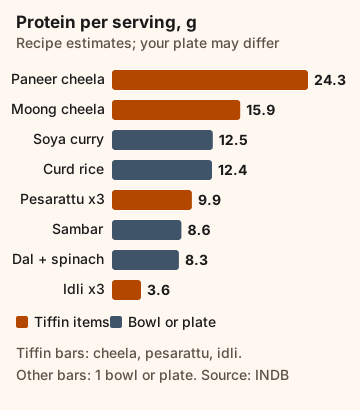 Figure 2. Recipe-estimated protein per serving of common dishes. Pesarattu and idli are shown for 3 pieces so they compare fairly with a bowl. Source: Indian Nutrient Databank.[4]
| Dish | Serving | Protein, g | kcal |
|---|---|---|---|
| Paneer stuffed cheela | 1 serving | 24.3 | 436 |
| Moong dal stuffed cheela | 1 serving | 15.9 | 352 |
| Soyabean curry | 1 bowl | 12.5 | 196 |
| Curd rice (perugu annam) | 1 plate | 12.4 | 423 |
| Dal makhani | 1 bowl | 11.7 | 262 |
| Sambar | 1 bowl | 8.6 | 249 |
| Arhar dal with spinach | 1 bowl | 8.3 | 213 |
| Whole moong dal | 1 bowl | 7.7 | 184 |
| Sabut moong dal with tadka (tempering) | 1 bowl | 7.3 | 143 |
| Sprouted moong raita | 1 bowl | 7.1 | 93 |
| Sprouted moong salad | 1 bowl | 4.7 | 77 |
| Besan chilla (gram flour pancake) | 1 each | 4.1 | 71 |
| Pesarattu | 1 each | 3.3 | 76 |
| Peanut chutney | 1 tablespoon | 2.5 | 54 |
| Idli | 1 each | 1.2 | 34 |
Source for all rows: INDB recipe estimates.[4]
Two things stand out. First, a plate of three pesarattu gives about 10 g of protein before chutney, and three idlis give under 4 g. The pesarattu figure is by one INDB recipe and rises or falls with how much dal goes into the batter, so treat it as a guide. That is a good reason to add a side such as curd or peanut chutney. Second, fermenting, as in idli and dosa, improves digestibility according to ICMR-NIN.[2]
A small note on blood sugar. The glycaemic index is a score for how fast a food raises blood sugar. In a Hyderabad study of 23 breakfast foods in 10 healthy young adults, pesarattu scored 60.7, against 79.4 for plain dosa and 36.9 for vada sambar (fried lentil doughnut in sambar).[23] The sample was small, so treat it as a hint. For more on tiffin choices, see idli, dosa, upma and pesarattu compared.
Putting it together in a day
Dal, grain and milk: why pairing helps
Protein is built from amino acids. Cereals are low in an amino acid called lysine, while pulses are lower in methionine and cysteine (two sulphur-containing amino acids). ICMR-NIN says a cereal to pulse ratio of about 3 to 1 by raw weight meets all essential amino acid needs, and 250 ml of milk a day improves it further.[2] The ICMR-NIN composition for a good-quality diet is 3 parts cereal, 1 part legume and 2.5 parts milk.[1] This is the old Indian thali logic: rice with dal, roti with curd.
The wider research is reassuring, with a caveat. A review of protein and amino acids in vegetarian diets, mostly from Western countries, concluded that worry about amino acid deficiency in vegetarian diets has been overstated, and that legumes, nuts and seeds can give full protein adequacy in adults.[8] Cereal-heavy Indian diets are a different case, which is why the pairing above matters. The Academy of Nutrition and Dietetics says appropriately planned vegetarian diets are nutritionally adequate at all life stages.[9] The key words are "well planned". ICMR-NIN also notes that most vegetarian foods have 70 to 85% protein digestibility,[2] so variety matters.
One vegetarian day that adds up
Here is one example day, built only from the sourced servings above. It is an illustration of sizes, not a prescription, and it is not suitable as written if you have kidney disease, are pregnant or breastfeeding, or take insulin. Your coach and doctor adjust food to your weight, goals and health. This day has no soya. If you take levothyroxine, follow the timing advice in the thyroid section below.
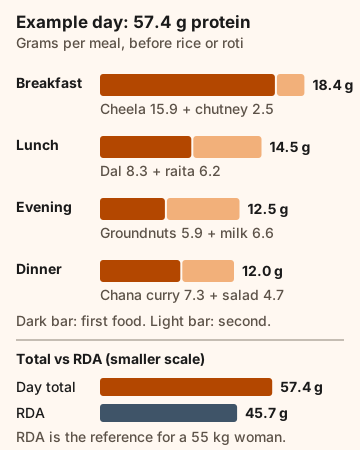 Figure 3. Protein in the example day, split by food. Dish values from INDB;[4] groundnut and milk portions are our arithmetic from IFCT.[3]
| Meal | What | Protein, g | kcal |
|---|---|---|---|
| Breakfast | Moong dal stuffed cheela (15.9) + peanut chutney, 1 tbsp (2.5) | 18.4 | 406 |
| Lunch | Arhar dal with spinach, 1 bowl (8.3) + cucumber raita, 1 bowl (6.2) | 14.5 | 303 |
| Evening | Groundnuts, 25 g (5.9) + cow milk, 200 ml (6.6) | 12.5 | 276 |
| Dinner | Chickpea curry (safed channa), 1 bowl (7.3) + sprouted moong salad, 1 bowl (4.7) | 12.0 | 273 |
| Listed items total | before rice or roti | 57.4 | about 1,260 |
Dish values are INDB estimates;[4] groundnut and milk portions are our arithmetic from IFCT, using 520 kcal and 73 kcal per 100 g.[3] Rice and roti add a few grams of protein and many more calories (see the 8 to 11 g per 100 g raw values above),[3] so the real day has more energy than 1,260 kcal. Real servings vary.
For comparison, the reference RDA for a 55 kg woman is 45.7 g,[1] and ICMR-NIN's vegetarian My Plate for a 2,000 kcal day comes to about 72 g, or 15% of energy.[2] So an ordinary vegetarian day can get close to these numbers without powders.
Spread it across the day
If your day looks like a light breakfast and a heavy dinner, this study is worth knowing. In a small crossover study of 8 adults, eating about 30 g of protein at each of three meals gave 25% higher 24-hour muscle protein synthesis than a pattern of about 11, 16 and 63 g.[11] It was a very small, short study, so it shows a mechanism, not a long-term result.
Reviews describe about 20 to 25 g of protein per meal as often maximising muscle building in young adults, though not all extra protein is wasted.[12] Higher-protein diets may also help appetite and keeping lean mass during weight loss, with modest results.[13] Our coaches suggest fixing breakfast first, using the options above.
Swaps for office days and NRI kitchens
These are practical ideas from our coaches, not research findings.
| If you... | Our coaches suggest |
|---|---|
| Carry a dabba (lunch box) to the office | Moong cheela with a side of curd, or dal and sambar with a small portion of rice |
| Eat in a canteen | Ask for extra dal or sambar, and curd on the side |
| Skip breakfast on busy mornings | Keep roasted chana or boiled pulses ready, or a glass of milk with a handful of groundnuts |
| Live in the US, UK or Australia | Buy dals, besan (gram flour) and soya granules from an Indian store, frozen drumstick leaves and spinach, and paneer from the store |
| Think you need protein powder | Start with food. ICMR-NIN advises against protein powders for building muscle[2] |
How much protein do you need?
For healthy Indian adults, ICMR-NIN (2020) sets the protein RDA (recommended daily allowance) at 0.83 g per kg body weight per day, and the EAR (average requirement) at 0.66 g per kg. For the reference woman of 55 kg, the RDA is 45.7 g a day.[1] That is a reference figure, not your personal target.
Some points that change the picture:
- ICMR-NIN says people on a cereal-based diet with low-quality protein need 1 g per kg per day.[1] Indian diets get almost 60% of their protein from cereals, which have lower quality and digestibility.[5]
- The same ICMR-NIN note also lists the older 2010 figure for vegetarians, 1.0 g per kg, which is 55 g for a 55 kg woman.[1]
- Pregnancy adds 9.5 g a day in the second trimester and 22 g in the third. Breastfeeding adds 16.9 g a day in the first six months.[1] Please plan these months with your doctor.
- Adults over 65 are advised to average at least 1.0 to 1.2 g per kg.[18]
- A meta-analysis of 49 trials of protein supplementation in healthy adults doing resistance training found no extra gain in fat-free mass above a total intake of about 1.6 g per kg a day.[10] ICMR-NIN likewise says intakes above about 1.6 g per kg a day add no further muscle gain with resistance training.[2]
To get a number built from your own weight and activity, use our free protein intake calculator. If your goal is weight loss, read how much protein per day for weight loss in women.
Who should be careful with protein
Kidney, diabetes and thyroid
Kidney disease. KDIGO (an international kidney guideline group) 2024 suggests 0.8 g per kg a day for adults with chronic kidney disease stages G3 to G5, and lists avoiding more than 1.3 g per kg a day as a practice point for those at risk of progression.[19] Adults over 65 with severe kidney disease (eGFR, a kidney blood test score, below 30) not on dialysis may need to limit protein.[18] Do not use this list without your kidney doctor's guidance.
Type 2 diabetes. A review by authors linked to RSSDI (the Research Society for the Study of Diabetes in India) lists protein at about 10 to 15% of calories for type 2 diabetes. If kidney function is impaired, protein is lowered, and the right figure is for your kidney doctor to set, not this article.[20] If you take diabetes medicines, especially insulin, ask your doctor before changing your meals sharply. See also diabetes-friendly breakfasts.
Thyroid and soy. A meta-analysis of randomised trials of soy protein or isoflavone supplements (plant compounds found in soy) found no change in free T3 or free T4. TSH, the blood test doctors use for thyroid, rose slightly, and the meaning is unclear.[21] If you take levothyroxine, it works best on an empty stomach, at least 30 to 60 minutes before food. Soy and high-fibre foods are best kept about 1 hour apart from the tablet, though evidence is limited.[22] Ask your doctor about your own timing.
Vitamins, minerals and powders
Vitamin B12. Vegetarians are at risk of low B12. A review using sensitive markers found deficiency in 62% of pregnant vegetarian women and from 25% to almost 86% of children.[16] A review of serum B12 studies found 17% to 39% deficiency in pregnant vegetarians, and advised screening of all types of vegetarians.[17] The Academy of Nutrition and Dietetics notes that vegans need a reliable B12 source.[9] Milk has only small amounts of B12.[2]
Iron and zinc. Plant foods can be lower in absorbable iron and zinc than meat. Our coaches suggest soaking or sprouting pulses and adding a lemon squeeze or a vitamin C food next to dal. If you feel unusually tired or breathless, ask your doctor about iron tests, and about calcium if you eat little milk or curd.
Protein powders. ICMR-NIN advises against protein powders for building muscle. It links prolonged intake of large amounts of protein powders to bone mineral loss and kidney damage.[2]
Pregnancy and breastfeeding. Protein needs are higher,[1] so plan your food with your doctor or dietitian.
Food safety, digestion and allergies
Kidney beans. Health Canada advises soaking dry red kidney beans (rajma) for at least 5 hours, discarding the water, then boiling them vigorously for at least 10 minutes. It says a slow cooker may not get hot enough to destroy the lectins (natural plant proteins that can make you ill).[24]
Raw sprouts. The US FDA advises people at higher risk of foodborne illness to avoid raw sprouts. It lists pregnant women and children under 5, older adults, and people with cancer, diabetes, HIV/AIDS, organ transplants or autoimmune disease.[25] Our coaches suggest cooking sprouts well instead of eating them raw.
Digestion, gout and calories. Our coaches suggest raising pulses slowly, soaking dry pulses and discarding the soak water, because a sudden jump can cause gas and bloating. If you have a medical condition that limits protein-rich foods, ask your doctor how much dal, soya and paneer suit you. Paneer, groundnuts and seeds are also calorie-dense, so measure portions if weight loss is your goal.
Allergies. If you or your family have food allergies, introduce new foods carefully and ask your doctor first.
When to see a doctor
Please talk to a doctor before changing your protein, or soon after, if:
- You have kidney disease, a reduced eGFR, or have been told to limit protein.
- You have diabetes or take diabetes medicines and want to change your meals sharply.
- You are pregnant or breastfeeding.
- You have thyroid disease and take levothyroxine, and want to add soy or more fibre.
- You feel unusually tired or breathless, notice other unexplained symptoms, or have been vegetarian for years without a B12 test. Ask for a B12 check.
- You have gout, high uric acid or kidney stones and want to eat more dal, soya or paneer.
- You notice swelling, foamy urine or sudden changes after raising your protein.
- You get hives, swelling or trouble breathing after a new food. Seek urgent care.
Flexcellence coaches plan food and movement. Diagnosis, lab interpretation and medicines are your doctor's job.
Next step
Start with your own number: try the free protein intake calculator. Screenshot the tables above and keep them on your phone for shopping.
If you would like your protein foods matched to your own cooking, schedule and health reports, you can book a free 30-minute consultation with a Flexcellence coach. There is no pressure, and no promise of results. Just a clear starting point.
Common questions
Which Indian vegetarian food has the most protein per 100 g?
Among common raw foods, soybean is highest. From the Indian Food Composition Tables 2017, raw per 100 g: white soybean 37.8 g, masoor dal 24.4 g, moong dal 23.9 g, groundnut 23.7 g, toor dal 21.7 g, rajma 19.9 g and paneer 18.9 g. These are raw, dry weights. Cooked dishes hold less per 100 g because of water.
What is a high protein Indian vegetarian breakfast?
By recipe estimates from the Indian Nutrient Databank, one paneer stuffed cheela gives 24.3 g, one moong dal stuffed cheela 15.9 g, a plate of sprouted moong poha 10.7 g and a plate of sprouts upma 9.1 g. Three idlis give only about 3.6 g, so add dal, curd or paneer. Three pesarattu (green gram dosa) give about 10 g before chutney, by a recipe estimate that depends on how much dal is in the batter.
How much protein is in one bowl of dal?
Recipe-calculated estimates from the Indian Nutrient Databank are about 7.7 g for a bowl of whole moong dal and 8.3 g for arhar dal with spinach. Your bowl may differ with thickness, oil and size.
Is paneer high in protein?
Paneer has 18.9 g protein per 100 g, but also 24.8 g fat and about 305 kcal per 100 g. It is a good protein food and also calorie-dense, so portion size matters.
Can vegetarians get enough protein without supplements?
Reviews say well-planned vegetarian diets can meet protein needs in adults, using legumes, grains, milk, nuts and seeds. The 2024 ICMR-NIN dietary guidelines advise against protein supplements for building muscle.
Who should limit protein?
People with chronic kidney disease may need a set protein amount. KDIGO 2024 suggests 0.8 g per kg a day in advanced kidney disease, and lists avoiding more than 1.3 g per kg a day as a practice point for those at risk of progression. Check with your kidney doctor before raising protein.
Reviewed by
Not yet reviewed by a Flexcellence coach.
Sources
ICMR-National Institute of Nutrition, Hyderabad. A Brief Note on Nutrient Requirements for Indians: RDA and EAR (ICMR-NIN 2020) (2020).
ICMR-National Institute of Nutrition, Hyderabad (copy hosted by GAIN Nutrition Connect). Dietary Guidelines for Indians (Revised Edition 2024), Guideline 8: protein (2024).
ICMR-National Institute of Nutrition (Longvah T, Ananthan R, Bhaskarachary K, Venkaiah K). Indian Food Composition Tables 2017 (Table 1: Proximate principles) (2017).
Current Developments in Nutrition (Vijayakumar A, Dubasi, Awasthi, Jaacks). Development of an Indian Food Composition Database (per-serving values are from the dataset file INDB.xlsx, github.com/lindsayjaacks/Indian-Nutrient-Databank-INDB-) (2024).
British Journal of Nutrition (Swaminathan S, Vaz M, Kurpad AV). Protein intakes in India (2012).
Nature Medicine (Anjana RM et al., ICMR-INDIAB). Dietary profiles and associated metabolic risk factors in India from the ICMR-INDIAB survey-21 (2025).
Public Health Nutrition (Radhika G et al., Madras Diabetes Research Foundation). Dietary profile of urban adult population in South India in the context of chronic disease epidemiology (CURES-68) (2011).
Nutrients (Mariotti F, Gardner CD). Dietary Protein and Amino Acids in Vegetarian Diets - A Review (2019).
Journal of the Academy of Nutrition and Dietetics (Melina V, Craig W, Levin S). Position of the Academy of Nutrition and Dietetics: Vegetarian Diets (2016).
British Journal of Sports Medicine (Morton RW et al.). A systematic review, meta-analysis and meta-regression of the effect of protein supplementation on resistance training-induced gains in muscle mass and strength in healthy adults (2018).
Journal of Nutrition (Mamerow MM et al.). Dietary protein distribution positively influences 24-h muscle protein synthesis in healthy adults (2014).
Journal of the International Society of Sports Nutrition (Schoenfeld BJ, Aragon AA). How much protein can the body use in a single meal for muscle-building? Implications for daily protein distribution (2018).
American Journal of Clinical Nutrition (Leidy HJ et al.). The role of protein in weight loss and maintenance (2015).
American Journal of Clinical Nutrition (Kim SJ et al.). Effects of dietary pulse consumption on body weight: a systematic review and meta-analysis of randomized controlled trials (2016).
Canadian Medical Association Journal (Ha V et al.). Effect of dietary pulse intake on established therapeutic lipid targets for cardiovascular risk reduction: a systematic review and meta-analysis of randomized controlled trials (2014).
Nutrition Reviews (Pawlak R et al.). How prevalent is vitamin B12 deficiency among vegetarians? (2013).
European Journal of Clinical Nutrition (Pawlak R, Lester SE, Babatunde T). The prevalence of cobalamin deficiency among vegetarians assessed by serum vitamin B12: a review of literature (2014).
Journal of the American Medical Directors Association (Bauer J et al., PROT-AGE Study Group). Evidence-based recommendations for optimal dietary protein intake in older people: a position paper from the PROT-AGE Study Group (2013).
Kidney International (KDIGO CKD Work Group). KDIGO 2024 Clinical Practice Guideline for the Evaluation and Management of Chronic Kidney Disease (2024).
Advances in Therapy (Viswanathan V et al., RSSDI-affiliated authors). Insights on Medical Nutrition Therapy for Type 2 Diabetes Mellitus: An Indian Perspective (2019).
Scientific Reports (Otun J et al.). Systematic Review and Meta-analysis on the Effect of Soy on Thyroid Function (2019).
Pharmaceuticals (Wiesner A, Gajewska D, Pasko P). Levothyroxine Interactions with Food and Dietary Supplements - A Systematic Review (2021).
Journal of Food Science and Technology (Shakappa D, Naik R, Sobhana PP). Glycemic carbohydrates, glycemic index, and glycemic load of commonly consumed South Indian breakfast foods (2022).
Health Canada. Lectins in Dry Legumes (2017).
U.S. Food and Drug Administration. People at Risk of Foodborne Illness (2025).