How much protein per day to lose weight? A guide for women
One research review suggests about 1.2-1.6 g of protein per kg a day for weight loss. Work out your grams, with dal, paneer, egg and curd examples.
The short answer
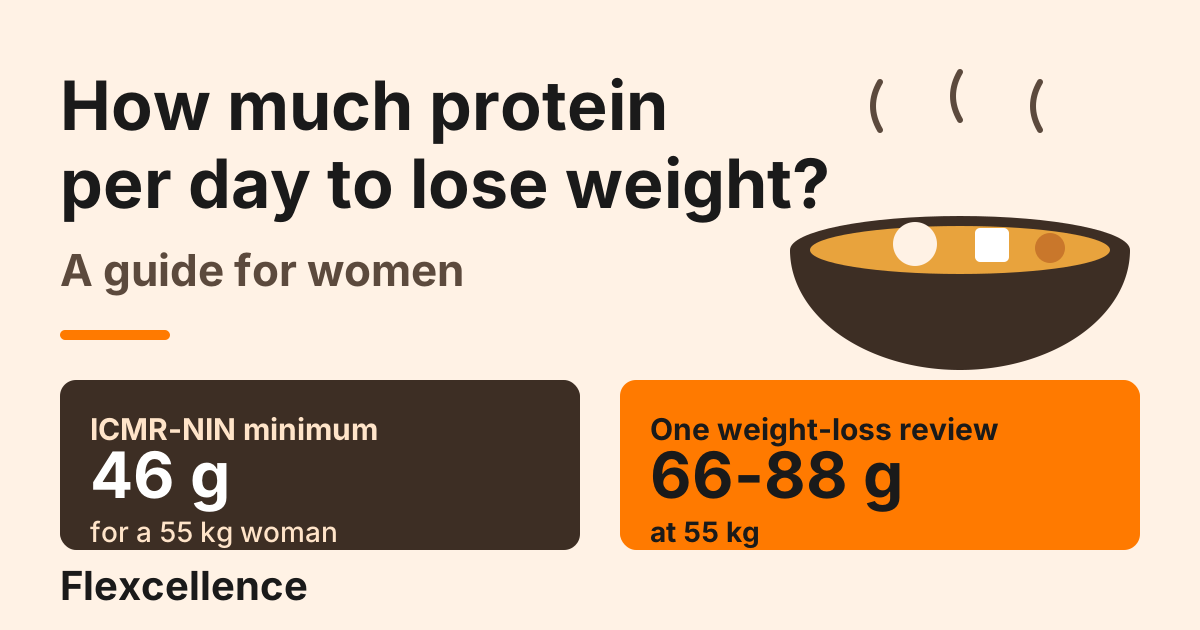
ICMR-NIN's minimum for healthy adults is 0.83 g per kg a day, about 46 g for a 55 kg woman. One review of weight-loss research suggests about 1.2-1.6 g per kg, roughly 66-88 g at 55 kg. Your own number depends on your health; kidney disease and pregnancy need doctor advice.
Work out your own numbers
Estimate optimal daily protein intake by weight and goal.
Free, takes a minute, and uses the same formulas our coaches use.
Open the Protein Intake CalculatorOn this page
You searched for one number in grams. Here it is first: ICMR-NIN's minimum for a 55 kg woman is about 46 g a day, and one review of weight-loss research suggests about 66-88 g a day for her.[1][4] The rest of this guide shows how to work out your own number and what it looks like on an Indian plate, with dal, paneer, egg and curd. It is written for healthy adult women. If you have kidney disease, are pregnant or breastfeeding, or have diabetes, read When to see your doctor first.
How much protein per day for women: the numbers
ICMR-NIN (the Indian Council of Medical Research's National Institute of Nutrition, Hyderabad) sets the protein RDA for healthy Indian adults at 0.83 g per kg of body weight a day. For its 55 kg reference woman, that is 45.7 g a day.[1] RDA means the amount that meets the needs of 97.5% of healthy people.[2]
That is a minimum for staying healthy, not a weight-loss target. One review of the research on protein and weight loss suggests about 1.2-1.6 g per kg a day for people cutting calories.[4] Treat that as one review's summary, not a rule. For a 55 kg woman, it works out to 66-88 g a day (our arithmetic).
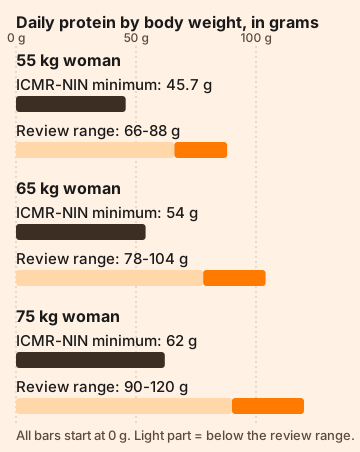
Daily protein for 55, 65 and 75 kg women: ICMR-NIN RDA of 0.83 g/kg[1] beside the 1.2-1.6 g/kg range from one weight-loss review.[4] Grams are our arithmetic.
Work out your number
Step 1: your weight in kg. Our coaches suggest starting with your current weight for a first estimate. If your BMI is high, a number based on current weight can come out very large. In that case, use the calculator below and ask a coach or doctor whether to use a goal weight instead.
Step 2: multiply. Multiply your weight by 1.2 and by 1.6. Those are the two ends of the range suggested by the review.[4] The table is plain arithmetic, a worked example and not a prescription.
| Your weight | ICMR-NIN RDA (0.83 g/kg) | Review range (1.2-1.6 g/kg) | Per meal, 3 meals |
|---|---|---|---|
| 45 kg | 37 g | 54-72 g | 18-24 g |
| 55 kg | 45.7 g | 66-88 g | 22-29 g |
| 65 kg | 54 g | 78-104 g | 26-35 g |
| 75 kg | 62 g | 90-120 g | 30-40 g |
| 85 kg | 71 g | 102-136 g | 34-45 g |
NIN's note says people eating cereal-based diets with lower-quality protein need about 1 g per kg, for example 55 g at 55 kg.[1]
Check your own number. Our free protein intake calculator does the multiplication for you. Pair it with the calorie deficit calculator or the TDEE calculator to see how protein fits into your calories. A free 30-minute consultation call can help if you want a coach to check it.
Why published ranges differ
The International Society of Sports Nutrition says 1.4-2.0 g per kg a day is enough for most exercising people.[5] A meta-analysis (a study that pools many trials) of 49 trials in 1,863 healthy adults doing resistance training found no further gain in fat-free mass above about 1.62 g per kg a day.[6] That finding is from people lifting weights. Intakes of 2.3-3.1 g per kg are for resistance-trained people during calorie restriction, and are not general advice.[5]
The ICMR-NIN point
NIN's dietary guidelines say about 15% of energy from protein may help preserve muscle on a typical weight-loss diet with a 500-750 kcal deficit. They also say a typical Indian adult diet already gives about 60-70 g of protein a day, and that the main gap is protein quality, not quantity.[2]
Here is our own arithmetic. On 1,300 kcal a day, 66 g of protein is about 20% of energy (66 x 4 / 1,300), and 88 g is about 27%. So when calories are low, the research range sits above NIN's 15%. We are not saying one source is wrong. We are saying the right number depends on your calories, your food and your health, which is why we ask a coach or dietitian to set it. NIN also says protein powders are unnecessary for normal healthy life and warns about added sugars and prolonged excess use, so a powder is not the answer either.[2] If you have kidney disease, whether to use a powder is a decision for your doctor or dietitian.
Why protein helps when you cut calories
What the trials found
A meta-analysis pooled 24 randomised trials (people were assigned to diets by chance) with 1,063 adults on calorie-restricted diets, lasting 12 weeks on average. Higher-protein diets gave 0.79 kg more weight loss and 0.87 kg more fat loss than standard-protein diets, and the people on them lost 0.43 kg less fat-free mass.[3] The authors called the benefit modest. A larger review of 74 trials also found small-to-moderate effects in favour of higher protein for weight loss.[11]
Some trials looked at women only. Please note who they studied, because the results should not be stretched to every woman.
| Study | Who | What they found |
|---|---|---|
| Josse 2011[7] | 90 overweight or obese premenopausal women, 16 weeks, calorie-reduced diet with daily exercise | The group eating 30% of energy as protein, with high dairy, lost more fat in weeks 8-16 and gained lean mass |
| Layman 2005[8] | 48 women, about 46 years old, BMI about 33, 4 months, about 1,700 kcal for all | The group eating 1.6 g per kg lost more fat; exercise added to the effect |
| Layman 2003[9] | 24 women aged 45-56, 10 weeks | 125 g or 68 g of protein a day: weight loss was similar (7.5 and 7.0 kg), but the higher-protein group lost more fat relative to lean tissue |
Fullness, and the limits
Higher-protein meals give a modest rise in fullness, but they do not reliably reduce what you eat at the next meal. In longer studies, the benefit showed up mainly in people who stuck to the plan.[4] Another review found convincing evidence that high-protein diets raise the energy your body spends digesting food and increase fullness, but inconsistent evidence for extra weight loss.[13]
The POUNDS LOST trial is a useful reality check. It randomised 811 overweight adults to diets with 15% or 25% of energy from protein. After 2 years the weight loss was similar, 3.0 kg and 3.6 kg, and the people who attended more sessions lost more.[12] So protein helps, but it is not magic. A plan you can follow matters more.
Protein in Indian food: what the grams really look like
Per 100 g, raw
The Indian Food Composition Tables 2017 (IFCT) give these protein values per 100 g of raw food.[24]
- Pulses: lentil dal (masoor) 24.4 g, green gram dal (pesara pappu) 23.9 g, black gram dal (minapa pappu) 23.1 g, red gram dal (kandi pappu, also called toor dal) 21.7 g, rajma (red kidney beans) 19.9 g, Bengal gram (senagalu, chana) 18.8 g.
- Soybean: 35.6 g.
- Dairy: paneer (Indian cottage cheese) 18.9 g, cow milk 3.3 g.
- Egg and flesh foods: whole raw egg 13.3 g, skinless chicken breast 21.8 g, rohu (a freshwater fish) 19.7 g.
- Cereals: wheat atta (whole-wheat flour) 10.6 g, raw milled rice 7.9 g, ragi (finger millet) 7.2 g.
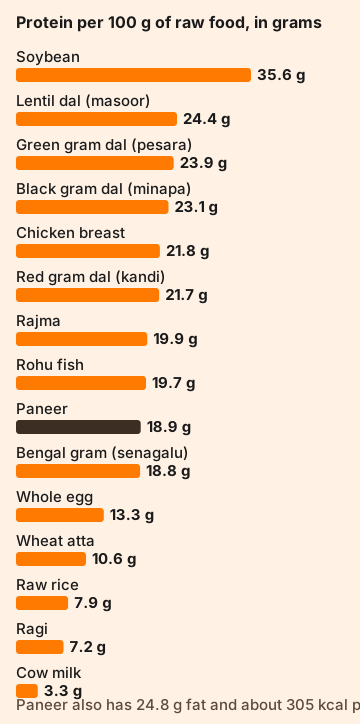
Protein per 100 g of raw food, from the Indian Food Composition Tables 2017.[24]
Protein-rich is not the same as light. Paneer has 18.9 g of protein, but also 24.8 g of fat and about 305 kcal per 100 g.[24]
Per serving, the honest picture
Raw numbers per 100 g do not tell you what is in your bowl. The Indian Nutrient Databank (INDB) gives recipe-level estimates per serving, which vary by recipe and portion.[25] The data are published as an open dataset.
- One bowl of washed moong dal (split green gram): about 7.4 g.
- One bowl of sambar (lentil and vegetable stew): about 8.6 g.
- One bowl of soyabean curry: about 12.5 g.
- One plate of curd rice (perugu annam): about 12.4 g.
- One boiled egg: about 6.7 g.
- One pesarattu (green gram dosa): about 3.3 g.
- One idli (steamed rice and black gram cake): about 1.2 g.
So a thin ladle of dal with rice and a couple of idlis will not reach 20 g at a meal. You need to add something.
Quality as well as quantity
Almost 60% of protein in Indian diets comes from cereals, which have lower digestibility and quality.[21] Another review estimated that 4-26% of the population, depending on age group and urban or rural sector, was at risk of quality-protein deficiency.[22] NIN suggests cereals and pulses at about 3:1 by raw weight, and adding 250 ml of milk a day further improves quality.[2] If you are vegetarian or eggless, we do not use a separate target. Our coaches check your mix of cereal, dal, curd and milk instead.
A day that adds up to about 70 g
A "bowl" here means one INDB serving, a typical katori of about 150-200 ml (our assumption; INDB servings vary). This is an example from our coaches, not a prescription. The protein and calorie figures are INDB recipe-level estimates per serving (a bowl, a plate or an egg), paneer calories are from IFCT, and the totals are our arithmetic.[25][24] Oil for tadka (tempering), tea and milk are not counted.
| Meal | Food and serving | Protein | Calories |
|---|---|---|---|
| Breakfast | 2 boiled eggs (egg day) or 1 bowl soyabean curry (vegetarian day) | 13.4 g or 12.5 g | 137 or 196 kcal |
| Breakfast | 2 pesarattu (green gram dosa) | 6.6 g | 152 kcal |
| Lunch | 1 bowl moong dal | 7.4 g | 139 kcal |
| Lunch | 1 plate curd rice (perugu annam) | 12.4 g | 423 kcal |
| Evening | 1 bowl sprouted moong salad | 4.7 g | 77 kcal |
| Dinner | 100 g paneer | 18.9 g | 305 kcal |
| Dinner | 1 bowl sambar | 8.6 g | 249 kcal |
| Egg day total | 72.0 g | about 1,480 kcal | |
| Vegetarian day total | 71.1 g | about 1,540 kcal |
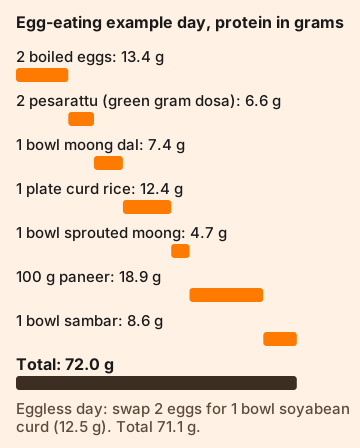
An example egg-eating day. Protein per serving is from INDB recipe-level estimates;[25] the totals are our arithmetic.
For a 55 kg woman, 66-88 g is the review range from earlier.[4] This day sits inside it. But it is not low in calories. At about 1,480-1,540 kcal it is above a 1,300 kcal plan, so a reader on fewer calories should shrink the heavier items (curd rice, paneer) rather than copy the day. Check the total with the calorie calculator.
Our coaches suggest three simple habits. Put a protein item in breakfast. Add one protein item to the lunch box. Keep curd or sprouts as your snack. If you eat meat or fish, IFCT lists skinless chicken breast and rohu at about 20 g per 100 g raw, which can replace the paneer or eggs above.[24] On a budget or when eating out, our coaches suggest dal, curd, eggs and sprouts as everyday options, and ask for dal, curd or a grilled item rather than a fried one. For more breakfast ideas, see our guide to high-protein Indian breakfasts.
Spreading it across meals
The review suggests about 25-30 g of protein per meal.[4] The ISSN guide is about 0.25 g per kg per meal, or 20-40 g, every 3-4 hours.[5] In a small 7-day study of 8 healthy adults, an even spread of about 30 g at each meal gave 25% higher 24-hour muscle protein synthesis than a skewed spread of about 11 g, 16 g and 63 g. That is a short-term marker, not a weight-loss result.[14] Another review says that above about 20-25 g of protein in a meal, more of the extra is burned for energy, but not all of it, and some still goes to building tissue.[15]
A 72 g day split in three is 24 g a meal, which is a little under the 25-30 g figure. It is a reasonable start, and a coach can adjust it.
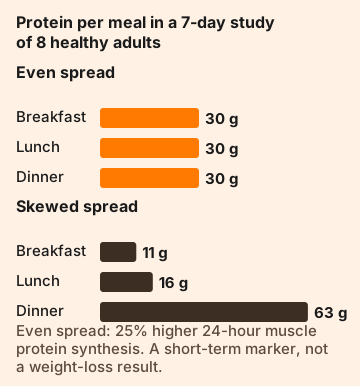
Protein per meal in a 7-day study of 8 healthy adults: an even spread gave 25% higher 24-hour muscle protein synthesis than a skewed one. A short-term marker, not a weight-loss result.[14]
One small crossover trial (each girl tried every breakfast in turn) of 20 breakfast-skipping girls, about 19 years old, compared a 35 g protein breakfast with a 13 g one and with skipping breakfast. Compared with skipping breakfast, the 35 g protein breakfast reduced evening snacking on high-fat foods. Daily energy intake did not differ.[16] It was a short study in young girls, so we do not claim it for all women.
What to do today
- Weigh yourself and note it in kg.
- Multiply by 1.2 and by 1.6 to get your range, or use the calculator.
- Add one protein item (egg, dal, curd, paneer, sprouts or soya) to each meal.
- Check the result against your health, then talk to a coach.
Who should not follow a general number
Kidney disease
A meta-analysis of 28 trials with 1,358 adults without kidney disease looked at kidney filtration (how well the kidneys clean the blood). The change in filtration did not differ between higher-protein and normal-protein diets. Here, high protein meant at least 1.5 g per kg, at least 20% of energy, or at least 100 g a day. Trials of more than 4 days were eligible, and many were short, so this is not proof of long-term safety.[17] That applies to healthy adults only. For adults with chronic kidney disease, the KDIGO 2024 guideline gives its own protein advice, which is different from the numbers in this article, so we do not quote a figure here.[18] Anyone with kidney disease, including diabetic kidney disease, should take a protein target from their doctor or kidney dietitian, not from a blog.
On bones, a meta-analysis of 16 trials and 20 cohort studies in adults found no adverse effect of higher protein intake on bone health.[19] That review looked at protein alone and together with calcium and vitamin D. Our coaches suggest keeping calcium-rich foods such as milk and curd in the plan.
Pregnancy and breastfeeding
Needs go up, so do not apply a weight-loss number, and do not use this article to cut calories while pregnant or in the first 6 months of breastfeeding without your doctor. The ICMR-NIN table lists extra protein of 9.5 g a day in the second trimester, 22 g in the third trimester, and 16.9 g in the first six months of breastfeeding. It lists no extra amount for the first trimester.[1]
Diabetes, thyroid and PCOS
The American Diabetes Association gives no diabetes-specific protein target, with a general range of about 0.8-1.5 g per kg a day, individualised to usual eating.[20] That range is not advice for everyone. Our coaches advise that if you take insulin or diabetes tablets, you talk to your doctor before changing your food mix, because your sugar levels and medicine needs may change. If you have diabetic kidney disease, the ADA says protein should not be cut below 0.8 g per kg a day, and your doctor or kidney dietitian should set your target.[20]
A 2024 meta-analysis in women with PCOS covered 8 trials with 300 women. High-protein diets lowered fasting insulin and a measure of insulin resistance, though results varied a lot between studies, so they are less certain. Weight loss, belly fat, blood fats and reproductive hormones were similar to balanced diets, and the authors concluded high-protein diets may help insulin resistance.[27] So for weight loss itself, the PCOS review did not find an advantage. None of the sources we cite gives a thyroid-specific protein number, so please ask your doctor if you have a thyroid condition. Our guide to PCOS weight loss covers more.
Other groups: ask first
Our coaches advise asking your doctor or dietitian before using a general number if you are over about 50 or past menopause, a teenager, fully vegan, or living with liver disease or gout. We do not give a number for these groups here.
When to see your doctor
- You have kidney disease or reduced kidney function, or a doctor has told you to limit protein.
- You are pregnant, trying to conceive or breastfeeding.
- You have diabetes, especially if you take insulin or tablets, or you take thyroid or PCOS medicines.
- Our coaches advise a doctor visit if you notice swelling, blood or foam in your urine, or unusual tiredness after raising your protein.
- You have liver disease or gout, or you are over about 50 or past menopause and want to raise your protein.
- You have a history of an eating disorder, or you are cutting your food very low.
This guide is general information, not medical advice. It does not promise any result on the scale. ICMR-NIN advises slow and steady weight reduction and warns that extreme approaches may be hazardous.[2]
How Flexcellence coaches handle it
Your protein number depends on your weight, calories, food habits and health. This is how our service works, not a promise of any result: at Flexcellence, a nutritionist and a fitness coach set your calories and protein together, build the plan around the food your family already cooks, and check in with you every week. If you would like help, book a free 30-minute consultation call. You can also start with the free protein intake calculator.
Related guides:
- High-protein Indian vegetarian foods, for food lists with grams.
- Indian diet plan for weight loss for women, for a full chart.
- Calorie deficit with Indian meals, to pair protein with calories.
- PCOS weight loss, for PCOS-specific questions.
- High-protein Indian breakfasts, for morning ideas.
Common questions
How much protein per day for women who want to lose weight?
ICMR-NIN's minimum for healthy adults is 0.83 g per kg a day, which is 45.7 g for its 55 kg reference woman. A review of weight-loss research suggests about 1.2-1.6 g per kg, or 66-88 g at 55 kg. Your coach or dietitian sets your own number.
Is 100 g of protein a day too much for an Indian woman?
It depends on your weight. At 55 kg, 100 g is about 1.8 g per kg, above the review range and above the 1.62 g per kg point where trials in healthy adults doing resistance training saw no extra muscle. At 75 kg it is 1.3 g per kg. With kidney disease, ask your doctor first.
Can I get enough protein from a vegetarian diet?
Yes, with a plan. One bowl of dal gives only about 7.4 g, so add paneer, curd, soya, sprouts or milk. ICMR-NIN says cereals and pulses at about 3:1 by raw weight, plus 250 ml of milk, improve protein quality. A coach can check your mix.
Do I need protein powder to lose weight?
Food comes first. ICMR-NIN says protein powders are unnecessary for normal healthy life and warns about added sugars, sweeteners and additives, and about prolonged excess use. It asks people to get protein from food combinations. If you are thinking of one, talk to your doctor or dietitian first, and especially if you have kidney disease.
Will extra protein harm my kidneys?
In a review of 28 trials with 1,358 adults who did not have kidney disease, the change in kidney filtration did not differ between higher and normal protein diets. The trials were short, so it is not proof of long-term safety, and it does not apply to kidney disease, where guidelines advise a lower target. If you have any kidney problem, ask your doctor.
Does the protein number change with PCOS, diabetes or thyroid conditions?
Ask your doctor first. The American Diabetes Association gives no diabetes-specific target, only a general range of 0.8-1.5 g per kg. A 2024 review of 8 PCOS trials found high-protein diets lowered fasting insulin, but weight loss was similar to balanced diets. We cite no thyroid-specific number. If you take medicines for these conditions, talk to your doctor and coach before changing your protein.
Reviewed by
Not yet reviewed by a Flexcellence coach.
Sources
ICMR-National Institute of Nutrition, Hyderabad. A Brief Note on Nutrient Requirements for Indians: Recommended Dietary Allowances (RDA) and Estimated Average Requirements (EAR) 2020 (2020).
ICMR-National Institute of Nutrition, Hyderabad. Dietary Guidelines for Indians 2024 (Guideline 8: protein; weight management; physical activity) (2024).
American Journal of Clinical Nutrition (Wycherley TP et al.). Effects of energy-restricted high-protein, low-fat compared with standard-protein, low-fat diets: a meta-analysis of randomized controlled trials (2012).
American Journal of Clinical Nutrition (Leidy HJ et al.). The role of protein in weight loss and maintenance (2015).
Journal of the International Society of Sports Nutrition (Jager R et al.). International Society of Sports Nutrition Position Stand: protein and exercise (2017).
British Journal of Sports Medicine (Morton RW et al.). A systematic review, meta-analysis and meta-regression of the effect of protein supplementation on resistance training-induced gains in muscle mass and strength in healthy adults (2018).
Journal of Nutrition (Josse AR et al.). Increased consumption of dairy foods and protein during diet- and exercise-induced weight loss promotes fat mass loss and lean mass gain in overweight and obese premenopausal women (2011).
Journal of Nutrition (Layman DK et al.). Dietary protein and exercise have additive effects on body composition during weight loss in adult women (2005).
Journal of Nutrition (Layman DK et al.). A reduced ratio of dietary carbohydrate to protein improves body composition and blood lipid profiles during weight loss in adult women (2003).
European Journal of Clinical Nutrition (Santesso N et al.). Effects of higher- versus lower-protein diets on health outcomes: a systematic review and meta-analysis (2012).
New England Journal of Medicine (Sacks FM et al., POUNDS LOST). Comparison of weight-loss diets with different compositions of fat, protein, and carbohydrates (2009).
Journal of the American College of Nutrition (Halton TL, Hu FB). The effects of high protein diets on thermogenesis, satiety and weight loss: a critical review (2004).
Journal of Nutrition (Mamerow MM et al.). Dietary protein distribution positively influences 24-h muscle protein synthesis in healthy adults (2014).
Journal of the International Society of Sports Nutrition (Schoenfeld BJ, Aragon AA). How much protein can the body use in a single meal for muscle-building? Implications for daily protein distribution (2018).
American Journal of Clinical Nutrition (Leidy HJ et al.). Beneficial effects of a higher-protein breakfast on the appetitive, hormonal, and neural signals controlling energy intake regulation in overweight/obese, breakfast-skipping, late-adolescent girls (2013).
Journal of Nutrition (Devries MC et al.). Changes in Kidney Function Do Not Differ between Healthy Adults Consuming Higher- Compared with Lower- or Normal-Protein Diets: A Systematic Review and Meta-Analysis (2018).
Kidney Disease: Improving Global Outcomes (KDIGO), Kidney International. KDIGO 2024 Clinical Practice Guideline for the Evaluation and Management of Chronic Kidney Disease (2024).
American Journal of Clinical Nutrition (Shams-White MM et al., National Osteoporosis Foundation). Dietary protein and bone health: a systematic review and meta-analysis from the National Osteoporosis Foundation (2017).
American Diabetes Association (Diabetes Care). 5. Facilitating Positive Health Behaviors and Well-being to Improve Health Outcomes: Standards of Care in Diabetes-2025 (2025).
British Journal of Nutrition (Swaminathan S, Vaz M, Kurpad AV). Protein intakes in India (2012).
Journal of Nutrition (Minocha S, Thomas T, Kurpad AV). Dietary Protein and the Health-Nutrition-Agriculture Connection in India (2017).
ICMR-National Institute of Nutrition (Longvah T et al.). Indian Food Composition Tables 2017 (2017).
Indian Nutrient Databank (open dataset, GitHub). Indian Nutrient Databank (INDB) recipe dataset (2024).
Nutrition & Diabetes (Wang et al.). Effects of high-protein diets on the cardiometabolic factors and reproductive hormones of women with polycystic ovary syndrome: a systematic review and meta-analysis (2024).