Indian Meal Prep Ideas for Weight Loss: 7-Day US Plan
Indian meal prep ideas for weight loss: a 7-day chart with US groceries, a two-session cook plan, ICMR portions and safe fridge and freezer times.
The short answer
Cook in two short sessions, not one: dal, vegetable kuras and pulses for days 1 to 3, then a second batch or freezer portions for the rest of the week. Fill each box with vegetables, a pulse, egg, fish or paneer, a measured portion of grain and little oil. This makes steady eating easier during weight loss, but no result is promised. Eat cooked rice within a day or freeze it quickly.
Work out your own numbers
Calculate meal calories from common Indian food portions.
Free, takes a minute, and uses the same formulas our coaches use.
Open the Meal Calorie CalculatorOn this page
You get home tired. Takeout is one tap away. Meal prep is a simple answer to that: you cook some things once and eat them over several days, so the better choice is also the easy choice. This page gives you a calm, two-session week of Indian meal prep, boxes built on the ICMR (Indian Council of Medical Research) plate, safe fridge and freezer limits, and a 7-day chart that uses groceries you can find in the US.
An honest note: most research on meal planning is observational, so it shows links, not proof. A prep plan will not "burn fat" or guarantee any result. It makes it easier to eat the way you already want to eat.
Read this first. This is general education, not medical advice. If you have diabetes, a thyroid condition, PCOS on medicines or kidney disease, are pregnant or breastfeeding, are underweight, or have ever had a difficult relationship with food, please read the last section before you change how you eat.
Want the plan straight away? Jump to the 7-day chart.
A 7-day Indian meal prep chart (South Indian style, US groceries) {#seven-day-chart}
This is an example for a healthy adult, built around the ICMR food groups. It is not a prescription. The layout follows the ICMR plate: vegetables and fruit about half the plate, a pulse, egg, fish or paneer at the main meals, and a measured portion of grain.[3] No dish below is "fat-burning"; it is just food.
Standard box (our coaches' suggestion): about half the box vegetables; 1 to 1.5 katori (a small bowl, about 150 ml) of cooked dal or another pulse, or about 50 g paneer, or 1 to 2 eggs, or about 100 g raw fish or chicken; 1 phulka (thin oil-free roti) or about 1 katori of cooked rice; oil measured with a spoon.
| Day | Breakfast | Lunch box | Dinner | Prep note and rough protein from main foods (estimate) |
|---|---|---|---|---|
| Mon | Pesarattu (green gram dosa) with ginger chutney | Phulka, kandi pappu (toor dal), beerakaya kura (ridge gourd curry), perugu (curd) | Sambar (lentil and vegetable stew) with 1 katori rice and a vegetable side | From Session 1: dal and kura. About 20 to 25 g |
| Tue | Ragi java (finger-millet porridge) with a boiled egg or roasted chana | Lauki (bottle gourd) with chana dal (split chickpeas) and phulka | Dal, cabbage kura, perugu | Eggs and dal from Session 1. About 18 to 22 g |
| Wed | Idli (steamed rice and black gram cake) with sambar; store-bought batter, follow the pack | Chana sundal (boiled chickpea stir-fry) salad bowl | Fresh sambar, cooked in Session 2 | Session 2 starts. About 14 to 18 g |
| Thu | Vegetable upma (savoury semolina or millet porridge) | Fish pulusu (tangy tamarind fish curry) or paneer bhurji (scrambled cottage cheese) with rice, fresh or a frozen portion | Mixed vegetable kura with phulka | Rice: fresh or frozen, not 3 days old. About 10 g (paneer) to 20 g (fish) |
| Fri | Ragi dosa or oats with chutney | Egg curry or soya chunk kura with phulka | Vegetable khichdi (one-pot rice and lentils) with perugu | Soya and egg are swaps for the pulse. About 19 g with egg; soya not estimated |
| Sat | Egg bhurji (scrambled eggs) with phulka | Freezer portion of dal and a vegetable kura | Chicken curry with vegetables and 1 katori rice, a family meal | Fresh cook or freezer portions. About 35 to 40 g |
| Sun | Idli with sambar, from a fresh batch of store-bought batter (follow the pack) | A freezer portion of dal and kura; Wednesday's leftovers would be past the 3 to 4 day limit | Dal soup and a big salad | Cook Session 1 again today. Our rhythm, not a rule. About 12 to 18 g |
How we estimated protein. These are our own rough sums, not a measured analysis. We used the raw-weight values in the Indian Food Composition Tables (red, green and black gram dals 21.7 to 23.9 g per 100 g, egg 13.3 g, paneer 18.9 g, Bengal gram 18.8 g, rohu fish 19.7 g, chicken breast 21.8 g)[5] and assumed about 25 to 30 g of raw dal per katori, one egg of about 50 g, 50 g of paneer, and 100 g raw fish or chicken. Grains, vegetables, curd and nuts add more, which we did not count. So the main-food total is only about 10 to 40 g a day, and many people will want a second protein food in a box. ICMR's allowance is 0.83 g per kg a day, which is about 45.7 g at 55 kg.[4] We have not put calories in the chart, because they depend on your portions and oil. The meal calorie calculator will total your own version.
Chart notes. Pickles, podis (dry spice and lentil powders), store sauces and packaged soya or sambar mixes can add salt, so our coaches suggest checking labels, especially if you have high blood pressure. If you take glucose-lowering medicines, rice, idli and ragi java portions and meal timing can change your blood sugar, so ask your doctor first and see our diabetes diet chart for Indians. If you are pregnant or breastfeeding, fish choices and food-safety rules are different, so ask your doctor and see our pregnancy diet chart. For a fuller menu, see our South Indian weight-loss diet plan and the diet plan for working women.
Indian vegetarian meal prep: swaps for the same chart
Egg, fish, chicken, paneer, tofu or soya can replace part of the pulse portion.[3] For Indian vegetarian meal prep, drop the fish, chicken and egg days and use paneer, tofu, soya chunks, chana, rajma (kidney beans) or a second dal instead. Use unsweetened perugu or majjiga (thin spiced buttermilk) instead of sweet drinks.
Dish names used in this article
| Word | Meaning |
|---|---|
| Kura | Vegetable curry |
| Pappu | Dal (cooked lentils); kandi pappu is toor or red gram dal |
| Pulusu | Tangy tamarind curry |
| Podi | Dry spice and lentil powder |
| Dosa | Pancake from a fermented rice and black gram batter |
| Majjiga | Thin spiced buttermilk |
| Katori | Small bowl, about 150 ml (our coaches' size) |
| Patel Brothers | A chain of Indian grocery stores in the US |
Does meal prep actually help with weight loss? {#does-it-help}
Short answer: it is linked with better eating, and the studies cannot prove why.
Planning meals goes with better diet quality. In a study of 40,554 French adults, people who planned their meals were more likely to be in the top quarter for diet quality and for food variety. Women who planned meals had lower odds of overweight (odds ratio 0.92) and of obesity (0.79). It was a cross-sectional study, so it shows an association, not that planning caused the difference.[6]
Home cooking shows a similar pattern. Among 11,396 UK adults aged 29 to 64, those who ate home-cooked main meals more than 5 times a week, compared with fewer than 3 times, ate about 98 g more vegetables and 62 g more fruit a day and were 28% less likely to have an overweight BMI. There was no significant link with HbA1c, cholesterol or blood pressure after adjustment, and the design was cross-sectional.[7]
Time is the real barrier. In a 2008 to 2009 population-based survey of 1,319 US adults, people who spent under an hour a day on food preparation were often working adults who prioritised convenience, and they used more fast food.[8] If that sounds like your week, prep is aimed at you.
Food type matters too. In a small inpatient trial of 20 adults, people ate about 508 kcal a day more on an ultra-processed diet than on an unprocessed diet when they could eat as much as they wanted.[9] That trial was about the type of food, not about prep. Our coaches suggest that a fridge full of home-cooked boxes makes the unprocessed choice the easy one.
Writing down what you eat also helps some people. A review of 22 studies found that self-monitoring was consistently linked with weight loss, although the evidence quality was weak and the samples were mostly white women.[16] A planned box is easy to log, because you already know what is in it.
None of this promises a number on the scale. For the calories in your own box, use the free meal calorie calculator.
Build the box: the ICMR plate and a few numbers {#build-the-box}
The ICMR "My Plate for the Day"
ICMR's National Institute of Nutrition describes a 2,000 kcal reference day using raw weights: cereals including millets 250 g (about 42% of energy), pulses 85 g (14%), milk or curd 300 ml (11%), vegetables including green leafy vegetables 400 g (9%), fruit 100 g (3%), nuts and seeds 35 g (9%), and fats and oils 27 g (12%).[3] Vegetables, fruit and roots make up about half the plate. The plate gives about 15% of energy from protein and about 30% from fat. Eggs, fish or meat can replace a portion of the pulses.[3]
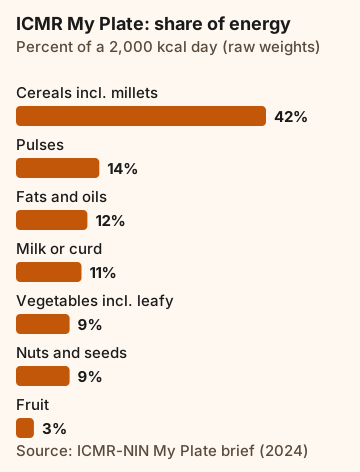
Figure 1. Share of energy by food group in the ICMR 2,000 kcal reference day, which uses raw weights.[3]
2,000 kcal is a reference day, not a weight-loss target. ICMR lists a reference sedentary Indian woman of 55 kg at about 1,660 kcal a day, and 2,130 kcal for moderate work. Energy needs depend on body weight and activity.[4] The proportions of vegetables, fruit and milk stay the same when the calories change.[3] So scale the cereal and the oil first, and keep the vegetables.
Weight-loss guidance, without the promises
In the weight-loss section of its guidelines, ICMR describes an energy deficit of 500 to 750 kcal a day, advises not going beyond a 40% deficit, and suggests about 15% of energy from protein to help preserve muscle, with a cereal to pulse ratio of about 3:1 to 5:1.[1] The 40% figure is an upper limit, not a target to aim for. Our coaches suggest this guidance is for adults who have excess weight and whose doctor agrees. It is not for people who are lean or underweight, older adults without medical advice, or anyone pregnant or breastfeeding.
Please do not turn the numbers into "kg per week". The old rule that 3,500 kcal equals one pound overestimates real weight loss in closely supervised experiments.[27] ICMR also says that weight loss should be slow and steady, and that extreme approaches can harm health.[2] NIDDK in the US suggests a starting goal of about 5 to 10% of your starting weight over 6 months, and lists very fast loss and "eat anything" claims as warning signs of an unsafe programme.[28]
A meta-analysis of 48 randomised trials in 7,286 overweight and obese adults found that differences between named diets were small.[26] Our coaches' view is that this supports choosing a way of eating you can keep up.
Protein in each box
ICMR's protein allowance is 0.83 g per kg of body weight a day for a reference adult, and about 1 g per kg for cereal-based diets with lower-quality protein. That is about 45.7 g a day at 55 kg.[4] Higher-protein diets give slightly more weight loss and keep more lean mass. In a meta-analysis of 24 trials with 1,063 adults (mean 12 weeks, same calories in both arms), they gave 0.79 kg more weight loss and 0.87 kg more fat loss.[12] A review suggests that 1.2 to 1.6 g per kg a day, and about 25 to 30 g of protein per meal, may help appetite, body weight and body composition. The review notes that longer-term studies were limited and conflicting, and that benefits showed up in people who stuck to the higher-protein plan.[13] Those higher amounts are not for everyone. If you have kidney disease, ask your doctor or dietitian first.
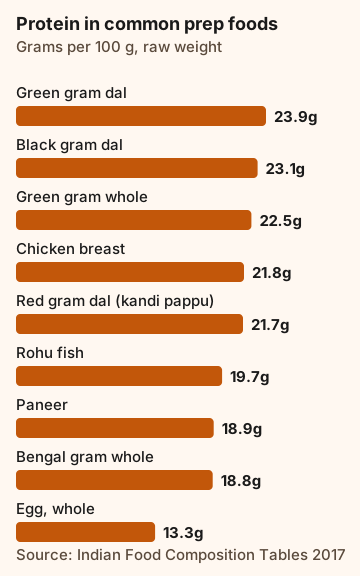
Figure 2. Protein per 100 g raw weight, from the Indian Food Composition Tables.[5]
These figures are for raw foods. Cooked values differ, because water is added when you cook.[5]
Pulses and fibre
Pulses help a little with weight. In 21 trials with 940 people (median 6 weeks), diets that included about one serving of pulses a day (median 132 g) gave 0.34 kg more weight loss than diets without. That is a small effect in short trials.[14] Fibre matters for disease risk. A large review of 185 prospective studies and 58 clinical trials linked higher fibre intake with lower risk of several diseases, with the biggest risk reduction at 25 to 29 g of fibre a day. In the trials, which were not weight-loss trials, higher fibre was also linked with lower body weight, blood pressure and cholesterol.[15] Dal, chana, rajma and millets are cheap ways to add both.
Oil, portions and salt
- Oil: ICMR's figure for visible fat is 20 to 50 g (4 to 10 teaspoons) a day depending on energy need, and not more than 27 g on a 2,000 kcal diet.[4] Fat gives about 9 kcal per gram on the standard Atwater factors.[30] When you cook a big batch, our coaches suggest measuring the oil with a spoon.
- Portions: a Cochrane review of 72 studies in adults and children found that larger portions, packages and tableware increased how much people ate, and rated the evidence as moderate quality.[10] A review of 22 controlled trials of portion size and eating frequency in adults found larger portions went with about 295 kcal a day more intake, though there was too little long-term data to show effects on body weight.[11] Fixed-size boxes and a katori make this easy. This is our coaches' suggestion.
- Salt: both WHO and ICMR advise adults to keep salt under 5 g a day, which WHO puts at about one teaspoon.[25][1] Pickles, podis and store sauces add salt, so our coaches suggest checking labels.
- Packets: the point is to batch-cook from raw ingredients, not to ban every packet.
The two-session week: what to cook on Sunday and Wednesday {#two-session-week}
The US FDA says cooked dishes like meat dishes, poultry dishes, fish and soups or stews keep for 3 to 4 days in the fridge.[20] A single huge Sunday cook would leave days 5 to 7 outside that window. So our coaches suggest two shorter sessions instead. The schedule is ours; the 3 to 4 day limit is the FDA's.
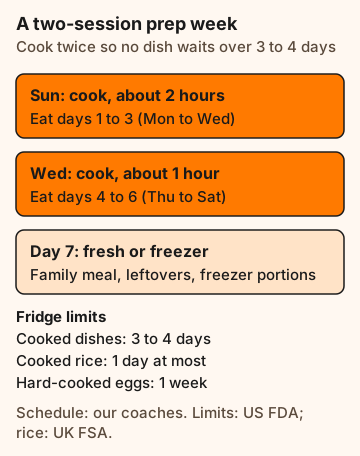
Figure 3. Our coaches' two-session schedule, built around the FDA 3 to 4 day fridge limit for cooked dishes, the UK FSA 1 day limit for rice, and the FDA 1 week limit for hard-cooked eggs.[20][22]
Session 1: Sunday, about 2 hours (feeds days 1 to 3)
- One pot of kandi pappu or moong dal as the base.
- One or two vegetable kuras.
- A batch of chutney or podi.
- Hard-cooked eggs. The FDA gives 1 week in the fridge and says not to freeze them.[20]
- A pot of boiled chana (chickpeas) or rajma (kidney beans), and some cut vegetables.
- Extra portions go straight into the freezer.
Session 2: Wednesday evening, about 60 to 75 minutes (feeds days 4 to 6)
- A different dal or fresh sambar.
- One more kura.
- Fresh grain.
- Fish or chicken curry, cooked fresh or taken from the freezer.
Day 7 is for eating fresh or from the freezer, and for a family meal.
Cook once, use twice
One pot of dal can be a plain dal on Monday and sambar on Tuesday, once you add vegetables and tamarind. Boiled chana can become sundal one day and a salad bowl the next. Pulses are rich in protein in the food tables,[5] and in our coaches' experience they are also easy on the budget.
Cooking methods
ICMR advises sauteing, steaming, grilling, boiling or baking instead of frying, and says not to reuse heated oils.[1] Fermentation (idli, dosa, dhokla, a steamed gram-flour cake) and sprouting are common in Indian cooking, and ICMR notes that they improve digestibility and the bioavailability of micronutrients.[1]
A small note on rice
In a trial with 15 healthy adults, rice that was cooled for 24 hours at 4°C and then reheated had more resistant starch (1.65 g per 100 g, against 0.64 g for fresh rice) and gave a lower blood glucose response (125 against 152 mmol·min/L). It was a small effect in healthy people, and the study was not about weight loss.[24] Do not use this as a reason to leave rice out. The safety rules below come first.
Storage, freezing and reheating (and the rice rule) {#storage-and-safety}
- Temperatures: keep the fridge at 40°F (4°C) or below and the freezer at 0°F (-18°C) or below. Use an appliance thermometer to check.[21]
- Cool fast: refrigerate or freeze within 2 hours of cooking, or within 1 hour if it is above 90°F (32°C) outside. Divide big pots into shallow containers so they cool faster.[21]
- Reheat: the FDA says to heat leftovers and casseroles to 165°F (74°C) and to bring soups, sauces and gravy to a boil.[21] Our coaches suggest treating curries, fish and egg dishes the same way.
- Thaw safely: in the fridge, in cold water or in the microwave, never on the counter.[21]
The rice rule
Uncooked rice can carry spores of Bacillus cereus, and the risk comes from how cooked rice is stored before reheating. The UK Food Standards Agency advises chilling leftover rice as quickly as possible, ideally within 1 hour, and not leaving it to cool in the rice cooker or pan. Keep it in the fridge for no more than 1 day (24 hours), and reheat it only once, until it is steaming hot all the way through. Rice can be frozen in small containers within an hour of cooking, defrosted in the fridge and then reheated until steaming hot.[22]
This UK advice is stricter than the FDA's 3 to 4 days for dishes, so treat rice as the exception to the general fridge limit. Do not copy the common blog claim that cooked rice keeps for 4 or 5 days.
Freezer notes
Freezing at 0°F keeps food safe indefinitely. The freezer times on the FDA chart are for quality only: cooked meat dishes and soups or stews 2 to 3 months, and cooked poultry and fish 4 to 6 months.[20] The chart does not list dal or sambar. Our reading is to treat them like soups and stews, which is our coaches' judgement and not an FDA statement.
Frozen vegetables are a fine shortcut. In a lab comparison of 8 fruits and vegetables, vitamin C was the same in 5 of 8 foods and higher in frozen for the other 3, compared with fresh stored in the fridge. Beta-carotene was lower in frozen peas, carrots and spinach.[23]
| Food | Fridge | Freezer (for quality) | Notes |
|---|---|---|---|
| Cooked meat, poultry or fish dishes (for example chicken curry or fish pulusu) | 3 to 4 days | Meat 2 to 3 months; poultry and fish 4 to 6 months (quality, not safety) | Reheat to 165°F[20][21] |
| Soups and stews | 3 to 4 days | 2 to 3 months | Dal and sambar: our coaches treat them like stews[20] |
| Hard-cooked eggs | 1 week | Do not freeze | Fridge only[20] |
| Cooked rice | No more than 1 day | Freeze within 1 hour, in small containers | Reheat once, steaming hot throughout; UK FSA advice[22] |
Shortcuts for busy weeks, and US grocery notes {#shortcuts-and-us-groceries}
In the US survey above, the adults who spent under an hour a day on food prep were often working adults.[8] By our estimate, the two sessions above come to about 3 to 3.5 hours a week. If that is too much, start with one session and add the second later.
US store map (our coaches' suggestions):
- Full shopping list: see our healthy Indian grocery list for the US.
- Indian stores such as Patel Brothers: dals, atta (whole wheat flour), ragi flour, millets, pickles and podis.
- Costco, Trader Joe's, Walmart: eggs, chicken, fish, frozen vegetables and plain curd.
- Appliance: an Instant Pot or pressure cooker for dal and chana.
Frozen vegetables are an acceptable shortcut.[23] Our coaches suggest dried pulses as the budget protein base. For freezing, our coaches suggest freezing cooked portions, and making idli and dosa batter fresh or following the pack. We do not yet have a food-safety source for freezing batter, so we leave it out. Pack lunch boxes cold and reheat to 165°F.[21]
The move to the US can quietly change what we eat. In 874 South Asian adults in the US MASALA study, longer US residence was linked with less fibre, beans and lentils, and with more fat and mixed dishes such as pizza and pasta. The design was cross-sectional, so it shows association, not cause.[17] Keeping dal on the weekly menu is a simple way to hold on to the old pattern. For more on this shift, read why Indians gain weight after moving to the USA.
Common mistakes, and when to see your doctor {#see-your-doctor}
Common mistakes
- Cutting calories too far or skipping meals. ICMR warns that extreme approaches can harm health.[2]
- Prepping six or seven days of food at once, which goes past the 3 to 4 day fridge limit.[20]
- Leaving rice out to cool.[22]
- Treating prep as a 7-day "detox".
Please talk to your doctor or a registered dietitian first if you are pregnant or breastfeeding, or have diabetes, kidney disease, a thyroid condition, PCOS with medicines, or take any medicine that changes with food. Our coaches suggest asking before changing your diet in these cases. In particular, if you take insulin or a sulfonylurea, do not cut carbohydrate portions or skip meals without advice, because blood sugar can drop too low. The protein advice above does not apply if you have kidney disease. NIDDK also says that talking with a health care professional about your weight is an important first step.[28]
Eating disorder warning signs. The NHS lists constant worry about weight and shape, eating very little, strict food rules, making yourself sick or using laxatives, exercising excessively, and avoiding eating with others. Physical signs include feeling cold, tired or dizzy, fainting, a racing heartbeat and missed periods. If you think you may have an eating disorder, see a doctor as soon as you can.[29] A prep plan with strict rules can make this worse. If that feels familiar, stop and get help.
See a doctor if you notice dizziness or fainting, missed periods, very low energy, feeling cold all the time, or weight that changes quickly without a reason.[29]
A note for South Asians in the US. Asian Americans tend to develop type 2 diabetes at a lower BMI than white Americans.[19] The American Diabetes Association's 2025 Standards of Care say testing should be considered for adults with overweight (BMI 25 or more, or 23 or more in people of Asian ancestry) who have one or more risk factors, and list Asian American ancestry among them.[31] Ask your doctor whether a blood sugar check makes sense for you.
Your first step this week
You do not need to do all seven days. Pick one session this Sunday: a pot of dal, one vegetable kura and a few hard-cooked eggs, packed into three boxes. Then check what a box adds up to with the free meal calorie calculator. If you would like a weekly plan built around your own Indian food, with a coach in your time zone, you can book a free consultation call. There is no pressure and no promised results.
Common questions
How long does cooked Indian food last in the fridge?
The US FDA says cooked meat, poultry and fish dishes and soups or stews keep 3 to 4 days in the fridge at 40°F (4°C) or below, and hard-cooked eggs keep 1 week. Cooked rice is the exception: UK Food Standards Agency advice is no more than 1 day (24 hours).
Can I freeze cooked rice, dal and sambar?
Rice can be frozen in small containers within an hour of cooking, defrosted in the fridge and reheated until steaming hot. FDA freezer times are for quality only. Dal and sambar are not on the FDA chart, so our coaches treat them like soups and stews, which the FDA lists at 2 to 3 months.
Is it safe to reheat rice?
Yes, if you cool it quickly (ideally within 1 hour), keep it in the fridge for no more than 1 day, and reheat it only once until it is steaming hot all the way through. The UK Food Standards Agency gives this advice because of Bacillus cereus spores. The FDA says to reheat leftovers to 165°F (74°C).
Does meal prep help you lose weight?
Studies link meal planning and home cooking with better diet quality and lower odds of overweight, in French and UK adults. These are observational, so they do not prove prep causes weight loss. Portion size and food type also affect how much people eat. No result can be promised.
How do I do high-protein Indian vegetarian meal prep?
Put a pulse, paneer or (if you eat them) eggs in every box. The Indian Food Composition Tables list raw red, green and black gram dals at 21.7 to 23.9 g protein per 100 g and paneer at 18.9 g; cooked values are lower per 100 g because water is added. ICMR's protein allowance is 0.83 g per kg of body weight a day for a reference adult. If you have kidney disease, ask your doctor or dietitian before raising protein.
Do I need to count calories to meal prep for weight loss?
Not necessarily. ICMR describes a 500 to 750 kcal a day deficit in its weight-loss guidance and advises not going beyond a 40% deficit, which is an upper limit and not a target. A calculator gives only an estimate, so talk to a health care professional first, as NIDDK suggests.
Reviewed by
Not yet reviewed by a Flexcellence coach.
Sources
ICMR-National Institute of Nutrition. Dietary Guidelines for Indians (Revised Edition 2024) (2024).
ICMR-National Institute of Nutrition, Hyderabad. Dietary Guidelines for Indians (2024) - summary booklet (2024).
ICMR-National Institute of Nutrition, Hyderabad. Policy Brief: Promotion of 'My Plate for the Day' and physical activity (2024).
ICMR-National Institute of Nutrition, Hyderabad. A Brief Note on Nutrient Requirements for Indians: RDA and EAR 2020 (2020).
ICMR-National Institute of Nutrition (Longvah T, Ananthan R, Bhaskarachary K, Venkaiah K). Indian Food Composition Tables 2017 (2017).
International Journal of Behavioral Nutrition and Physical Activity (Ducrot P et al., NutriNet-Santé). Meal planning is associated with food variety, diet quality and body weight status in a large sample of French adults (2017).
International Journal of Behavioral Nutrition and Physical Activity (Mills S et al., Fenland study). Frequency of eating home cooked meals and potential benefits for diet and health: cross-sectional analysis of a population-based cohort study (2017).
American Journal of Preventive Medicine (Monsivais P, Aggarwal A, Drewnowski A). Time spent on home food preparation and indicators of healthy eating (2014).
Cell Metabolism. Ultra-Processed Diets Cause Excess Calorie Intake and Weight Gain: An Inpatient RCT of Ad Libitum Food Intake (Hall KD et al.) (2019).
Cochrane Database of Systematic Reviews (Hollands GJ et al.). Portion, package or tableware size for changing selection and consumption of food, alcohol and tobacco (2015).
Advances in Nutrition. Systematic Review and Meta-Analysis on the Effect of Portion Size and Ingestive Frequency on Energy Intake and Body Weight among Adults in RCTs (2022).
American Journal of Clinical Nutrition (Wycherley TP et al.). Effects of energy-restricted high-protein, low-fat compared with standard-protein, low-fat diets: a meta-analysis of randomized controlled trials (2012).
American Journal of Clinical Nutrition (Leidy HJ et al.). The role of protein in weight loss and maintenance (2015).
American Journal of Clinical Nutrition (Kim SJ et al.). Effects of dietary pulse consumption on body weight: a systematic review and meta-analysis of randomized controlled trials (2016).
The Lancet (Reynolds A et al.). Carbohydrate quality and human health: a series of systematic reviews and meta-analyses (2019).
Journal of the American Dietetic Association (Burke LE et al.). Self-monitoring in weight loss: a systematic review of the literature (2011).
Public Health Nutrition (Talegawkar SA, Kandula NR, Gadgil MD, Desai D, Kanaya AM; MASALA study). Dietary intakes among South Asian adults differ by length of residence in the USA (2016).
Diabetes Care (Hsu WC, Araneta MR, Kanaya AM, Chiang JL, Fujimoto W). BMI cut points to identify at-risk Asian Americans for type 2 diabetes screening (2015).
US Food and Drug Administration. Refrigerator & Freezer Storage Chart (2018).
US Food and Drug Administration. Safe Food Handling (2024).
Food Standards Agency (UK). Home food fact checker (rice, eggs, meat, freezing) (2026).
Journal of Agricultural and Food Chemistry (Bouzari A, Holstege D, Barrett DM). Vitamin retention in eight fruits and vegetables: a comparison of refrigerated and frozen storage (2015).
Asia Pacific Journal of Clinical Nutrition. Effect of cooling of cooked white rice on resistant starch content and glycemic response (Sonia S et al.) (2015).
World Health Organization. Salt reduction (fact sheet) (2026).
JAMA (Johnston BC et al.). Comparison of weight loss among named diet programs in overweight and obese adults: a meta-analysis (2014).
International Journal of Obesity (Thomas DM, Gonzalez MC, Pereira AZ, Redman LM, Heymsfield SB). Can a weight loss of one pound a week be achieved with a 3500-kcal deficit? Commentary on a commonly accepted rule (2013).
US National Institute of Diabetes and Digestive and Kidney Diseases (NIDDK). Choosing a Safe & Successful Weight-loss Program (2025).
NHS (UK). Eating disorders: overview (reviewed 23 January 2024) (2024).
FAO (Food and Agriculture Organization of the UN). Food energy - methods of analysis and conversion factors (FAO Food and Nutrition Paper 77), chapter 3 (2003).
Diabetes Care (American Diabetes Association). 2. Diagnosis and Classification of Diabetes: Standards of Care in Diabetes-2025 (2025).