South Indian Diet Plan for Weight Loss: 7-Day Andhra Chart
A sourced South Indian diet plan for weight loss: 7-day Andhra and Telangana veg and non-veg chart, rice portions, office and NRI swaps, red flags.
The short answer
You don't need to stop rice. A South Indian diet plan for weight loss keeps your usual food but changes the plate: half vegetables and fruit, a smaller rice or millet portion, a full katori of pappu, curd, egg or fish, and less sugar, oil and fried snacks. Aim to lose weight slowly, and pick a plan you'll keep.
Work out your own numbers
Calculate meal calories from common Indian food portions.
Free, takes a minute, and uses the same formulas our coaches use.
Open the Meal Calorie CalculatorOn this page
South Indian diet plan for weight loss: 7-day Andhra and Telangana chart
Short answer: You don't need to stop rice. A South Indian diet plan for weight loss keeps your usual food but changes the plate: half vegetables and fruit, a smaller rice or millet portion, a full katori of pappu, curd, egg or fish, and less sugar, oil and fried snacks.[1][2] Aim to lose weight slowly, and pick a plan you'll keep.[1][13]
Jump to: The plate · Veg chart · Non-veg chart · For women · Office and NRI swaps · How fast is safe? · When to see a doctor
You may have been told to quit rice to lose weight. If you tried it, you probably missed your annam (rice) and pappu (dal) within a few weeks. This plan keeps the food you grew up with: pesarattu (green gram dosa), idli, pappu, kura (vegetable curry), perugu (curd) and jonna rotte (sorghum roti). It changes the portions and the order you eat them in.
It is for women and men, veg and non-veg eaters, office-goers, parents and NRIs cooking Telugu food abroad. It is general guidance, not a prescription: India's national nutrition institute (ICMR-NIN) advises slow and steady weight loss and warns that extreme approaches can harm health.[1] For a broader plan, read our Indian diet plan for weight loss for women.
The weight-loss plate, Telugu style
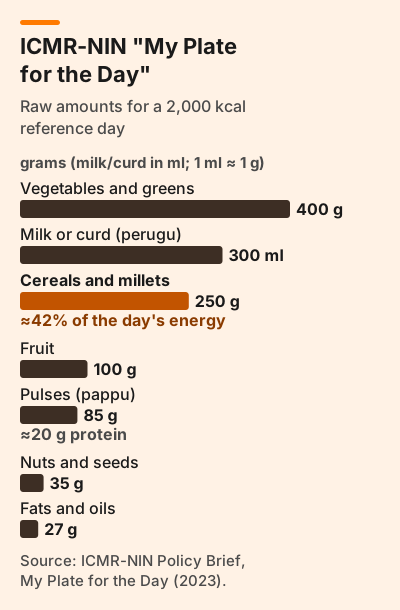
ICMR-NIN "My Plate for the Day": raw amounts for a 2,000 kcal reference day. By weight cereals look modest, but they give about 42% of the day's energy.[2]
In ICMR-NIN's plate, vegetables, fruit and greens (kura, aaku kura or leafy-greens curry) fill about half, cereals (annam, jonna, ragi) give about 42% of the energy, and pulses (pappu) give about 20 g of protein.[2] The 2,000 kcal figure is a reference, not your target. Check your own lunch with the free meal calorie calculator.
For weight loss, we trim the cereal. NIN says the share of vegetables, fruit and milk or curd stays the same even when energy needs change.[2] So we cut the rice and keep the kura, fruit and perugu. That is our reading of the plate, not a NIN rule. Eggs, fish or meat can replace part of the pulses.[2] Keep rice and pappu together: cereals and pulses in a 3:1 ratio improve the protein quality of a meal.[1]
Sugar, salt, oil and snacks
- Sugar: keep added sugar under 5% of daily energy.[1] NIN's 2024 guidelines say to avoid sugar or keep it to 20 to 25 g a day for adults, and their My Plate notes give 25 to 30 g a day.[1][2] We use the stricter 20 to 25 g.
- Salt: no more than 5 g of salt a day.[1][25] Pickles count. Take avakaya (mango pickle) or gongura (sorrel leaves) pachadi (chutney) by the teaspoon, not the heaped spoon.
- Oil: NIN's plate has 27 g of fats and oils for 2,000 kcal.[2] Scaled to about 1,500 kcal, that is roughly 20 g, or 4 teaspoons a day, counting tadka, pulusu (tamarind stew), fry curry and the dosa pan.
- Chutneys: groundnut and fresh coconut are each about 40% fat by weight.[3] Keep palli (peanut) or coconut chutney to 1 to 2 tablespoons.
- Drinks and snacks: each extra daily sugary drink was linked to about 0.1 to 0.2 kg of weight gain a year.[17] In NIN surveys, chips, biscuits, sweets and juices gave over 10% of calories.[2] Punugulu, bajji and mirchi (deep-fried batter snacks) are fine sometimes, but NIN asks us to cut deep-fried and refined foods.[1] For lighter biryani and pulihora (tamarind rice), see Hyderabadi and Andhra food: calories and swaps.
Your plan in 5 steps
- Trim the rice to 1 katori at each main meal, and use the same katori every day.
- Fill half the plate with kura and fruit.[2]
- Have pappu, perugu, egg or fish at every meal.[2]
- Eat kura and pappu first, rice last.[19][18]
- Move more: build up slowly towards 60 minutes of activity a day.[21] Our coaches suggest a short walk after meals as an easy way to start.
Why this works: what Indian research says
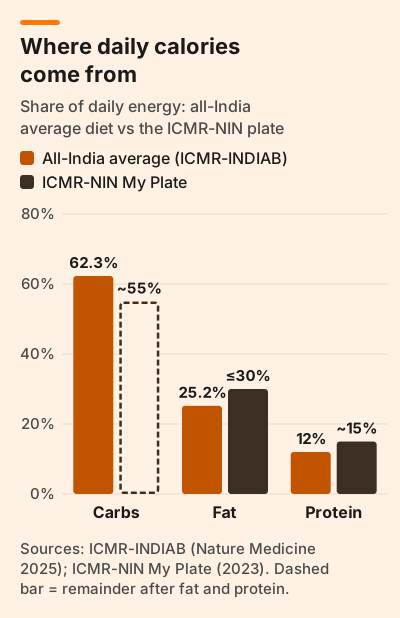
Share of daily energy in the all-India average diet (ICMR-INDIAB) compared with the ICMR-NIN plate. The dashed NIN carbohydrate bar is the remainder after fat and protein.[4][2]
Lots of rice, not much protein
The ICMR-INDIAB survey of 18,090 adults, including undivided Andhra Pradesh, found carbohydrates gave 62.3% of daily energy and protein only 12%, below the suggested 15%.[4] The highest carbohydrate eaters had about 22% higher odds of obesity.[4] In Chennai, the highest refined-grain eaters had waists about 8% bigger.[8] These snapshot studies show a link, not proof that rice causes weight gain.[4][8] So an Andhra diet plan for weight loss starts with the rice portion.
Rice, millets and tiffins
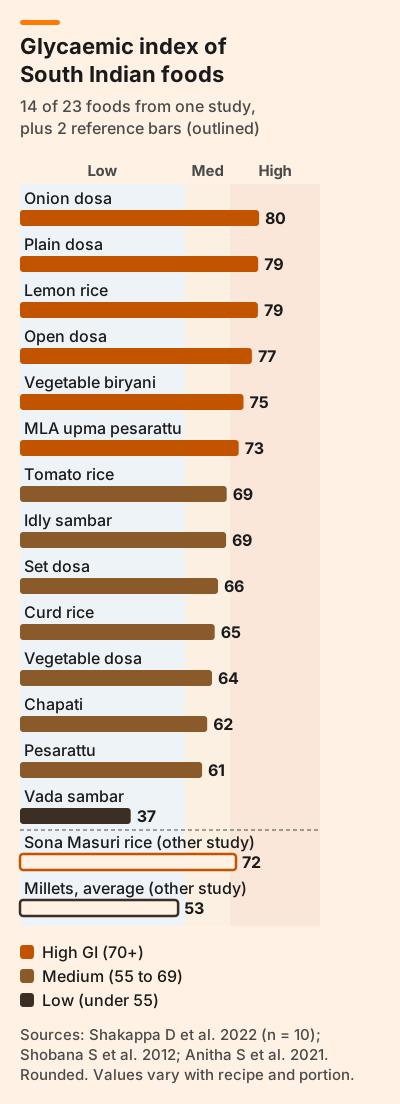
GI of 14 South Indian foods tested in 10 healthy adults,[5] plus reference bars for Sona Masuri rice[6] and the millet average.[11]
The glycaemic index (GI) shows how fast a food raises blood sugar. Under 55 is low, 55 to 69 is medium, and 70 or above is high.[11]
- White rice: cooked Sona Masuri has a GI of about 72 and Ponni about 70.[6] In Chinese and Japanese studies, the highest white-rice eaters had about 1.5 times the risk of type 2 diabetes, a link rather than proof.[7] Read is rice bad for weight loss.
- Brown rice: in a Chennai crossover trial, 166 overweight adults ate brown rice for 3 months and white rice for 3 months. Overall there was no difference in blood sugar, HbA1c (a 3-month blood sugar test) or cholesterol. Some groups, such as people with metabolic syndrome (belly fat with high sugar, blood pressure or blood fats) or a BMI of 25 and above, saw small improvements.[9]
- Millets (ragi or finger millet, jonna or sorghum, korra or foxtail millet): their average GI is about a quarter lower than milled rice.[11] But swapping to millets without cutting total carbohydrate was not linked to lower diabetes risk or less belly fat.[4] See millets for weight loss.
- Tiffins: in one small study, plain dosa had a GI of about 79 and pesarattu about 61.[5] But low-GI diets make little to no difference to weight loss,[12] and the gaps between named diets are small.[13] Pick the tiffin you like and watch the amount: see idli, dosa, upma or pesarattu.
Low GI is not the same as low calorie. Vada sambar had the lowest GI of all, about 37.[5] Frying adds oil, and NIN asks us to cut deep-fried food.[1]
Eat kura and pappu first, rice last
In two tiny single-meal studies, one in Indian-origin adults and one in people with type 2 diabetes, eating protein (and, in the diabetes study, vegetables) before carbohydrate gave a smaller rise in blood sugar.[19][18] They measured blood sugar, not weight, so treat this as a useful habit, not a weight-loss trick.
Your 7-day Telugu diet chart (vegetarian)
How to read the portions: these are our working measures, not official ones. A katori is a small bowl of about 150 ml. A tsp is a teaspoon, about 5 g of oil. Rice, pappu and kura portions are cooked amounts, 1 katori each unless the chart says otherwise.
Telugu food names in the charts: beerakaya (ridge gourd), vankaya (brinjal), munagakaya (drumstick), bendakaya (okra), dondakaya (ivy gourd), sorakaya (bottle gourd), kandi pappu (toor dal), mudda pappu (plain mashed toor dal), pesalu (green gram), phulka (thin roti), rasam (thin tamarind-pepper soup).
This daily meal plan follows the ICMR-NIN plate: lots of vegetables, a smaller cereal portion, pappu or curd at every main meal, and fruit instead of juice.[2]
Every day: tea or coffee with little or no sugar, well before breakfast; about 4 teaspoons of oil in all; and about 1 tablespoon (10 to 15 g) of nuts or seeds, such as palli, flax or sesame. NIN's plate has 35 g for 2,000 kcal;[2] we use less on purpose because nuts are high in fat.[3]
About how many calories? Our own rough estimate, not a measured value: using Indian Food Composition Table values,[3] days 1 to 6 come to roughly 1,300 to 1,500 kcal. We assumed about 40 g of raw rice per katori of cooked rice, 30 g of raw dal per katori of pappu, 2 cups of milky tea and 4 teaspoons of oil. Day 7, the family day, can go above this. Most women can start here. Most men should add a katori of rice or pappu, or 2 eggs.
| Day | Breakfast | Mid-morning | Lunch | Evening | Dinner |
|---|---|---|---|---|---|
| 1 | 2 pesarattu + 1 tsp allam pachadi (ginger chutney) | 1 guava | Rice + palakura pappu (spinach dal) + beerakaya kura + perugu | 1 glass majjiga (buttermilk) | 2 jonna rotte + vankaya kura + pappu |
| 2 | 2–3 idli + 1 katori sambar + cucumber | 1 katori papaya | Rice + munagakaya sambar + cabbage kura + perugu | Tea + 1 small handful roasted senagalu (chickpeas) | 1 plate korra (foxtail millet) upma with vegetables + perugu |
| 3 | 1 glass thin, unsweetened ragi java (porridge) + 1 katori boiled senagalu | 1 orange | ½ katori rice + ½ katori korra rice + kandi pappu + bendakaya kura | 1 glass majjiga | 2 phulka + pappu + mixed veg kura |
| 4 | 2 vegetable dosa (little oil) + 1 katori sambar | 1 guava | 1 small ball ragi mudda (ragi ball) + pappu + aaku kura + perugu | Tea + 1 small handful roasted palli | Rasam + rice + dondakaya kura + ½ katori paneer bhurji |
| 5 | 1 plate vegetable upma + 1 katori sprouted pesalu (green gram) | 1 katori papaya | Rice + tomato pappu + sorakaya kura + perugu | 1 glass majjiga | 2 jonna rotte + pappu + beans kura |
| 6 | 2–3 idli + 1 tbsp palli chutney + 1 katori sambar | 1 apple | Rice + mudda pappu + carrot-beans kura + perugu | Tea + 1 katori boiled senagalu | 1 plate korra-pesara pappu kichidi + kura |
| 7 | 2 pesarattu + 1 katori sambar | 1 guava | Family day: 1 to 1½ katori pulihora or veg biryani + 1 katori raita + salad | Tea + 1 katori boiled senagalu | Rasam + rice + pappu + kura + perugu |
Want help fitting this to your own kitchen? A coach can adjust it on a free call (details below).
Your 7-day South Indian diet chart (non-vegetarian)
Same plate, same portions, same morning tea, nuts and oil budget. Eggs, fish or chicken replace part of the pulses on some days.[2] Cook kodi kura (chicken curry) and chepala pulusu (fish stew) home-style with less oil.
| Day | Breakfast | Mid-morning | Lunch | Evening | Dinner |
|---|---|---|---|---|---|
| 1 | 2 dosa + 2 boiled eggs + 1 katori sambar | 1 guava | Rice + chepala pulusu (1 medium piece, about 75–100 g fish) + beerakaya kura + perugu | 1 glass majjiga | 2 jonna rotte + 1 katori kodi kura (about 75–100 g chicken) + veg kura |
| 2 | 2–3 idli + 1 katori sambar | 1 katori papaya | Rice + palakura pappu + cabbage kura + perugu | Tea + 1 small handful roasted senagalu | 1 plate korra upma with vegetables + 2 boiled eggs |
| 3 | 2 pesarattu + 1 tsp allam pachadi | 1 orange | Rice + egg curry (2 eggs) + bendakaya kura | 1 glass majjiga | 2 phulka + 1 katori kodi kura (about 75–100 g chicken) + salad |
| 4 | 1 glass unsweetened ragi java + 2-egg bhurji | 1 guava | 1 small ball ragi mudda + chepala pulusu (1 medium piece, about 75–100 g fish) + aaku kura | Tea + 1 small handful roasted palli | Rasam + rice + pappu + kura |
| 5 | 2 vegetable dosa + 1 katori sambar | 1 katori papaya | Rice + tomato pappu + sorakaya kura + perugu | 1 glass majjiga | 2 jonna rotte + 1 katori kodi kura (about 75–100 g chicken) + beans kura |
| 6 | 1 plate vegetable upma + 2 boiled eggs | 1 apple | Rice + pan-cooked fish (1 medium piece, about 75–100 g, little oil) + pappu + kura | Tea + 1 katori boiled senagalu | 2 phulka + egg curry (2 eggs) + salad |
| 7 | 2–3 idli + 1 katori sambar | 1 guava | Family day: 1 to 1½ katori chicken biryani + 1 katori raita + salad | 1 glass majjiga | Rasam + rice + pappu + kura + perugu |
Add protein and fibre without protein powder
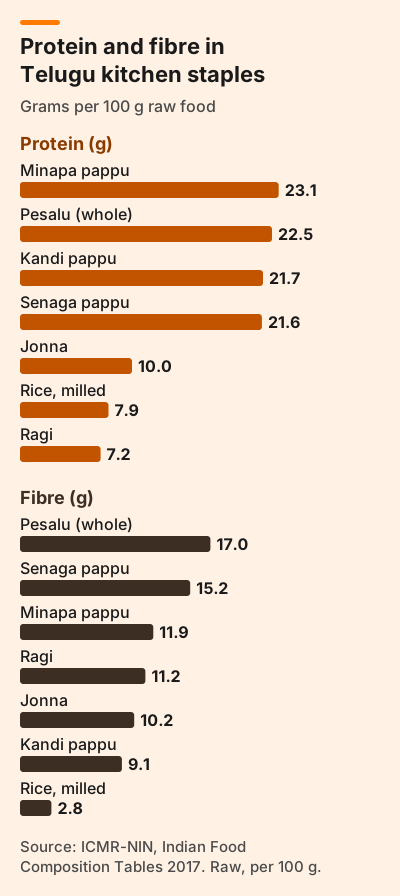
Protein and fibre in grams per 100 g raw food, from the Indian Food Composition Tables. Minapa pappu is urad dal, senaga pappu is chana dal, pesalu is whole green gram.[3]
In calorie-cut trials, higher-protein diets gave a little under 1 kg more weight loss on average and kept more muscle, a modest effect.[14] About one serving of pulses a day added about a third of a kilo of weight loss in short trials.[15] For fibre, a Lancet review found the most benefit at 25 to 29 g a day,[16] and WHO advises at least 25 g.[25]
How much protein? NIN's daily allowance for healthy adults is 0.83 g per kg of body weight, and about 1 g per kg if your diet is mostly cereal.[36] For a 60 kg woman that is about 50 to 60 g a day. That's why the chart has pappu, senagalu, curd or eggs at every main meal. If a day looks light, or you weigh more, add a katori of pappu, senagalu or 2 eggs. You don't need protein powder: NIN says pulses, milk and curd can meet a vegetarian's needs.[1] Paneer (about 19 g per 100 g) and boiled egg (about 13 g) help too.[3] Find your own number with the protein intake calculator.
Is this plan different for women?
The food is the same. The portions and a few nutrients change.
- Portions: a 2013 US guideline suggests about 1,200 to 1,500 kcal a day for women and 1,500 to 1,800 for men on a weight-loss diet.[32] Our rough estimate for this chart fits the women's range. If you are shorter or less active, cut dinner rice to ½ katori rather than cutting pappu or perugu.
- Iron: anaemia is still a public health problem in India.[1] Eat palakura, gongura or aaku kura with a vitamin C fruit like guava or orange, or a squeeze of lemon, and keep tea away from meals, because tea reduces iron absorption.[1] Get your haemoglobin checked if you often feel very tired, dizzy or short of breath, or have heavy periods.[34]
- Calcium: ragi has about 364 mg of calcium per 100 g, against under 10 mg in milled rice.[3] Milk and curd are good sources, and NIN calls milk the best-absorbed one.[1]
- Vitamin B12: NIN lists B12 as a nutrient to watch for vegetarians; curd and eggs are sources.[1] Ask your doctor about a test if you are fully vegetarian.
- PCOS and thyroid: the 2023 PCOS guideline keeps healthy lifestyle at the centre of care.[27] If you take thyroid tablets, ask your doctor how to time them around breakfast, tea, curd or ragi. Read PCOS and weight loss.
- Pregnant or breastfeeding: this chart is not for you. NIN says you need extra food and care at this stage.[1]
Swaps for office tiffins and NRI kitchens
The same rules apply at your desk or in a US kitchen: keep vegetables and pulses, trim the cereal, and choose fresh fruit over juice.[2] Cut sugary drinks and fried snacks where you can.[1]
| If you… | Try |
|---|---|
| Carry a lunch dabba to office | Rice in the small box, a double portion of pappu and kura in the big box, curd on the side |
| Get canteen biryani once a week | Half the portion, plus raita and a full plate of salad |
| Have chai with biscuits at 4 pm | Chai with a small handful of roasted senagalu |
| Live in the US and can't find fresh greens | Frozen palak or methi for palakura pappu |
| Can't get homemade perugu | Plain, unsweetened yogurt |
| Miss jonna and ragi abroad | Millet flours and rice from Indian stores; cook them the same way |
| Don't know how much rice you serve | Measure it once with a katori, then use the same katori every day |
More ideas: weight loss diet plan for working women.
Movement and sleep: the other half
- General health: WHO advises 150 to 300 minutes of moderate activity a week plus muscle-strengthening on 2 or more days;[26] NIN suggests at least 30 to 45 minutes of brisk walking a day.[1]
- Weight loss: an Indian expert consensus recommends at least 60 minutes of activity a day, plus resistance exercise (strength work with weights, bands or your own body weight) on at least 3 days a week.[21] Build up to it slowly. A 10-minute walk after lunch counts.[26]
- Sleep: NIN advises 6 to 8 hours a day to avoid unhealthy eating and weight gain.[1]
Exercise safely. If you have heart disease, diabetes or high blood pressure, or get chest pain or dizziness, ask your doctor which activities are safe before you do more.[33] As an extra caution, our coaches suggest you do the same if you have a joint or back injury, and that you stop and get medical help straight away if you get chest pain, feel faint or become very breathless while exercising.
How fast is safe?
People often search for a plan "in one month". We won't promise a number, because no honest plan can. NIN advises slow and steady weight loss, calls losing about half a kilogram a week safe, and warns against rapid weight loss.[1] An Indian expert consensus gives 0.5 to 1 kg a week as a widely accepted safe range,[21] so 1 kg a week is the upper end, not the Indian standard. Treat it as a ceiling, not a target. The US CDC says people who lose weight gradually are more likely to keep it off.[30] Many people lose less, and that is normal. Losing weight fast raises the risk of gallstones.[29]
The 2025 Indian consensus advises a daily deficit of roughly 500 kcal, through eating less and moving more.[21] Don't cut too far: the 2013 US guideline keeps very-low-calorie diets (under 800 kcal) for medical settings with supervision.[32] NIN's 2024 guidelines say a weight-reduction diet should not go below 1,000 kcal a day.[1] As an extra caution, our coaches suggest you don't go below about 1,200 kcal (women) or 1,500 kcal (men) without your doctor's supervision.
Small changes count. Losing 5% of your body weight can improve blood pressure, cholesterol and blood sugar.[30][24] To see what a gentle deficit looks like for you, try the calorie deficit calculator.
When to see a doctor
See your doctor before you start, or during the plan, if any of these apply to you:
- Your waist is 80 cm or more (women) or 90 cm or more (men), or your BMI is over 23. These are the Asian Indian cut-offs in the 2025 Indian consensus.[21] Ask for a blood sugar, blood pressure and cholesterol check. Check your number with the waist-to-height ratio calculator.
- You take any diabetes medicine. Lifestyle change helps prevent type 2 diabetes, including in Asian Indians.[22][23] But insulin and some tablets can drop your blood sugar too low if you eat less carbohydrate or skip meals.[31] Signs include feeling shaky, hungry, dizzy or confused.[31] Ask your doctor before you cut rice or switch to millets, because your medicine or dose may need to change.
- You take blood pressure tablets. Weight loss can improve blood pressure.[30] Tell your doctor you are changing your diet, so they can review your dose if you feel dizzy.
- You have irregular periods, PCOS or thyroid symptoms, or take thyroid tablets. Get tested and ask your doctor. PCOS comes with metabolic and pregnancy risks that need medical care alongside lifestyle.[27]
- You often feel very tired, dizzy or breathless, or have heavy periods. Ask for a haemoglobin test.[34]
- You are pregnant, breastfeeding or have just delivered. Many women gain weight after childbirth,[1] but this chart is not for this stage. Ask your doctor or a dietitian for a plan made for you.
- You have lost weight without trying, or you have ever had an eating disorder. In our coaches' view, a diet chart is not the right starting point. Talk to your doctor first.
- You get pain in the upper right side of your belly after losing weight quickly. Fast weight loss raises gallstone risk.[29] Get medical care right away if the pain lasts several hours, or comes with fever or chills, vomiting, or yellow skin or eyes.[35]
As a precaution, we don't recommend this chart for teenagers under 18, pregnant or breastfeeding women, people with kidney disease or gout, or older adults who are frail or losing muscle, unless their doctor or a dietitian adapts it.
Flexcellence coaches plan food and movement. Diagnosis and medicines are your doctor's job.
How a Flexcellence coach would adjust this chart
On a free 30-minute call, a Flexcellence coach looks at what you cook, your work hours, your family's meals and any reports your doctor has shared, then adjusts the portions and swaps to fit your day. Book a free 30-minute consultation.
Prefer reading in Telugu? See our weight loss diet for Telugu women.
Frequently asked questions
Can I eat rice and still lose weight?
Yes. Sona Masuri and Ponni are high-GI rices,[6] but the ICMR-NIN plate keeps cereals. NIN keeps vegetables, fruit and curd the same at any calorie level, so we trim the rice.[2] Eat a smaller katori, add pappu and kura, and eat the rice last.[19][18]
Which South Indian breakfast is best for weight loss?
Pesarattu, and idli or dosa with sambar and extra vegetables, are good everyday choices. Pesarattu had a lower GI than plain dosa in one small study,[5] but GI alone makes little difference to weight.[12] How much you eat matters more.
Is ragi or jonna better than rice?
Millets have a lower average GI[11] and much more fibre than milled rice.[3] But swapping without cutting total carbohydrate was not linked to lower diabetes or belly-fat risk.[4] Swap and keep the portion small.
Is this South Indian diet plan right for females?
Yes. Guidelines give women a lower calorie range than men,[32] so many women can follow the chart as written. See the section for women for iron, calcium and B12.
How much weight can I lose in one month on a South Indian diet?
We can't promise a number, and no honest plan can. ICMR-NIN calls losing about half a kilogram a week safe.[1] An Indian expert consensus gives 0.5 to 1 kg a week as a safe range, so treat 1 kg as the upper limit; many people lose less.[21] See How fast is safe?
Is this South Indian diet plan OK for women with PCOS or thyroid?
The same plate is a good base for PCOS, where healthy lifestyle is central to care.[27] For thyroid symptoms or tablets, check with your doctor first.
Common questions
Can I eat rice and still lose weight?
Yes. Sona Masuri and Ponni are high-GI rices, but the ICMR-NIN plate keeps cereals. NIN keeps vegetables, fruit and curd the same at any calorie level, so we trim the rice. Eat a smaller katori, add pappu and kura, and eat the rice last.
Which South Indian breakfast is best for weight loss?
Pesarattu, and idli or dosa with sambar and extra vegetables, are good everyday choices. Pesarattu had a lower GI than plain dosa in one small study, but GI alone makes little difference to weight. How much you eat matters more.
Is ragi or jonna better than rice?
Millets have a lower average GI and much more fibre than milled rice. But swapping without cutting total carbohydrate was not linked to lower diabetes or belly-fat risk. Swap and keep the portion small.
Is this South Indian diet plan right for females?
Yes. Guidelines give women a lower calorie range than men, so many women can follow the chart as written. See the section for women for iron, calcium and B12.
How much weight can I lose in one month on a South Indian diet?
We can't promise a number, and no honest plan can. ICMR-NIN calls losing about half a kilogram a week safe. An Indian expert consensus gives 0.5 to 1 kg a week as a safe range, so treat 1 kg as the upper limit; many people lose less. See How fast is safe?
Is this South Indian diet plan OK for women with PCOS or thyroid?
The same plate is a good base for PCOS, where healthy lifestyle is central to care. For thyroid symptoms or tablets, check with your doctor first.
Reviewed by
Not yet reviewed by a Flexcellence coach.
Sources
ICMR-National Institute of Nutrition. Dietary Guidelines for Indians 2024 (2024).
ICMR-National Institute of Nutrition (Hemalatha R). Policy Brief: Promotion of My Plate for the Day and physical activity (2023).
ICMR-National Institute of Nutrition. Indian Food Composition Tables 2017 (Longvah T, Ananthan R, Bhaskarachary K, Venkaiah K) (2017).
Nature Medicine (Anjana RM et al., ICMR-INDIAB). Dietary profiles and associated metabolic risk factors in India from the ICMR-INDIAB survey-21 (2025).
Journal of Food Science and Technology (Shakappa D et al.). Glycemic carbohydrates, glycemic index, and glycemic load of commonly consumed South Indian breakfast foods (2022).
International Journal of Food Sciences and Nutrition (Shobana S et al.). Glycaemic index of three Indian rice varieties (2012).
BMJ (Hu EA, Pan A, Malik V, Sun Q). White rice consumption and risk of type 2 diabetes: meta-analysis and systematic review (2012).
Metabolism (Radhika G et al., CURES-57). Refined grain consumption and the metabolic syndrome in urban Asian Indians (Chennai Urban Rural Epidemiology Study 57) (2009).
British Journal of Nutrition (Malik VS, Sudha V et al.). Substituting brown rice for white rice on diabetes risk factors in India: a randomised controlled trial (2019).
Frontiers in Nutrition (Anitha S et al.). A Systematic Review and Meta-Analysis of the Potential of Millets for Managing and Reducing the Risk of Developing Diabetes Mellitus (2021).
Cochrane Database of Systematic Reviews (Chekima K et al.). Low glycaemic index or low glycaemic load diets for people with overweight or obesity (2023).
JAMA (Johnston BC et al.). Comparison of weight loss among named diet programs in overweight and obese adults: a meta-analysis (2014).
American Journal of Clinical Nutrition (Wycherley TP et al.). Effects of energy-restricted high-protein, low-fat compared with standard-protein, low-fat diets: a meta-analysis of randomized controlled trials (2012).
American Journal of Clinical Nutrition (Kim SJ et al.). Effects of dietary pulse consumption on body weight: a systematic review and meta-analysis of randomized controlled trials (2016).
The Lancet (Reynolds A et al.). Carbohydrate quality and human health: a series of systematic reviews and meta-analyses (2019).
American Journal of Clinical Nutrition (Malik VS, Pan A, Willett WC, Hu FB). Sugar-sweetened beverages and weight gain in children and adults: a systematic review and meta-analysis (2013).
Diabetes Care (Shukla AP et al.). Food Order Has a Significant Impact on Postprandial Glucose and Insulin Levels (2015).
Nutrition and Health. Food order and glucose excursion in Indian adults with normal and overweight/obese Body Mass Index: A randomised crossover pilot trial (2021).
Diabetes & Metabolic Syndrome: Clinical Research & Reviews (Misra A et al.). Revised definition of obesity in Asian Indians living in India (2025).
New England Journal of Medicine (Diabetes Prevention Program Research Group). Reduction in the incidence of type 2 diabetes with lifestyle intervention or metformin (2002).
Diabetologia (Ramachandran A et al., IDPP-1). The Indian Diabetes Prevention Programme shows that lifestyle modification and metformin prevent type 2 diabetes in Asian Indian subjects with impaired glucose tolerance (2006).
Diabetes Care (Wing RR et al., Look AHEAD). Benefits of modest weight loss in improving cardiovascular risk factors in overweight and obese individuals with type 2 diabetes (2011).
World Health Organization. Healthy diet (fact sheet) (2026).
British Journal of Sports Medicine (Bull FC et al., WHO). World Health Organization 2020 guidelines on physical activity and sedentary behaviour (2020).
Journal of Clinical Endocrinology & Metabolism (Teede HJ et al.). Recommendations From the 2023 International Evidence-based Guideline for the Assessment and Management of Polycystic Ovary Syndrome (2023).
US National Institute of Diabetes and Digestive and Kidney Diseases (NIDDK). Definition & Facts for Gallstones (2017).
US Centers for Disease Control and Prevention. Losing Weight (2025).
US National Institute of Diabetes and Digestive and Kidney Diseases (NIDDK). Low Blood Glucose (Hypoglycemia) (2021).
Circulation (Jensen MD et al., AHA/ACC/TOS). 2013 AHA/ACC/TOS Guideline for the Management of Overweight and Obesity in Adults (2014).
US National Heart, Lung, and Blood Institute (NHLBI). Physical Activity and Your Heart: Be active and safe (2022).
US National Heart, Lung, and Blood Institute (NHLBI). Iron-Deficiency Anemia (2022).
US National Institute of Diabetes and Digestive and Kidney Diseases (NIDDK). Symptoms & Causes of Gallstones (2017).
ICMR-National Institute of Nutrition. A Brief Note on Nutrient Requirements for Indians, the Recommended Dietary Allowances (RDA) and the Estimated Average Requirements (EAR), ICMR-NIN 2020 (2020).