PCOS Diet Chart for Indian Women: 7-Day Veg & Non-Veg Plan
PCOS diet chart for Indian women: 7-day vegetarian and non-veg plans with South Indian food, portions, office and NRI swaps, and when to see a doctor.
The short answer
There is no single "PCOS diet". The 2023 international guideline backs any healthy pattern you can keep up, with a calorie deficit only for weight loss. ICMR-NIN's plate is about half vegetables and fruit, with little sugar. Our hand guide: a fist of rice or millet, 1 katori dal or a palm-sized piece of egg, fish or paneer, and curd.
Work out your own numbers
Estimate PCOS-adjusted calorie targets using an evidence-based metabolic correction.
Free, takes a minute, and uses the same formulas our coaches use.
Open the PCOS Weight Loss Calorie CalculatorOn this page
PCOS diet chart for Indian women: a 7-day veg and non-veg plan
Quick answer: There is no single "PCOS diet". The 2023 international guideline backs any healthy pattern you can keep up, with a calorie deficit only for weight loss.[1] ICMR-NIN's plate is about half vegetables and fruit, with little sugar.[18][17] Our hand guide (our own shortcut, not an ICMR measure): a fist of rice or millet, 1 katori dal or a palm-sized piece of egg, fish or paneer, and curd.
Jump to: Food list · Veg chart · Non-veg chart · Swaps · See your doctor · Read this guide in Telugu
This Indian PCOS diet chart, with veg and non-veg options, gives you 7 days of Telugu and South Indian home cooking, with the research figures linked to their sources. No diet cures PCOS,[2][22] but food and movement can help with symptoms, even when your weight does not change.[2] PCOS is common: an ICMR study found it in about 1 in 5 Indian women aged 18 to 40 using the widely used Rotterdam criteria (about 1 in 14 to 1 in 7 by stricter definitions).[3]
This is general guidance for adults (vegetarians, non-vegetarians, office-goers and NRIs), not a prescription. Your doctor and dietitian can adjust it to your reports. Not sure if it is PCOD or PCOS? Read PCOD vs PCOS. (The NHS now calls the condition polyendocrine metabolic ovarian syndrome (PMOS).[22])
Under 18? Please don't use this chart to cut calories. For girls and teens who are not overweight, the guideline focuses on healthy habits and avoiding extra weight gain.[1] Whatever your weight, ask your doctor or a children's dietitian to set your plan.
The PCOS plate, Indian style
The chart is built on ICMR-NIN's "My Plate for the Day". For a 2,000 kcal day, it suggests these raw amounts:[18]
| Food group | Raw amount per day | Share of energy |
|---|---|---|
| Cereals and millets | 250 g | 42% |
| Pulses (dal, chana, pesalu) | 85 g | 14% |
| Milk or curd | 300 ml | 11% |
| Vegetables and greens | 400 g | 9% |
| Fruits | 100 g | 3% |
| Nuts and seeds | 35 g | 9% |
| Fats and oils | 27 g | 12% |
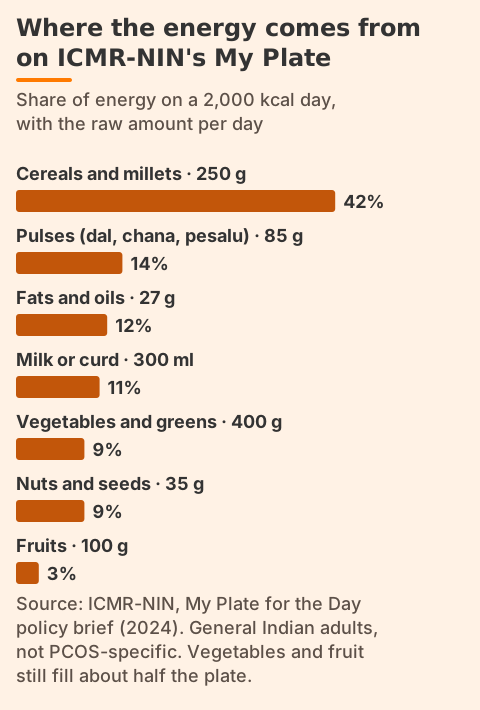
Share of daily energy from each food group on ICMR-NIN's My Plate for a 2,000 kcal day.[18]
Space on the plate is not the same as calories. Vegetables, fruits and greens fill about half the plate but give only about 12% of the day's energy.[18] Cereals take less space but give the most energy, so the chart controls rice and roti portions, not vegetables.
Most women do not need exactly 2,000 kcal. When calories change, the vegetable, fruit and milk amounts stay the same, and cereals are the part that changes.[18] Two limits apply to everyone: sugar under 5% of daily energy, and added salt at 5 g a day at most.[17] My Plate is made for the general Indian population, not for PCOS, but the PCOS guideline supports any healthy pattern.[1]
PCOS food list: what to eat and what to limit
Foods to eat more often
- Vegetables and greens: palakura (spinach), gongura (sorrel leaves), beans, bendakaya (okra), sorakaya (bottle gourd), cabbage. Potato does not count.[17][18]
- Whole pulses and dals: pesalu (whole green gram), senagalu (chana), rajma, kandi pappu (toor dal), all rich in protein and fibre.[19]
- Millets and whole grains: jonna (jowar), korralu (foxtail millet), samalu / samai (little millet), ragi, atta.[17]
- Milk, curd and majjiga (buttermilk): about 300 ml a day.[18]
- Eggs, fish and chicken (if you eat them), in place of a portion of pulses.[18]
- Nuts and seeds: a small handful of palli (peanuts) or other nuts, about 35 g a day.[18]
- Whole fruit over juice: guava, orange, papaya, apple.[18]
Foods to limit (not ban)
- Sugar and sweets. If you eat sugar, ICMR-NIN suggests no more than 25 to 30 g a day.[18] Our coaches count the sugar in your tea and coffee towards this too.
- Soft drinks and packaged juices. Avoid soft drinks and choose whole fruit over juice.[17][18]
- Deep-fried snacks like bajji, punugulu (fried batter balls), samosa and chips: keep them for occasions.[17]
- Maida. It has 2.8 g fibre per 100 g raw, against 11.4 g in whole wheat atta.[19]
- Ultra-processed foods. ICMR-NIN advises restricting them, naming biscuits, cakes, pastries, packaged juices and cool drinks among its examples.[17] We would add instant noodles and packaged namkeen (salty fried snacks).
- Salt. Go easy on pickles, papad and salty snacks; the limit is 5 g of added salt a day.[17]
You don't need to cut out dairy or gluten: the guideline does not ask for it, and curd and milk are part of ICMR-NIN's plate.[1][18] The 2023 guideline does not recommend trends like seed cycling or cinnamon water; it backs ordinary healthy eating. Had a festival sweet or biryani? Enjoy it, then go back to the chart at your next meal.
How to use this Indian PCOS meal plan
Portions (our own conventions):
- 1 katori = a small 150 ml bowl. Every dal, kura (vegetable curry), sambar, curd and soup is 1 katori unless it says otherwise.
- 1 fist of rice or millet = a cooked amount about the size of your closed fist.
- Oil: about 4 teaspoons (20 g) for the whole day. My Plate allows 27 g on a 2,000 kcal day,[18] so a smaller calorie target needs less.
- On waking: a glass of water, or plain tea or coffee without sugar.
Roughly how much energy is this? Using the Indian Food Composition Tables, we estimate a typical day at about 1,300 to 1,500 kcal and 50 to 60 g of protein.[19] That is our own rough estimate, and for many adult women it is already close to a weight-loss intake.
Change it to your number. Find your target with the free PCOS calorie calculator, then adjust the rice and roti first: cereals are the part My Plate changes to balance calories.[18] Our coaches also adjust the oil and keep the vegetables, dal and curd the same, like this:
- Lower target: half a fist of rice or 1 roti at lunch, and 3 teaspoons of oil for the day. Don't go lower without a dietitian or doctor: ICMR-NIN advises slow, steady weight loss and warns that extreme approaches can harm health.[17]
- Higher target: for every extra 200 kcal or so, add one of these: 1 fist of rice or millet, 2 phulkas with 1 teaspoon of oil, about 30 g of palli or nuts, or a glass of milk with a fruit (our rough estimates). If you are not trying to lose weight, the guideline's focus is healthy habits, not restriction,[1] so eat to your calculator number.
This chart does not promise any amount of weight loss.
Protein check: have a protein food at every meal (dal, chana, pesalu, curd, paneer, egg, fish or chicken). On a low-protein day, add a katori of curd, a little paneer or a katori of sprouts.
On insulin, metformin or other diabetes medicine? Talk to your doctor before you cut carbs or change meal times. Low blood sugar mainly affects people on insulin, but it can happen with medicines like gliclazide and glimepiride, or when meals are skipped or delayed.[28] Signs include shaking, sweating, hunger, dizziness and confusion. If you notice them, check your blood sugar if you can, then have something sugary, like a small glass of fruit juice, then a snack or meal. If someone cannot respond normally or passes out, call an ambulance.[28]
Your 7-day South Indian PCOS diet chart (vegetarian)
Telugu food words used in both charts: pesarattu (green gram dosa), allam chutney (ginger chutney), pappu (dal), kura (vegetable curry), dondakaya (ivy gourd), beerakaya (ridge gourd), godhuma ravva (broken wheat), jonna rotte (jowar flatbread), ragi java (thin ragi porridge), kodi kura (chicken curry), chepala pulusu (tangy fish curry). Other foods are explained in the food list above.
Part 1: breakfast to lunch
| Day | Breakfast | Mid-morning | Lunch |
|---|---|---|---|
| Mon | 2 pesarattu + allam chutney + curd | Guava | 1 fist rice + palakura pappu (spinach dal) + bendakaya (okra) kura + curd |
| Tue | Korralu (foxtail millet) upma with vegetables + curd | Orange | 2 phulka + chana kura + salad + curd |
| Wed | Vegetable poha (1 fist) + 1 katori boiled chana + curd | Apple | 1 fist rice + kandi pappu + cabbage kura + curd |
| Thu | 2 idli + sambar + curd | Papaya | 2 phulka + rajma + dondakaya (ivy gourd) kura + salad + curd |
| Fri | Pesalu sprouts chaat + 1 methi phulka + 1 glass milk | Pear | Curd rice (½ fist rice, 1½ katori curd) + chana kura + beans kura |
| Sat | 2 jowar idli + sambar + 1 tbsp palli chutney | Guava | 2 phulka + palak paneer + salad + curd |
| Sun | Godhuma ravva (broken wheat) upma with vegetables + curd | Seasonal fruit | 1 fist rice + pappu + 2 vegetable curries (kura) + curd |
Part 2: evening to dinner (same day, continued; dinner is the lighter meal)
| Day | Evening | Dinner |
|---|---|---|
| Mon | Majjiga + small handful palli | 1 jonna rotte + pappu + 2 katori sorakaya (bottle gourd) kura |
| Tue | Tea, no sugar + boiled senagalu | ½ fist korralu rice + sambar + 2 katori beerakaya (ridge gourd) kura |
| Wed | Majjiga + pesalu sprouts salad | 1 jonna rotte + paneer bhurji + greens |
| Thu | Tea, no sugar + roasted chana | Samalu (little millet) and pesara pappu (split green gram / moong dal) khichdi (½ fist) + 2 katori vegetables + curd |
| Fri | Majjiga + small handful palli | 1 pesarattu + 2 katori vegetable kura + tomato chutney |
| Sat | Tea, no sugar + boiled senagalu | ½ fist rice + tomato pappu + 2 katori mixed veg kura |
| Sun | Majjiga + roasted chana | Vegetable soup + 1 phulka + dal |
Vegetarian? Ask about vitamin B12. In a study of 6,555 Indian adults, vegetarians got less vitamin B12 from their food than non-vegetarians, and the authors flagged B12 as a concern.[30] Ask your doctor whether you need a B12 test. If you also take metformin, the guideline says B12 checks should be considered, especially if you have other risk factors.[1]
Your 7-day PCOS diet chart (non-vegetarian)
Same portion rules. Eggs, fish or meat replace a portion of the pulses,[18] so each non-veg dish takes the place of one dal serving. Choose home-style curries with less oil, and tawa or grilled fish and chicken, since ICMR-NIN asks everyone to cut down on deep-fried food.[17]
Part 1: breakfast to lunch
| Day | Breakfast | Mid-morning | Lunch |
|---|---|---|---|
| Mon | 1 pesarattu + 2 boiled eggs + allam chutney | Guava | 1 fist rice + kodi kura (home-style chicken curry) + vegetable kura + curd |
| Tue | Egg bhurji (2 eggs) + 1 phulka | Orange | 1 fist korralu rice + chepala pulusu (fish curry) + beans kura |
| Wed | Thin ragi java (no sugar) + 2 boiled eggs + 1 phulka | Apple | 2 phulka + chicken curry + salad + curd |
| Thu | 2 idli + sambar + 1 boiled egg | Papaya | 1 fist rice + kandi pappu + cabbage kura + curd |
| Fri | Vegetable upma + 2-egg omelette with spinach | Pear | Curd rice (½ fist rice) + tawa chicken + beerakaya kura |
| Sat | 2 jowar idli + sambar + 1 tbsp chutney | Guava | 1 fist rice + chepala pulusu + dondakaya kura + curd |
| Sun | Godhuma ravva upma + 1 boiled egg | Seasonal fruit | 1 fist chicken biryani + raita + large salad (skip the second helping) |
Part 2: evening to dinner (same day, continued; dinner is the lighter meal)
| Day | Evening | Dinner |
|---|---|---|
| Mon | Majjiga + small handful palli | 1 jonna rotte + pappu + 2 katori sorakaya kura |
| Tue | Tea, no sugar + boiled chana | Samalu-pesara pappu khichdi (½ fist) + vegetables + curd |
| Wed | Majjiga + sprouts salad | 1 pesarattu + 2 katori vegetable kura |
| Thu | Tea, no sugar + roasted chana | Tawa fish (1 palm-sized piece) + 2 katori sautéed vegetables + 1 phulka |
| Fri | Majjiga + small handful palli | 1 jonna rotte + egg curry (1 egg) + greens |
| Sat | Tea, no sugar + boiled senagalu | Chicken and vegetable soup + 1 phulka |
| Sun | Majjiga | 1 phulka + palakura pappu + vegetable kura |
Save or print this chart. Open your browser's Print option and choose "Save as PDF" to keep this PCOS diet plan as a PDF on your phone, or print it for the fridge. Each diet has two tables (Part 1 and Part 2), so print both. Swap days freely: any breakfast can go with any lunch.
Swaps for office days and NRI kitchens
Same plate, different kitchen: vegetables, whole grains or millets, a protein and curd.[17][18]
| If you… | Try this |
|---|---|
| Carry a dabba to office | 2 phulka or 1 fist millet rice + dry sabzi + a separate box of chana, rajma or chicken; carry curd in a small steel box |
| Eat at the office canteen | Pick dal, a vegetable and curd first; take 1 fist of rice or 2 roti; skip fried sides on most days |
| Live in the US and miss fresh greens | Frozen spinach, methi or mixed vegetables for pappu and kura |
| Can't find Indian curd | Plain unsweetened yogurt or Greek yogurt |
| Only have basmati at home | Keep it to 1 fist; mix in brown rice when you can |
| Want millets abroad | Look for foxtail millet, little millet, jowar and ragi flour at an Indian grocery store |
| Need a quick protein after work | Plain rotisserie chicken (skin removed), eggs, canned chickpeas rinsed well, or paneer |
What the research says (in plain words)
Blood sugar and weight
A review of 40 studies found women with PCOS had about three times the odds of high blood sugar after a glucose test, and of type 2 diabetes. The extra risk of high blood sugar after a glucose test was highest in Asian studies.[12] In the ICMR study, 24.9% of Indian women with PCOS had metabolic syndrome (a cluster of high blood sugar, blood pressure, blood fats and waist size).[3] The guideline says this diabetes risk holds at any age or body size.[1] More on this in our insulin resistance diet in Indian food.
If weight loss is your goal, the guideline suggests a tailored calorie deficit, and says waist size and metabolic health matter, not only the scale. The guideline supports weight-inclusive care (healthy habits without a focus on losing weight) as an option, alongside care aimed at weight loss, depending on your goals.[1] For Asian Indian women, a waist of 80 cm or more counts as abdominal obesity (extra belly fat); measure just above the hip bone, at the end of a normal breath out.[21] The same cut-off is used for Asian Indians living abroad.[20] Lifestyle trials averaged about 1.68 kg of weight change against little or no treatment, from mostly low-quality studies,[10] so treat that as an average, not a target. See PCOS weight loss.
Carbs, rice and millets
The guideline found no diet type clearly better than another.[1] One network review ranked the DASH diet first for insulin resistance, but these are rankings, not effect sizes, and the paper's own figures are not fully consistent.[8] (DASH is an eating plan built on vegetables, fruit and whole grains, with low-fat dairy, fish, poultry, beans, nuts and vegetable oils.[32]) In PCOS trials, low-GI diets (GI, or glycaemic index, ranks carb foods by how much they raise blood sugar[16]) lowered a measure of insulin resistance and trimmed waist size by under 3 cm on average.[6] High-fibre diets improved fasting sugar, insulin resistance and the free androgen index (a measure of active male-type hormones), but not total testosterone.[7] Both reviews used few, small trials.[6][7]
Do you need to stop rice? No. In Asian populations, people who ate the most white rice had a 55% higher risk of type 2 diabetes than those who ate the least, with intakes averaging 3 to 4 servings a day.[14] That was the general population, so the message is about amount. Brown rice has 4.4 g and parboiled rice 3.7 g of fibre per 100 g raw, against 2.8 g in milled white rice.[19]
Not every millet dish is low-GI. Across 39 studies, millets averaged a GI of 52.7, against 71.7 for milled rice and 74.2 for refined wheat; foxtail millet was low-GI and ragi averaged 61.1.[15] Cooking matters: a stiff ragi ball (ragi mudde, its Kannada name) measured 98.2, broken wheat upma 51.7, jowar idli 61.3 and wheat dosa 61.8.[16] Ragi sangati is the Telugu/Rayalaseema version of this stiff ragi ball; the study did not measure it under that name.
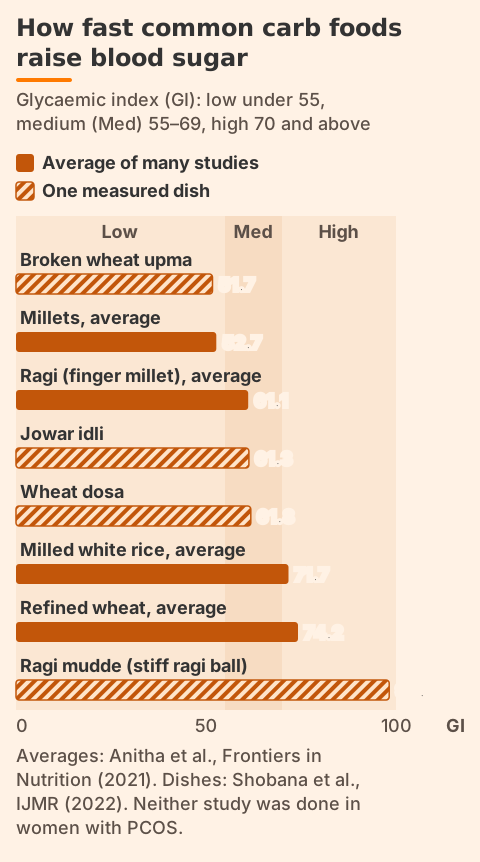
Glycaemic index of common carb foods. Solid bars are averages from a millet meta-analysis;[15] hatched bars are single dishes from an Indian GI study.[16] Neither study was done in women with PCOS.
Ragi java or ragi mudde? Ragi is rich in fibre (11.2 g per 100 g raw),[19] but the stiff ragi ball measured high-GI.[16] We have not found a measured GI for thin ragi java, so the chart keeps ragi portions small and serves them with protein.
Protein and fibre in Indian foods
In 8 trials, high-protein diets lowered fasting insulin and insulin resistance compared with balanced diets of the same calories, without changing weight or hormones.[9] Protein per 100 g raw:[19]
| Food (Telugu name) | Protein per 100 g |
|---|---|
| Green gram whole (pesalu) | 22.5 g |
| Red gram dal (kandi pappu) | 21.7 g |
| Rohu fish | 19.7 g |
| Chicken leg, skinless | 19.4 g |
| Paneer | 18.9 g |
| Bengal gram whole (chana / senagalu) | 18.8 g |
| Egg, whole | 13.3 g |
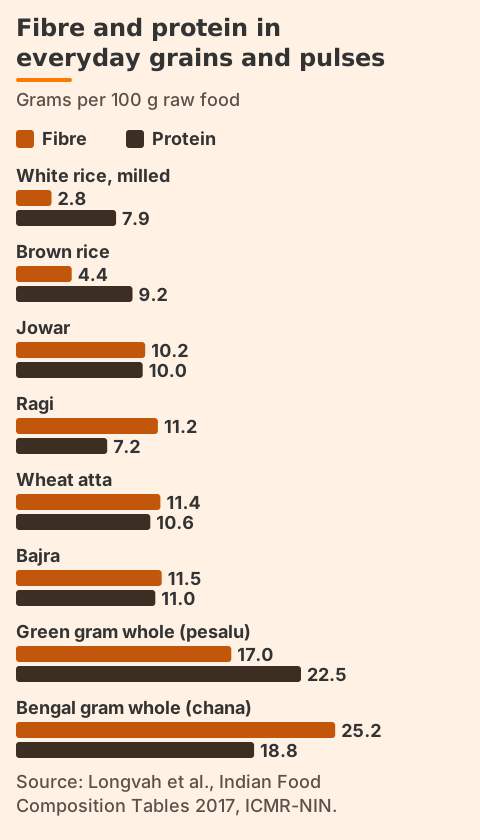
Fibre and protein per 100 g raw food, from the Indian Food Composition Tables.[19] Whole pulses and millets carry far more fibre than white rice.
When you eat matters too
One 90-day trial gave 60 lean women with PCOS the same calories (about 1,800 kcal) as a big breakfast (980 kcal), medium lunch (640 kcal) and small dinner (190 kcal), or the reverse.[11] The big-breakfast group had lower insulin and free testosterone and ovulated more often; the big-dinner group showed no change.[11]
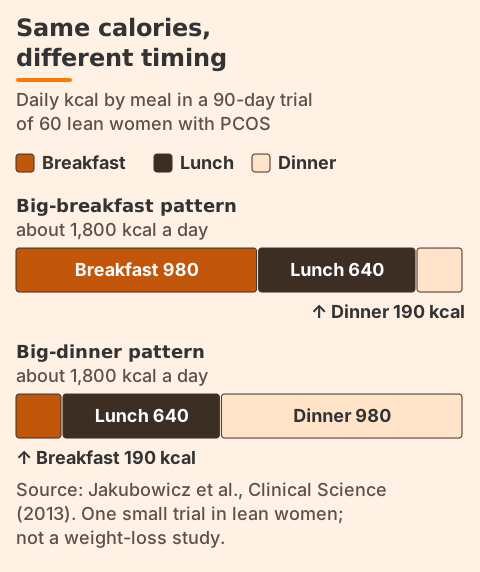
The two meal patterns compared in one 90-day trial of 60 lean women with PCOS. Same calories, different timing.[11]
It was a single small trial, not a weight-loss study.[11] So the takeaway is gentle: don't skip breakfast, and keep dinner lighter when you can. Our chart never skips breakfast, and most dinners have less rice or roti than lunch.
Movement, sleep and stress: the other half
The guideline calls a healthy lifestyle a core part of treatment for everyone with PCOS.[1]
| Goal | Weekly activity (adults) |
|---|---|
| Stay healthy and avoid weight gain | 150 to 300 min moderate (like brisk walking), or 75 to 150 min vigorous[1] |
| More benefit, including modest weight loss | At least 250 min moderate, or 150 min vigorous[1] |
| Strength | Muscle-strengthening on 2 non-consecutive days[1] |
- Daily walk: ICMR-NIN suggests at least 30 to 45 minutes of brisk walking or similar activity a day, and yoga counts.[17]
- Sitting less: any movement helps, so break up long desk hours and screen time.[1] Our PCOS exercise plan at home fits into a workday.
- Sleep: 6 to 8 hours a day helps you avoid unhealthy eating and weight gain.[17]
- Mood: low mood and anxiety are common with PCOS.[22] The guideline says every woman with PCOS should be screened for depression, and adults for anxiety too.[1]
See your doctor if…
Please see a doctor, and don't rely on diet alone, if:
- Your periods stop or come rarely. See a doctor if you have missed 3 periods in a row.[29] PCOS also raises the risk of thickening of the womb lining and womb cancer, so long gaps between periods need a doctor's review.[1][22]
- Your periods are very heavy, or you often feel tired or short of breath. Your doctor may test for anaemia.[27]
- You have not had a thyroid test. Missed periods are not always PCOS: thyroid problems can also stop periods.[29] Ask your doctor whether you need a thyroid test (TSH), and see our hypothyroidism diet with Indian food.
- You have signs of high blood sugar: constant thirst, passing urine more than usual, feeling very tired, or losing weight without trying. Get tested soon.[26]
- Your blood sugar check is due: at diagnosis, then every 1 to 3 years depending on your risk factors.[1]
- You are trying to conceive. PCOS raises the risk of gestational diabetes (diabetes that starts in pregnancy), high blood pressure in pregnancy and pre-eclampsia (a serious blood pressure problem in pregnancy).[1][25] The guideline advises a glucose tolerance test when planning pregnancy.[1] Read our PCOS diet to get pregnant and plan your food and tests with your doctor.
- You notice dark, thick skin patches on the neck or armpits, extra hair growth on the face or body, or hair loss.[22]
- You feel low or anxious, or food feels hard to manage. Eating disorders are linked with PCOS,[2] and the guideline asks doctors to look for them at any weight, especially during weight loss.[1] Signs can include worrying a lot about your weight and body shape, eating very little, having very strict habits or routines around food, or making yourself sick after eating.[31]
- You are thinking about supplements or medicines. Metformin is your doctor's decision; taken long term, it may lower vitamin B12.[1]
- You are pregnant or breastfeeding. Pregnancy with PCOS needs its own monitoring,[1] so don't follow this chart without your doctor's advice.
How Flexcellence coaches use this chart
The chart is a starting point. On a Flexcellence plan, your nutritionist and fitness coach start from your food habits, work timings, family meals and the reports your doctor has already done. They adjust portions to your calorie number, swap dishes you don't like, and check in every week in the app. Diagnosis, tests and medicines stay with your doctor.
Key takeaways
- There is no single best PCOS diet. Pick a healthy pattern you can keep up.[1]
- Fill about half the plate with vegetables and fruit, and keep rice or roti to a measured portion.[18]
- You can keep rice: eat one fist of it with dal, vegetables and curd.[14][18]
- Don't cut calories hard. Slow, steady change is safer.[17]
- See your doctor for missed or heavy periods, signs of high blood sugar, pregnancy plans, low mood or supplements.
Your next step: find your own number with the free PCOS calorie calculator, then, if you want the chart fitted to your food and schedule, book a free 30-minute consultation with our team.
Frequently asked questions
Can diet cure PCOS?
No. WHO and the NHS both say there is no cure for PCOS.[2][22] Healthy eating and regular movement can help with symptoms even when your weight does not change,[2] and the 2023 guideline calls a healthy lifestyle a core part of PCOS care.[1]
Which Indian diet is best for PCOS?
There is no single best diet. The 2023 guideline found no diet type better than another and suggests any healthy pattern you like and can keep up.[1] Low-GI, high-fibre and DASH-style eating all have some trial evidence,[6][7][8] and all of them can be cooked with Indian food.
Can I eat rice if I have PCOS?
Yes. Keep the portion smaller and fill the rest of the plate with dal, vegetables and curd. High daily white rice intake is linked with higher type 2 diabetes risk in Asian populations.[14] Brown and parboiled rice have more fibre than milled white rice.[19]
Is ragi good for PCOS?
Ragi is high in fibre,[19] but how you cook it matters. An Indian study measured a stiff ragi porridge ball (ragi mudde) at a GI of 98.2, which is high.[16] Keep ragi portions small and eat them with dal, vegetables or curd.
How many calories should I eat with PCOS to lose weight?
It depends on your body, activity and goals. The guideline suggests a tailored calorie deficit only if weight loss is a goal.[1] Use the free PCOS calorie calculator (linked above) for your own number. Cereals are the part My Plate adjusts to balance calories,[18] so our coaches scale the rice and roti (and the oil) in this chart to it. Don't cut further without a dietitian or doctor.[17]
Is a non-veg diet OK for PCOS?
Yes. ICMR-NIN says eggs, fish or meat can replace part of the pulses on your plate.[18] It also asks everyone to cut down on deep-fried food,[17] so choose home-style curries with less oil.
This article is general information, not medical advice. Medical review pending.
Common questions
Can diet cure PCOS?
No. WHO and the NHS both say there is no cure for PCOS. Healthy eating and regular movement can help with symptoms even when your weight does not change, and the 2023 guideline calls a healthy lifestyle a core part of PCOS care.
Which Indian diet is best for PCOS?
There is no single best diet. The 2023 international guideline found no diet type better than another and suggests any healthy pattern you like and can keep up. Low-GI, high-fibre and DASH-style eating all have some trial evidence, and all of them can be cooked with Indian food.
Can I eat rice if I have PCOS?
Yes. Keep the portion smaller and fill the rest of the plate with dal, vegetables and curd. Large daily amounts of white rice are linked with higher diabetes risk in Asian populations. Brown and parboiled rice have more fibre than milled white rice.
Is ragi good for PCOS?
Ragi is high in fibre, but how you cook it matters. An Indian study measured a stiff ragi porridge ball (ragi mudde) at a GI of 98.2, which is high. Keep ragi portions small and eat them with dal, vegetables or curd.
How many calories should I eat with PCOS to lose weight?
It depends on your body, activity and goals. The guideline suggests a tailored calorie deficit only if weight loss is a goal. Use the free PCOS calorie calculator for your own number, then our coaches suggest scaling the rice, roti and oil in this chart to it. Don't cut further without a dietitian or doctor.
Is a non-veg diet OK for PCOS?
Yes. ICMR-NIN says eggs, fish or meat can replace part of the pulses on your plate. It also asks everyone to cut down on deep-fried food, so choose home-style curries with less oil.
Reviewed by
Not yet reviewed by a Flexcellence coach.
Sources
Human Reproduction (Monash-led International PCOS Guideline Network). Recommendations from the 2023 International Evidence-based Guideline for the Assessment and Management of Polycystic Ovary Syndrome (2023).
World Health Organization. Polycystic ovary syndrome (fact sheet) (2026).
JAMA Network Open (Ganie et al., ICMR PCOS Study Group). Prevalence, Phenotypes, and Comorbidities of Polycystic Ovary Syndrome Among Indian Women (2024).
Advances in Nutrition (Kazemi et al.). Effects of Dietary Glycemic Index and Glycemic Load on Cardiometabolic and Reproductive Profiles in Women with PCOS: A Systematic Review and Meta-analysis of RCTs (2021).
Frontiers in Nutrition (Zhang et al.). Optimizing carbohydrate quality: a path to better health for women with PCOS (systematic review and meta-analysis) (2025).
Reproductive Health (Juhasz et al.). Ranking the dietary interventions by their effectiveness in the management of polycystic ovary syndrome: a systematic review and network meta-analysis (2024).
Nutrition & Diabetes (Wang et al.). Effects of high-protein diets on the cardiometabolic factors and reproductive hormones of women with PCOS: a systematic review and meta-analysis (2024).
Cochrane Database of Systematic Reviews (Lim et al.). Lifestyle changes in women with polycystic ovary syndrome (2019).
Clinical Science (Jakubowicz et al.). Effects of caloric intake timing on insulin resistance and hyperandrogenism in lean women with polycystic ovary syndrome (2013).
Human Reproduction Update (Kakoly et al.). Ethnicity, obesity and the prevalence of impaired glucose tolerance and type 2 diabetes in PCOS: a systematic review and meta-regression (2018).
BMJ (Hu et al.). White rice consumption and risk of type 2 diabetes: meta-analysis and systematic review (2012).
Frontiers in Nutrition (Anitha et al., ICRISAT). A Systematic Review and Meta-Analysis of the Potential of Millets for Managing and Reducing the Risk of Developing Diabetes Mellitus (2021).
Indian Journal of Medical Research (Shobana et al., Madras Diabetes Research Foundation). Carbohydrate profiling & glycaemic indices of selected traditional Indian foods (2022).
ICMR-National Institute of Nutrition, Hyderabad. Dietary Guidelines for Indians (2024) - summary booklet (2024).
ICMR-National Institute of Nutrition, Hyderabad. Policy Brief: Promotion of 'My Plate for the Day' and physical activity (2024).
ICMR-National Institute of Nutrition (Longvah et al.). Indian Food Composition Tables 2017 (2017).
Journal of the Association of Physicians of India (Misra et al.). Consensus statement for diagnosis of obesity, abdominal obesity and the metabolic syndrome for Asian Indians (2009).
Diabetes & Metabolic Syndrome: Clinical Research & Reviews (Misra et al.). Revised definition of obesity in Asian Indians living in India (2025).
NHS (UK). Polyendocrine metabolic ovarian syndrome (PMOS), formerly PCOS (2026).
Obesity Reviews (Bahri Khomami et al.). Increased maternal pregnancy complications in polycystic ovary syndrome appear to be independent of obesity: a systematic review, meta-analysis, and meta-regression (2019).
NHS (UK). Symptoms of type 2 diabetes and how it's diagnosed (2026).
NHS (UK). Heavy periods (2026).
NHS (UK). Low blood sugar (hypoglycaemia) (2026).
NHS (UK). Missed or late periods (2026).
Nutrition Journal (Shridhar et al., Indian Migration Study). Nutritional profile of Indian vegetarian diets: the Indian Migration Study (IMS) (2014).
NHS (UK). Overview: Eating disorders (2024).
National Heart, Lung, and Blood Institute (NIH). DASH Eating Plan (2026).