Hypothyroidism Diet with Indian Food: What to Eat & Avoid
What to eat and avoid with hypothyroidism, using Indian food. Tablet timing, millet and cabbage myths, and a printable veg/non-veg diet chart.
The short answer
Food does not cure hypothyroidism; the daily tablet does the main work. Take it with plain water on an empty stomach and wait about an hour before breakfast, chai or coffee. Use iodised salt, have dal, egg or fish, vegetables and millets, and keep calcium or iron tablets, antacids and soy foods 4 hours from the tablet. Avoid kelp and high-dose iodine pills.
Work out your own numbers
Calculate total daily energy expenditure from BMR and activity.
Free, takes a minute, and uses the same formulas our coaches use.
Open the TDEE CalculatorOn this page
Hypothyroidism diet with Indian food: what to eat and avoid
Yes, you can eat normal Indian food with hypothyroidism. What matters most is when you eat it around your tablet.
The quick answer
- Eat: iodised salt, dal, eggs or fish at each meal, plenty of vegetables (cooked cabbage and cauliflower included) and millets in a mixed diet.
- Limit: salty packaged food, pickles and papads, seaweed or kelp, and high-dose iodine pills.
- Time it: take the tablet with plain water on an empty stomach,[28] then wait about an hour for breakfast and coffee.[1] Keep calcium or iron tablets, antacids and soy foods 4 hours away.[28]
Skip to the Indian thyroid diet chart
Levothyroxine is the first-line treatment, usually taken daily and often for life.[27][11] What you eat, and when, helps the tablet work and helps you manage cholesterol and weight. This is general guidance, not a prescription.
Hypothyroidism is common in India. A study of 5,360 adults in eight cities found it in about 1 in 10, and women had it about three times as often as men.[8]
What hypothyroidism is
Your thyroid gland makes too little hormone.[11] Where people get enough iodine, the main cause is an autoimmune condition, Hashimoto's thyroiditis.[20][28] Symptoms such as tiredness, feeling cold and constipation overlap with other conditions, so only blood tests (TSH and free T4) can confirm it.[11][28] Some people with mild (subclinical) hypothyroidism are watched with repeat tests instead of tablets;[27] the food advice below applies to them too.
Can diet fix hypothyroidism?
No. The daily tablet does the main work.[27] Selenium, kelp and herbal "thyroid" mixes do not treat it and can delay real treatment.[28] Food still matters for absorbing the tablet, for cholesterol and for weight.
Cholesterol. A study pooling 16 earlier studies found that people with mild hypothyroidism had higher total cholesterol, LDL and triglycerides than people with normal thyroid function.[19] Ask whether your lipids need checking, and keep cooking oil to 25–30 g a day.[16]
Weight. In a study presented at a thyroid conference, about half (52%) of newly treated patients lost some weight within 24 months, about 3.8 kg on average.[12] Hypothyroidism can add about 2–9 kg, but it does not cause obesity.[28]
Never take thyroxine to lose weight if your TSH is normal: too high a dose can weaken muscles and bones and harm the heart, including an irregular heartbeat.[28]
The WHO advises 150–300 minutes a week of moderate activity, such as brisk walking, plus strength work on 2 days.[22] More in our thyroid weight loss guide.
Thyroid tablet and food: the timing that matters most
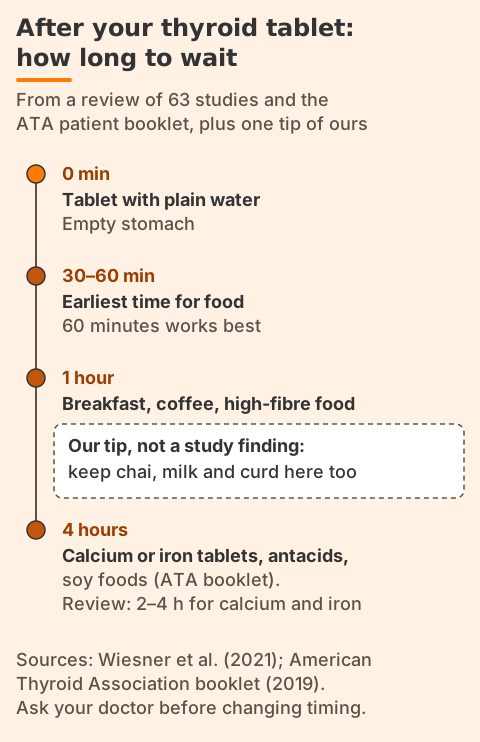
How long to wait after the thyroid tablet, from a review of 63 studies and the ATA patient booklet.[1][28] The chai, milk and curd box is our own tip.
Our simple rule
- Tablet with plain water on an empty stomach.
- Wait 1 hour for any food or drink, chai and milk included.
- Wait 4 hours for calcium or iron tablets, calcium or aluminium antacids, and soy foods.
Why these numbers: the review gives 30–60 minutes for food, about 1 hour for coffee, fibre and soy, and 2–4 hours for calcium and iron.[1] The American Thyroid Association (ATA) booklet says 4 hours for calcium, iron, soy and these antacids.[28] Where they differ, we use the longer gap.
Why water only, and why an hour
The ATA booklet says to take the pill ideally with water only.[28] Absorption is best when breakfast comes 60 minutes later; 30 minutes is the shortest gap the review accepts.[1]
Missing one pill a week is like taking about 14% less medicine.[28]
Bedtime dosing worked about as well as morning dosing,[1] so ask your doctor if mornings are hard. Liquid and soft-gel forms are less affected by food;[1][2] whether you need one, and whether it is sold where you live, is your doctor's call.
Chai, coffee, milk and breakfast
In a small study, espresso taken with the tablet lowered how much thyroid hormone reached the blood; coffee taken an hour later did not.[21] No study tested chai, so our reading is to treat it like coffee. Evidence on milk is too thin to set a gap,[1] so we keep milk and curd to the one-hour mark too.
Many Indian breakfasts, such as pesarattu (green gram dosa) or chilla, contain whole gram, and the review suggests keeping high-fibre food about an hour away.[1]
In a small series, fibre supplements and high-fibre diets were linked with higher dose needs, and wheat bran bound the medicine in lab tests.[25]
Our reading: keep fibre in meals and steady from day to day, keep bran or fibre powders away from the tablet, and stick to one routine, because your doctor sets the dose from your blood tests.[28]
Other medicines and biotin
Acid-reducing tablets, hormonal pills and some seizure medicines can also interfere with the tablet.[2][11] Biotin, a common over-the-counter supplement, can make thyroid blood tests look wrong. The ATA booklet advises stopping it 2 days before a thyroid blood test.[28]
Don't change your dose, brand or timing on your own. Speak to your doctor first.[11]
The hypothyroidism plate, Indian style
There is no special "thyroid plate". ICMR-NIN's "My Plate for the Day" works for you too. Vegetables, fruits, greens and roots fill about half the plate, and you eat from 8–10 food groups a day.[15]
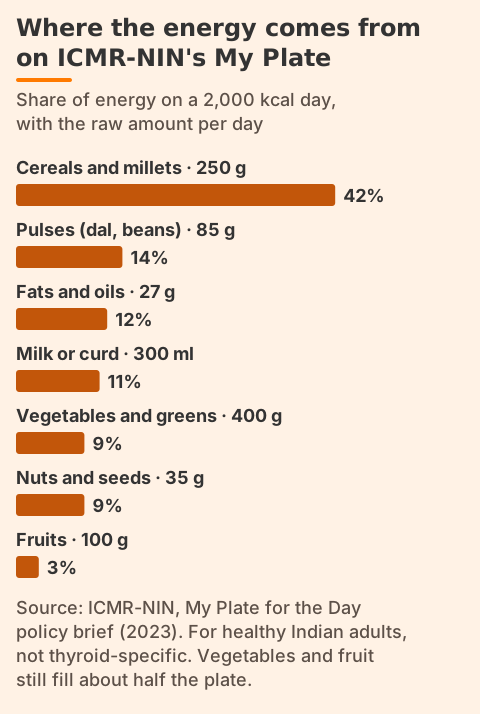
Share of daily energy by food group on ICMR-NIN's My Plate for 2,000 kcal. Vegetables are the biggest amount by weight but only 9% of energy.[15]
Most women with desk jobs need less. ICMR-NIN lists about 1,660 kcal for a sedentary 55 kg woman: 190 g cereals and millets, 60 g pulses, 300 ml milk or curd, 300 g vegetables, 100 g roots, 100 g fruit, 30 g nuts and 25 g oil (raw weights).[16] The diet chart below uses these amounts. Find your own number with the TDEE calculator.
Foods to eat: an Indian list
Iodine: iodised salt, dairy, fish
Your thyroid needs iodine to make hormone. The main sources are iodised salt, dairy, chicken, meat and fish.[28] The Indian adult RDA is 150 mcg a day.[29] About 94% of Indian households used iodised salt in NFHS-5 (2019–21), but Andhra Pradesh had the lowest share of any state, 83%.[26][18]
Sendha namak, pink, black or rock salt have almost the same sodium as common salt, so they are not healthier.[16] Keep iodised salt as your everyday salt.[16]
Protein at every meal
Include a protein food at each meal: dal, whole gram, curd, egg, fish or chicken. Indian adults need about 0.83 g of protein per kg of body weight a day.[29]
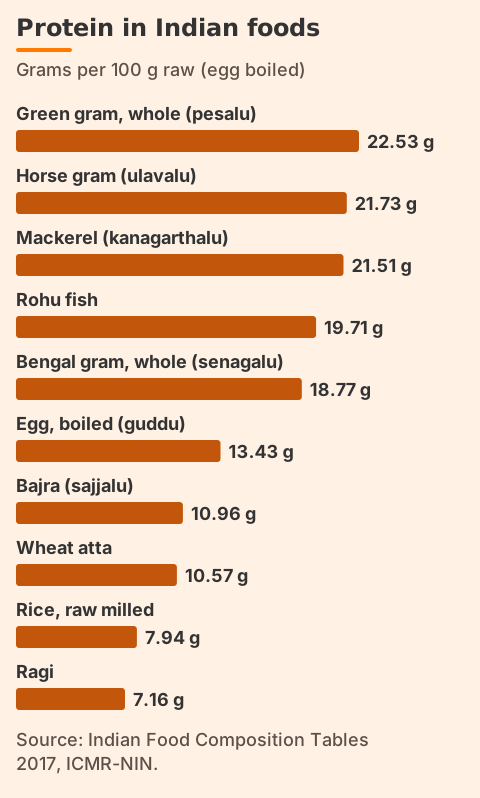
Protein per 100 g raw food (egg boiled), with local names, from the Indian Food Composition Tables 2017.[17]
Iron and fibre
Iron deficiency is linked with thyroid problems in women of reproductive age and in pregnancy.[10] Most of these studies were snapshots in time, so in our reading they show a link, not proof of cause. This matters in India, where 57% of women aged 15–49 have anaemia.[26] The iron RDA for adult Indian women is 29 mg a day.[29]
| Food (per 100 g raw) | Iron | Fibre |
|---|---|---|
| Ulavalu (horse gram), whole | 8.76 mg | 7.88 g |
| Senagalu (Bengal gram), whole | 6.78 mg | 25.22 g |
| Sajjalu (bajra) | 6.42 mg | 11.49 g |
| Menthi kura (fenugreek leaves) | 5.69 mg | 4.90 g |
| Pesalu (green gram), whole | 4.89 mg | 17.04 g |
| Thotakura (amaranth, green) | 4.64 mg | 4.41 g |
Values from the Indian Food Composition Tables 2017.[17]
Eat iron foods with amla, guava, citrus or a coriander-chilli chutney, and keep tea at least an hour away from meals, as ICMR-NIN advises.[16] Constipation is common with hypothyroidism,[28] and ICMR-NIN notes that dietary fibre reduces constipation.[16]
Thyroid foods to avoid or limit
| Limit or avoid | Why |
|---|---|
| Packaged snacks, papads, pickles, sauces, salted dry fish | Lots of salt; keep total salt under 5 g a day[16] |
| Seaweed, kelp, high-dose iodine pills | Too much iodine can cause or worsen hypothyroidism[28] |
| Added sugar | Keep it to 20–25 g a day, the stricter ICMR-NIN figure[16] |
| Any food or drink near the tablet | Wait about 1 hour[1] |
| Calcium and iron tablets, some antacids, soy foods near the tablet | Wait 4 hours[28] |
Myths: do I need to avoid cabbage, millets, soy or gluten?
Cabbage, cauliflower and broccoli
In the lab, compounds in cabbage-family (brassica) vegetables can block iodine uptake.[3] In people, a 2024 review of 123 papers found effects only with very large raw servings, and cooking reduced them in most tests.[3]
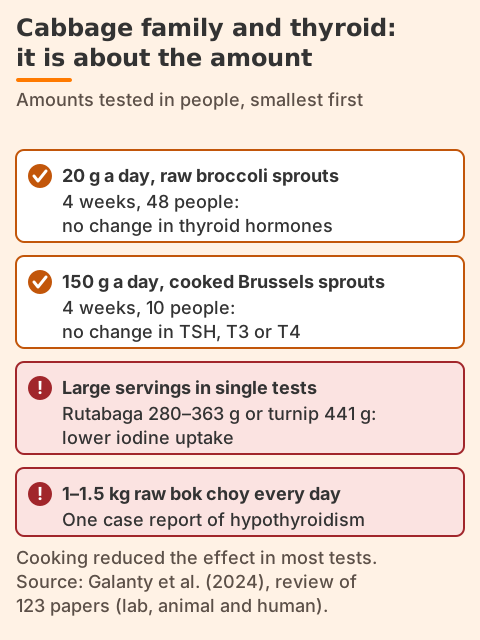
Cabbage-family amounts studied in people, smallest first.[3]
Verdict: cabbage koora, cauliflower curry and cooked broccoli are fine.
Millets: ragi, jonna (jowar), sajjalu (bajra)
The "millets are bad for thyroid" idea comes mainly from animal studies and from goitre surveys in parts of Sudan where pearl millet was the staple and iodine was short.[23][24]
A 2024 review of 9 papers, 8 on pearl millet (sajjalu), found the link to goitre was not convincing for millet eaten in a balanced diet.[23]
One lab study (boiled millet) and one rat study (fermented millet) found stronger effects, the review was funded by a state millet-promotion mission, and it found no studies on ragi or jonna.[23]
Verdict: for pearl millet in a mixed diet with iodised salt, the evidence so far is reassuring. For ragi and jonna there is little research either way, so we use them in everyday amounts as part of a mixed diet. See millets for weight loss.
Soy and tofu
A study pooling 18 trials of soy supplements found no change in free T3 or free T4. TSH rose very slightly; the authors say it is unclear whether that matters for health.[4] The authors want more research in people with thyroid disease.[4]
Verdict: soy chunks or tofu in normal amounts are fine. Keep them 4 hours from the tablet, as the ATA booklet advises, and tell your doctor if you eat a lot.[28]
Gluten-free for Hashimoto's?
A 2025 review found only 3 small trials (110 people); a gluten-free diet did not change TSH or free T4.[6] Verdict: no need to cut wheat unless you have coeliac disease, which your doctor can test for.
Do selenium or vitamin D pills help?
Pooled trials found selenium pills lowered TSH slightly in people not yet on thyroid hormone, and guidelines do not include selenium.[5] Vitamin D pills lowered antibody levels,[7] but that is not the same as treating hypothyroidism.
Too much selenium harms: Europe's food safety authority set an adult limit of 255 mcg a day, and hair loss is an early sign of excess.[33] Get selenium from food instead:
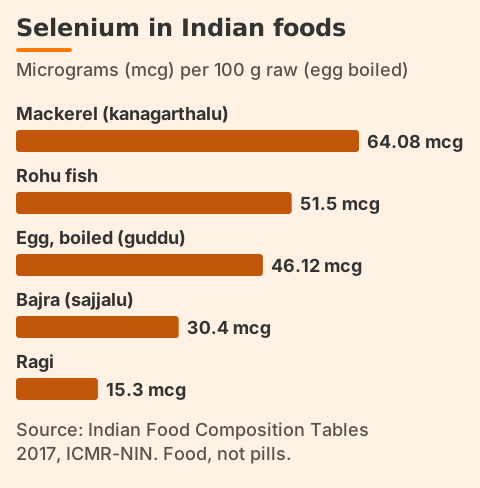
Selenium per 100 g raw food (egg boiled), from the Indian Food Composition Tables 2017.[17]
Verdict: our coaches suggest getting selenium from fish, eggs and millets, and asking your doctor before taking selenium or vitamin D pills.
Indian thyroid diet chart (veg and non-veg)
One-day diet chart
An example day for a non-pregnant woman on about 1,660 kcal, tablet at 6:30 am (times are examples). Amounts are raw weights from the ICMR-NIN figures above.[16]
| Time | Vegetarian | Non-veg swap | Example amount (raw) |
|---|---|---|---|
| 6:30 am | Thyroid tablet, plain water | Same | Nothing else for 1 hour |
| 7:30 am | 2 pesarattu + allam pachadi | 1 pesarattu + 1 boiled egg | 25 g green gram + 20 g rice (egg day: half of each) |
| 9:00 am | Chai | Same | 50 ml milk |
| 10:30 am | Ragi java with buttermilk, or 1 fruit | Same | 20 g ragi + 150 ml buttermilk |
| 1:00 pm | Rice or jonna rotte + pappu + thotakura koora + cabbage koora + perugu | Rice or jonna rotte + chepala pulusu instead of pappu + thotakura koora + perugu | 70 g rice or jonna; 25 g dal (or about 60 g fish); 200 g vegetables; 100 ml curd |
| 4:30 pm | Roasted senagalu + nuts + fruit | Same | 10 g chana; 30 g nuts; 100 g fruit |
| 7:30 pm | Chapati or millet upma + vegetable curry + salad | Same, or kodi kura on days without fish | 80 g atta or millet; 100 g vegetables + 100 g roots (about 60 g chicken) |
Telugu dish names in these charts
| Name | What it is |
|---|---|
| Pesarattu | Green gram dosa |
| Allam pachadi | Ginger chutney |
| Ragi java | Thin ragi porridge |
| Jonna rotte | Jowar (sorghum) roti |
| Sajjala rotte | Bajra roti |
| Pappu | Dal |
| Koora | Vegetable curry (thotakura koora: amaranth leaves) |
| Perugu | Curd |
| Chepala pulusu | Tamarind fish curry |
| Kodi kura | Chicken curry |
| Senagala koora | Chickpea curry |
| Ulava charu | Horse gram soup |
| Bendakaya | Okra |
Pulses are split across the day: 25 g at breakfast, 25 g at lunch and 10 g at the snack make 60 g. ICMR-NIN allows about 30 g of pulses to be swapped for fish, meat or egg;[16] the non-veg amounts are our examples, so ask your coach for exact swaps. Across the day: about 25 g oil (5 teaspoons) and iodised salt.[16]
This is a maintenance example, not a weight-loss plan. For weight loss, ICMR-NIN advises a gradual approach that still gives all nutrients.[16] Use the TDEE calculator and set a modest cut with a coach.
Seven-day plan (printable)
Print this table or save the page as a PDF (Ctrl+P or Cmd+P, then "Save as PDF"). Breakfast is about an hour after the tablet.
| Day | Breakfast | Lunch | Dinner |
|---|---|---|---|
| Mon | Pesarattu + chutney | Rice + pappu + thotakura koora + perugu | Jonna rotte + vegetable curry + dal |
| Tue | Idli + sambar | Rice + rajma + beans koora + curd | Ragi dosa + egg or paneer bhurji + salad |
| Wed | Vegetable upma + curd | Jonna rotte + chepala pulusu or senagala koora + salad | Chapati + palak dal + cauliflower curry |
| Thu | Moong dal chilla + mint chutney | Rice + sambar + cabbage koora + buttermilk | Millet khichdi + vegetable raita |
| Fri | Ragi idli + tomato chutney | Rice + kodi kura or ulava charu + bendakaya fry + curd | Chapati + chana masala + salad |
| Sat | Egg omelette + chapati, or besan chilla | Sajjala rotte + dal + vegetables | Small lemon rice + dal + vegetable curry |
| Sun | Pongal + sambar | Vegetable pulao + raita + dal | Dosa + sambar + vegetable side |
Snacks every day: chai (50 ml milk) away from meals; ragi java or 1 fruit; roasted chana, 30 g nuts and 1 fruit.
Daily portions (raw), as in the one-day chart: breakfast about 45 g grain and dal; lunch 70 g grain, 25 g dal, 200 g vegetables, 100 ml curd; dinner 80 g grain or flour, 200 g vegetables and roots; 25 g oil; iodised salt.
Also have diabetes? Our tip: swap lemon rice and pongal for dal-rich or millet dishes with more vegetables, and keep carbohydrate portions similar from day to day. If you take insulin or certain diabetes tablets (sulfonylureas such as glimepiride or gliclazide), skipping meals or eating less carbohydrate can cause low blood sugar,[34] so change your meals together with your doctor.
Pregnant or breastfeeding? These charts are for non-pregnant adults. ICMR-NIN advises a nutrient-rich balanced diet in pregnancy, with about 350 kcal a day extra in the second and third trimesters, so this is not a time to cut calories.[16] Ask your doctor or dietitian for your own plan.
Office days and NRI kitchens
- Office days: boiled eggs, idli or ragi java travel well; pack a dal or protein and a vegetable for lunch.
- Abroad: frozen methi and palak keep the vegetable half easy, plain yoghurt stands in for perugu, and sardines (mathi) give 17.91 g protein per 100 g raw.[17] Check that your salt says "iodised", one of the main iodine sources.[28]
Pregnancy, postpartum and planning a baby
Pooled Indian studies suggest about 11% of pregnant Indian women have hypothyroidism, though results varied widely.[9] Untreated, it raises the risk of pre-eclampsia, premature birth and miscarriage.[14] If you are planning a baby, see your doctor before you try.[28]
On thyroid tablets and think you might be pregnant? Contact your doctor right away.[13] The dose usually needs to go up. ATA's 2017 guidance suggests two extra tablets a week of your usual dose as a first step, then setting the dose from blood tests every 4 weeks until mid-pregnancy.[13] Agree that first step with your doctor when you call, rather than changing your dose on your own.
For iodine, Indian guidance relies on iodised salt in pregnancy.[16] US (ATA) guidance adds a daily iodine supplement for women who are not on thyroid tablets, but not for women already taking them.[13] Ask your doctor which applies to you.
After delivery, postpartum thyroiditis can cause an overactive phase (anxiety, palpitations), often 1–4 months after birth, then an underactive phase (tiredness, low mood), often 4–8 months after.[31] These signs are easy to blame on a new baby,[31] so ask for a thyroid test if they appear.
When to see a doctor
See your doctor if:
- You have symptoms of an underactive thyroid and have never been tested.[14]
- Symptoms come back or worsen on tablets, or after a brand change.[11][28]
- You get a racing or irregular heartbeat, tremor, sweating, anxiety or sudden weight loss after a dose change; the dose may be too high.[30][28] Get urgent help for chest pain.
- You notice a new neck swelling or lump, or trouble swallowing.[32] Go to emergency if breathing becomes hard.[32]
- You start calcium, iron, antacids, acid-reducing tablets, hormonal pills or seizure medicines.[2][11]
- You are pregnant, planning pregnancy, breastfeeding, or had a baby in the last year.[13][31]
Blood tests are usually rechecked 6–10 weeks after starting or changing the dose, and 6–12 weeks after a brand switch.[28] Untreated or poorly treated hypothyroidism raises the risk of heart disease and osteoporosis.[14]
Go to hospital straight away if someone with hypothyroidism becomes very cold, breathes slowly or shallowly, or becomes unusually drowsy, confused or hard to wake. This can be myxoedema coma, a rare medical emergency.[30][14]
Key takeaways
- Take the tablet with plain water on an empty stomach,[28] and wait about 1 hour for food and coffee.[1] We use the same gap for chai.
- Keep calcium or iron tablets, calcium or aluminium antacids and soy foods 4 hours from the tablet.[28]
- Use iodised salt as your everyday salt;[16] our coaches suggest a protein food at each meal.
- Cooked cabbage-family vegetables are fine.[3] Pearl millet in a mixed diet with iodised salt looks safe so far;[23] our coaches use ragi and jonna in everyday amounts too.
- See a doctor for the warning signs listed under "When to see a doctor".
How a Flexcellence coach can help
The Flexcellence Thyroid Control plan pairs you with a nutritionist and a fitness coach. Your plan is built on the food you already cook and the reports you share, with tablet timing worked in. We work alongside your doctor, never instead of them.
Start with the free TDEE calculator, then book a free consultation. Have PCOS too? Read our PCOS and thyroid diet guide. Telugu readers: thyroid diet in Telugu.
Frequently asked questions
Can I eat rice if I have hypothyroidism?
Yes. Rice fits in the cereals and millets share of the plate.[15] It has less fibre than atta or ragi (2.81 g against about 11 g per 100 g raw), so mix in whole grains or millets.[17]
Can I drink milk with thyroid problems?
Yes. Milk and curd are part of ICMR-NIN's daily plate, about 300 ml a day.[15][16] Evidence on milk and the tablet is thin,[1] so we suggest milk and curd at least an hour after the tablet, and calcium tablets 4 hours away.[28]
Is a thyroid diet different for weight loss?
The foods are the same; the amounts change. ICMR-NIN advises gradual weight loss on a diet that still meets all nutrient needs.[16] Find your number with the TDEE calculator and set a modest cut with a coach.
How long after the thyroid tablet can I drink tea or coffee?
About one hour.[1][21] Coffee was studied directly; we use the same gap for chai.
This article is general information, not medical advice. Medical review pending.
Common questions
Can I eat rice if I have hypothyroidism?
Yes. Rice fits in the cereals and millets share of the plate. It has less fibre than atta or ragi (2.81 g against about 11 g per 100 g raw), so mix in whole grains or millets.
Can I drink milk with thyroid problems?
Yes. Milk and curd are part of ICMR-NIN's daily plate, about 300 ml a day. Evidence on milk and the tablet is thin, so we suggest milk and curd at least an hour after the tablet, and calcium tablets 4 hours away.
Is a thyroid diet different for weight loss?
The foods are the same; the amounts change. ICMR-NIN advises gradual weight loss on a diet that still meets all nutrient needs. Find your number with the TDEE calculator and set a modest cut with a coach.
How long after the thyroid tablet can I drink tea or coffee?
About one hour. Coffee was studied directly; we use the same gap for chai.
Reviewed by
Not yet reviewed by a Flexcellence coach.
Sources
Pharmaceuticals (MDPI) / PubMed Central. Levothyroxine Interactions with Food and Dietary Supplements – A Systematic Review (Wiesner, Gajewska, Pasko) (2021).
Therapeutics and Clinical Risk Management (Dove Press) / PubMed Central. Medications and Food Interfering with the Bioavailability of Levothyroxine: A Systematic Review (Liu et al.) (2023).
International Journal of Molecular Sciences (MDPI) / PubMed Central. Do Brassica Vegetables Affect Thyroid Function? A Comprehensive Systematic Review (Galanty et al.) (2024).
Scientific Reports (Nature) / PubMed Central. Systematic Review and Meta-analysis on the Effect of Soy on Thyroid Function (Otun et al.) (2019).
Thyroid (Mary Ann Liebert) / PubMed Central. Selenium Supplementation in Patients with Hashimoto Thyroiditis: A Systematic Review and Meta-Analysis of Randomized Clinical Trials (Huwiler et al.) (2024).
Nutrients (MDPI) / PubMed Central. Effects of Gluten-Free Diet in Non-Celiac Hashimoto's Thyroiditis: A Systematic Review and Meta-Analysis (Araujo et al.) (2025).
Medicine (Baltimore) / PubMed Central. Effects of vitamin D supplementation on autoantibodies and thyroid function in patients with Hashimoto's thyroiditis: a systematic review and meta-analysis (Tang et al.) (2023).
Indian Journal of Endocrinology and Metabolism / PubMed Central. Prevalence of hypothyroidism in adults: An epidemiological study in eight cities of India (Unnikrishnan et al.) (2013).
Journal of Thyroid Research (Hindawi) / PubMed Central. A Systematic Review and Meta-Analysis of Prevalence of Hypothyroidism in Pregnant Women in India (Yadav et al.) (2021).
Frontiers in Endocrinology / PubMed Central. Iron Deficiency, a Risk Factor of Thyroid Disorders in Reproductive-Age and Pregnant Women: A Systematic Review and Meta-Analysis (Luo et al.) (2021).
American Thyroid Association. Hypothyroidism (Underactive) – patient information (2024).
American Thyroid Association. Does Treatment of Hypothyroidism Lead to Weight Loss? (study presented at the 83rd ATA Annual Meeting) (2013).
American Thyroid Association – Clinical Thyroidology for the Public. 2017 Guidelines of the American Thyroid Association for the Diagnosis and Management of Thyroid Disease During Pregnancy and the Postpartum (public summary) (2017).
NHS (UK National Health Service). Underactive thyroid (hypothyroidism) (2024).
ICMR-National Institute of Nutrition, Hyderabad. Policy Brief: Promotion of 'My Plate for the Day' and physical activity (2023).
ICMR-National Institute of Nutrition, Hyderabad. Dietary Guidelines for Indians (2024) (2024).
ICMR-National Institute of Nutrition, Hyderabad. Indian Food Composition Tables (IFCT) 2017 (Longvah et al.) (2017).
Directorate General of Health Services, Ministry of Health & Family Welfare, Govt. of India. National Iodine Deficiency Disorders Control Programme (NIDDCP) (2025).
Medical Science Monitor. Alteration of lipid profile in subclinical hypothyroidism: a meta-analysis (Liu et al.) (2014).
NHS (UK National Health Service). Underactive thyroid (hypothyroidism): causes (2024).
American Thyroid Association – Clinical Thyroidology for Patients. Coffee and levothyroxine absorption (summary of Benvenga et al., Thyroid 2008) (2008).
British Journal of Sports Medicine / World Health Organization. World Health Organization 2020 guidelines on physical activity and sedentary behaviour (Bull et al.) (2020).
Frontiers in Nutrition / PubMed Central. Does consumption of pearl millet cause goiter? A systematic review of existing evidence (2024).
Journal of Clinical Endocrinology & Metabolism / PubMed. Antithyroid and goitrogenic effects of millet: role of C-glycosylflavones (Gaitan et al.) (1989).
The Journal of Clinical Endocrinology & Metabolism (Oxford Academic). Evidence for a clinically important adverse effect of fiber-enriched diet on the bioavailability of levothyroxine in adult hypothyroid patients (Liel et al.) (1996).
International Institute for Population Sciences (IIPS) and ICF, for the Ministry of Health and Family Welfare, Govt. of India. National Family Health Survey (NFHS-5), 2019-21: India, Volume I (2021).
National Institute for Health and Care Excellence (NICE), UK. Thyroid disease: assessment and management (NG145) (2019).
American Thyroid Association. Hypothyroidism: A Booklet for Patients and Their Families (2019).
ICMR-National Institute of Nutrition, Hyderabad. A Brief Note on Nutrient Requirements for Indians: RDA and EAR (ICMR-NIN 2020) (2020).
MedlinePlus (US National Library of Medicine). Hypothyroidism – Medical Encyclopedia (2024).
American Thyroid Association. Postpartum Thyroiditis – patient information (2024).
NHS (UK National Health Service). Goitre (2024).
EFSA Journal (European Food Safety Authority) / PubMed Central. Scientific opinion on the tolerable upper intake level for selenium (EFSA NDA Panel) (2023).
National Institute of Diabetes and Digestive and Kidney Diseases (NIDDK), NIH (USA). Low Blood Glucose (Hypoglycemia) (2021).