How to Lose Belly Fat: What Works for Indian Women
Measure your waist, skip the crunches, and use food, walking, strength and sleep that studies support. Indian-food tips and red flags.
The short answer
Belly fat falls when overall body fat falls. A small trial found ab exercises alone did not reduce it. Food, regular aerobic activity, strength work and enough sleep help. Measure your waist first: 80 cm or more is high for Indian women. See a doctor for a swollen or bloated belly.
Work out your own numbers
Screen metabolic risk using waist-to-height ratio thresholds.
Free, takes a minute, and uses the same formulas our coaches use.
Open the Waist-to-Height Ratio CalculatorAlso useful
On this page
Belly fat comes down when your overall body fat comes down. You cannot crunch it away, and no honest plan can promise centimetres in a month. What helps is food you can keep eating, regular walking or other aerobic activity, some strength work and enough sleep. Many Indian women ask, "Where is this belly coming from?" and it is a fair question: in the ICMR-INDIAB survey, 113,043 adults aged 20 and above were surveyed across 31 states and union territories (2008 to 2020), abdominal obesity was assessed in about 108,665 of them, and an estimated 39.5% had it by WHO Asia-Pacific criteria.[1] So you are not alone.
What to do first
This is our coaches' suggested order. It is practical advice, not a study result or a promise.
- Measure your waist and height and write them down (steps below).
- Fix a regular sleep window. Short sleep worked against fat loss in one small study (see Sleep).
- Walk 10 minutes after one meal a day, then build up.
- Fill half your plate with vegetables and greens and swap sugary drinks, sweet chai and packaged juice for water or plain tea.
- Put some protein in every meal: dal, eggs, fish, paneer (Indian cottage cheese) or sprouts.
- Add 2 days of strength work after a few weeks, and re-measure your waist every 2 to 4 weeks.
If you have a health condition, are pregnant or breastfeeding, or take medicine for diabetes, read "Before you start: stay safe" first. Want a full day laid out? See our 7-day South Indian diet plan for weight loss.
Why belly fat matters more in South Asian bodies
South Asians tend to carry more fat around the trunk and inside the belly, and less muscle, than White Caucasians.[5] Type 2 diabetes and heart disease also appear earlier in South Asians, and at lower BMI and waist sizes.[5] An Indian consensus group describes the same pattern in Asian Indians: extra body fat, extra belly fat, and fat in places like the liver and muscle.[3]
Waist size also tells you something that BMI misses. In the EPIC study, 359,387 adults in 9 European countries were followed for an average of 9.7 years. After adjusting for BMI, men and women in the highest fifth for waist size had 2.05 and 1.78 times the risk of death.[8] This was a European group, not an Indian one, and it shows an association, not proof of cause. But it is one reason doctors now ask about waist as well as weight.
Two kinds of belly fat
Some belly fat sits under the skin. Some sits deeper, inside the belly, around the organs. A review of 89 studies found that no treatment (diet, exercise, drugs or surgery) picks out the deeper fat for special loss. When people lost fat overall, the deeper fat fell too, and in percentage terms it fell by more than the under-skin fat.[10] So the practical lesson is to work on overall fat loss and watch the waist. This review compared two kinds of fat, so it does not tell us whether exercising one body part burns fat from that part. For that, see the crunches section.
Measure first: your waist and waist-to-height ratio
Before changing anything, take two measurements. They are free and take two minutes.
Step 1: Waist. The Indian cut-offs for abdominal obesity are a waist of 80 cm or more in women and 90 cm or more in men.[31][5] They go back to a 2009 consensus for Asian Indians[3] and are lower than the Western cut-offs you may see online. A newer 2025 paper from the India Obesity Commission proposes a framework that looks at waist or waist-to-height ratio alongside BMI.[4] To measure, our coaches suggest a non-stretch tape, held level, around the waist while standing relaxed, read after a normal breath out. Guides differ on exactly where to place the tape, so pick one spot and use it every time.
Step 2: Waist-to-height ratio. Divide your waist by your height (both in cm). A review of 31 papers and over 300,000 adults from several ethnic groups found waist-to-height ratio a better screening tool than BMI for heart and metabolic risk factors.[6] Our coaches use "waist below half your height" as a rough guide. It is a rule of thumb, not a diagnosis.
Worked example (just arithmetic). If you are 155 cm tall, half of your height is 77.5 cm. A waist above 77.5 cm is above that line. The 80 cm rule and the half-height rule can differ a little, so look at both.
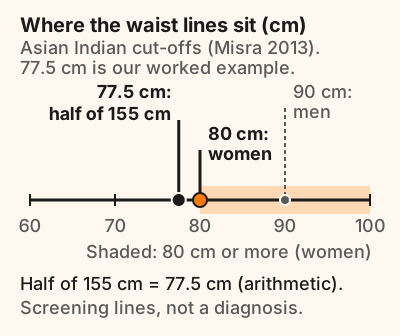 Waist lines for Asian Indian adults: the 80 and 90 cm lines are from the cited source.[31] The 77.5 cm line is worked arithmetic for a 155 cm tall woman, using our coaches' half-height rule of thumb.
You can do the sums with our free waist-to-height ratio calculator and waist-to-hip ratio calculator. The body fat calculator gives an estimate of body fat from tape measurements. These tools give estimates, not a diagnosis. A consensus statement recommends measuring waist routinely and treating a smaller waist as a goal.[7] That is also why we suggest tracking your waist, not only the scale.
Why crunches and "belly fat workouts" don't melt belly fat
In one small trial, 24 sedentary adults did 7 abdominal exercises (2 sets of 10) five days a week for 6 weeks, with their diet kept the same. Compared with a control group, they had no significant change in body weight, body fat percentage, belly fat or waist size. Their sit-up endurance did improve (47 versus 32 curl-ups).[9] It is one small trial, so treat it as a hint and not the final word.
So ab work builds core strength, but in that trial it did not shrink the waist. Our coaches still include some core work in programmes, for posture and back comfort. Just do not expect it to burn the belly.
Foods to reduce belly fat: an Indian plate
Overall fat loss is what reduces belly fat.[10] A large review of 117 studies (4,815 people, deep belly fat measured by scans) found that both a reduced-calorie diet and exercise reduced deep belly fat. Diet gave more weight loss, while exercise tended to cut more deep belly fat. It also found that scale weight is a poor marker of change in deep belly fat.[11] That is another reason to measure your waist.
Fill half the plate with vegetables, fruit and greens
ICMR-NIN's "My Plate for the Day" says vegetables, fruits, greens, roots and tubers should make up about half of the plate. For a 2,000 kcal day it lists these raw weights: cereals including millets 250 g, pulses (dals) 85 g, milk or curd 300 ml, vegetables and greens 400 g, fruit 100 g, nuts and seeds 35 g, and fats and oils 27 g. If sugar is eaten at all, it suggests 25 to 30 g a day.[2] That is a general template for a 2,000 kcal day, not a belly-fat diet, and not right for everyone. Fats and oils at 27 g is about 6 teaspoons for the whole day, so our coaches suggest measuring cooking oil with a spoon instead of pouring.
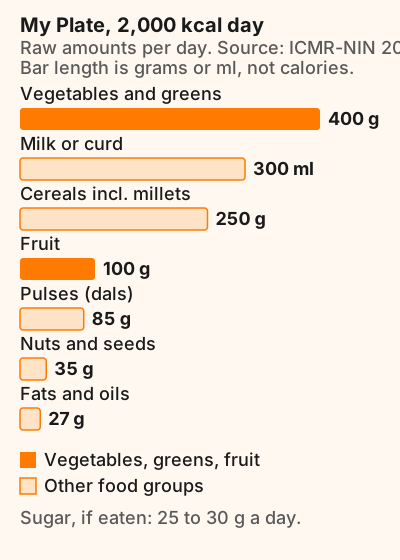 ICMR-NIN My Plate raw weights for a 2,000 kcal day. A general template, not a belly-fat diet.[2]
Protein at every meal
A review of 24 trials with 1,063 adults (about 12 weeks on average) compared energy-restricted high-protein, low-fat diets with standard-protein, low-fat diets. The higher-protein diets gave slightly more weight loss (0.79 kg more), slightly more fat loss (0.87 kg more) and kept slightly more lean mass (0.43 kg more).[22] The benefit was small, so protein helps but is not magic. Our protein per day guide and high-protein vegetarian foods guide have more.
Indian Food Composition Tables list these protein amounts per 100 g: pesalu (whole green gram) 22.5 g raw, kandi pappu (toor dal, split red gram) 21.7 g raw, whole egg 13.3 g, rohu (a freshwater fish) 19.7 g, and paneer 18.9 g, though paneer also has 24.8 g of fat.[28] Our coaches suggest building each meal around one of these, for example pesarattu (green gram dosa) at breakfast or dal at lunch.
Drinks and ultra-processed food
In a 6-month trial, 47 overweight adults drank 1 litre a day of regular cola, semi-skimmed milk, diet cola or water. The regular cola group had much larger rises in liver fat and deep belly fat than the other three groups.[19] In the Framingham study, 1,003 adults had CT scans about 6 years apart. Regular sugar-sweetened drinks went with an adverse rise in deep belly fat, while diet soda did not. This is an association, not proof.[20]
Ultra-processed food matters too. In a 2-week hospital trial of 20 adults, people ate about 508 kcal a day more on an ultra-processed diet than on an unprocessed one. They gained 0.9 kg on one diet and lost 0.9 kg on the other, even though both menus were matched on offered calories, sugar, fat and fibre.[21] For Indian homes, our coaches suggest looking first at sweet chai, packaged juice, bakery snacks and mithai (Indian sweets). We have no study of these particular items in our sources, so this is coach advice only.
South Indian swaps our coaches suggest
The swaps below are our coaches' practical advice, not study results. Portions are starting points and need adjusting for your size, work and health. One katori is a small bowl of about 150 ml, but home bowls vary, so check yours.
| Meal | Try this | Rough portion (our coaches suggest) | Why we like it |
|---|---|---|---|
| Breakfast | Pesarattu (green gram dosa) with ginger chutney | 2 medium pesarattu | Whole green gram has 22.5 g protein per 100 g raw.[28] |
| Breakfast | Idli with sambar and a side of vegetables | 2 to 3 idli, 1 katori sambar | Sambar adds dal and vegetables. |
| Breakfast | Egg bhurji (scrambled eggs) with a phulka (thin oil-free roti) | 2 eggs, 1 phulka | A whole egg has 13.3 g protein per 100 g.[28] |
| Lunch | Cooked rice, kandi pappu (toor dal), a vegetable curry and curd | Cooked rice about 1 katori; half the plate vegetables and greens | Follows the half-plate idea.[2] |
| Lunch | Ragi sangati (ragi ball) or jowar roti with fish curry | 1 ball or 2 rotis, 1 small piece of rohu (freshwater fish) | Rohu has 19.7 g protein per 100 g.[28] |
| Snack | Roasted senagalu (chickpeas) or a guava | 1 fistful or 1 medium fruit | White guava has 8.6 g fibre per 100 g.[28] |
| Dinner (veg) | Phulka with aaku kura (leafy greens curry), dal and a small portion of paneer or sprouts | 2 phulka | Wheat atta has 11.4 g fibre per 100 g against 2.8 g for maida (refined flour).[28] |
| Dinner (non-veg) | Grilled or curry fish or egg, with sautéed vegetables | 1 serving of fish or 2 eggs | Protein with little added starch. |
On millets, the Indian Food Composition Tables give per 100 g raw: ragi 321 kcal and 11.2 g fibre, jowar 334 kcal and 10.2 g fibre, and raw milled white rice 356 kcal and 2.8 g fibre.[28] These are composition facts. We do not claim that millets "burn" belly fat. They simply bring more fibre per bite, and we suggest keeping the portion modest. See our millets for weight loss guide.
Eating out, festivals and late dinners
These are our coaches' tips, with no study behind them. Eat dinner earlier and lighter when you can. When eating out, pick dal, vegetables, grilled items or curd with one starch, not two or three. At festivals, enjoy a small portion of mithai after a normal meal, not on an empty stomach, and go back to your usual plate at the next meal. Keep alcohol occasional, and ask your doctor what is safe for you.
Things we do not recommend relying on
We found no study in our sources showing that spot-reduction teas, "detox" drinks, jeera or lemon water, or waist-trainer belts reduce belly fat. If you enjoy a drink, fine. Do not pay for or rely on them.
Move more: what the research says works
The WHO says adults aged 18 to 64 should do 150 to 300 minutes of moderate aerobic activity a week, or 75 to 150 minutes of vigorous activity, or a mix. They should also do muscle-strengthening on at least 2 days a week, and limit sitting time.[17]
Aerobic activity (brisk walking, cycling, swimming, dancing). A review of 15 studies with 852 people found that exercise without dieting reduced deep belly fat, and that moderate or high intensity aerobic exercise had the most potential, even within 12 weeks.[12] An older review of 35 randomised trials (searched to 2010) found aerobic exercise reduced deep belly fat, while resistance training alone did not clearly do so.[13] A newer review, below, found strength training does help.
Strength training. A review of 34 studies with 2,285 people found strength training reduced deep belly fat compared with no training. Adding it to calorie restriction did not cut deep belly fat more than the diet alone.[14] So strength work is worth doing for muscle and health, but do not oversell it as a belly-fat tool.
HIIT (short hard bursts with rests). A review of 39 studies with 617 people (52% women) found HIIT reduced total body fat. It also reduced belly and deep belly fat when these were measured by CT or MRI scans.[15] Another review of 13 trials in adults aged 18 to 45 found HIIT and steady moderate exercise gave similar body-composition results, including waist.[16] So our coaches say: pick the kind you will actually keep doing.
In the ICMR-INDIAB study of 14,227 adults in four regions (including Tamil Nadu and Maharashtra), 54.4% were physically inactive. Inactivity was higher in urban areas, and women were less active than men.[18] That study did not cover all of India, and it is from 2014, but it shows how common inactivity is.
For desk workers, our coaches suggest a 10-minute walk after lunch and dinner, taking stairs, and standing up every hour. The WHO notes that replacing sitting with activity of any intensity, even light, has benefits.[17]
Sleep
In a small controlled study, 10 overweight adults followed the same calorie-restricted diet for 14 days, once with 8.5 hours and once with 5.5 hours in bed. On short sleep they lost less of their weight as fat (0.6 kg versus 1.4 kg) and more lean mass (2.4 kg versus 1.5 kg). They also felt hungrier.[23] With only 10 people, we would not read too much into the exact numbers.
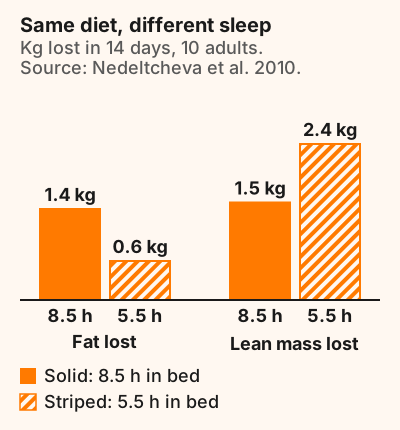 Fat and lean mass lost on the same calorie-restricted diet with 8.5 or 5.5 hours in bed. Ten adults, 14 days.[23]
Our coaches suggest keeping a fixed sleep window as one of the first changes. We have not cited a study on stress and belly fat here, so we make no claim about stress.
Special situations: menopause, after delivery, PCOS and thyroid
Menopause. In a study that followed 156 women (103 Caucasian and 53 African-American) for 4 years with scans, all gained under-skin belly fat with age. Only the 51 who became postmenopausal had a significant rise in deep belly fat. Their sleeping energy use also fell 7.9%, compared with 5.3% in women who did not reach menopause.[24] It describes an average, not what will happen to you.
After delivery. Separation of the tummy muscles (diastasis recti) is common during and after pregnancy, so a belly bulge after a baby is not always fat. A review of 8 studies with 336 women found the evidence on whether exercise helps is poor.[25] As safety advice, our coaches say to ask a doctor or physiotherapist before doing crunches if your belly bulges or domes when you sit up. Our guides on core recovery after delivery and the postpartum weight loss timeline cover this.
Pregnant or breastfeeding. Do not start a weight-loss diet on your own. Talk to your doctor first. Our pregnancy diet chart and breastfeeding diet chart are written for those stages.
PCOS and thyroid. We make no claim here about how belly fat behaves with PCOS or a thyroid condition. Follow your doctor's treatment plan, and read our guides on PCOS weight loss and thyroid weight loss.
How fast is realistic? Belly fat in 1 month
The US CDC says gradual, steady weight loss of about 1 to 2 pounds (about 0.5 to 1 kg) a week is more likely to be kept off, and that modest weight loss can improve blood pressure, cholesterol and blood sugar.[27] That is a general health-agency range, not a target for your belly. In the Look AHEAD study of people with type 2 diabetes, losing 5% to under 10% of body weight at 1 year went with better blood sugar, blood pressure, triglycerides and HDL cholesterol.[26]
We will not promise a flat tummy in 30 days, or any number of centimetres. The best tracking, in our coaches' view, is your waist measurement every 2 to 4 weeks, plus how your clothes fit, because the scale alone can mislead.[11][7] If weight stops moving, see our weight-loss plateau guide. For calorie maths with Indian meals, see our guide to calorie deficit with Indian meals and the calorie deficit calculator. Do not eat below the intake your doctor or dietitian has set for you.
A starter month you can actually keep
This is our coaches' suggested order of changes. It is practical advice, not a study result or a promise.
| Week | Focus | What to do |
|---|---|---|
| 1 | Measure and sleep | Record waist and height. Fix a regular sleep window. Walk 10 minutes after one meal a day. |
| 2 | Plate and drinks | Make half your plate vegetables and greens. Cut sugary drinks, sweet chai and packaged juice. |
| 3 | Add strength | Start 2 days of strength work (bodyweight squats, push-ups on knees, or resistance bands). Keep daily walks. |
| 4 | Build aerobic time | Add a third aerobic session. Re-measure waist. Compare with week 1 and adjust. |
The WHO guideline is the goal to build towards: 150 minutes of moderate activity and 2 days of muscle-strengthening a week.[17] You do not need to reach it in week 1.
One example day (illustration only). We do not give calorie totals, because they depend on your size and activity. Use it as a pattern, not a prescription.
- Veg: Breakfast: 2 pesarattu with chutney. Lunch: 1 katori cooked rice, a katori of kandi pappu, a vegetable curry, a large salad and curd. Evening: a guava or roasted senagalu. Dinner: 2 phulka, aaku kura, dal and a small portion of paneer.
- Non-veg: Same day, but swap the dinner paneer for a small portion of egg or fish.
Our South Indian diet plan has a full 7-day Andhra and Telangana chart.
Before you start: stay safe
This is general safety advice from our coaches, not a study result. Please read it before changing food or exercise.
- Check with your doctor first if you are pregnant or breastfeeding, have diabetes and take medicine, or have thyroid, kidney, liver or heart disease, high blood pressure or joint problems.
- If you take insulin or diabetes tablets, changing what you eat can affect how much medicine you need. Change your food only with your doctor's plan. See our diabetes weight loss guide.
- Start exercise gently, especially if you are untrained or have not exercised for a long time. Build up slowly. Stop and get medical help for chest pain, unusual breathlessness, or feeling faint or dizzy.
- Avoid crash or very low-calorie diets. If you feel afraid of food, binge, or skip meals to compensate, talk to your doctor.
- Stop and get advice if you feel dizzy or faint, or your periods become irregular after starting a strict diet.
When a big belly is not just fat: see a doctor
A growing or bloated belly is not always fat. Please see a doctor, and do not just try to diet it away, if you notice any of these.
- Ovarian cancer warning signs, when they happen often (about 12 or more times a month). The NHS lists tummy swelling or bloating, belly or pelvic pain, feeling full quickly or loss of appetite, and needing to pee more often. It also lists bowel changes, back pain, constant tiredness, unexplained weight loss and unusual vaginal bleeding, including after menopause. The NHS says finding it early can mean it is more treatable.[29]
- Signs of Cushing's syndrome. The NHS describes fat building up on the neck, upper back, chest and tummy while the arms and legs look thin, plus stretch marks and easy bruising. It advises seeing a GP, especially if you take steroid medicine.[30]
- Sudden or fast belly swelling, especially with swollen legs, breathlessness or yellow eyes. Our coaches say to get this checked quickly, because diet will not explain it.
- Fatty liver and metabolic checks. This is coach advice: if you have a large waist and have not had blood sugar, cholesterol, blood pressure and liver checks lately, ask your doctor whether you need them.
- Thyroid concerns. If you notice a swelling in the neck, unexplained weight change or lasting tiredness, ask your doctor whether a thyroid check is right for you.
Flexcellence coaches are not a substitute for your doctor. We work alongside your treatment, not instead of it.
Quick glossary
- Pesarattu: dosa made from whole green gram (pesalu).
- Kandi pappu: toor dal, split red gram.
- Senagalu: chickpeas.
- Aaku kura: leafy greens curry.
- Sangati: ragi ball, a cooked ball of ragi flour.
- Ragi / jowar: finger millet / sorghum.
- Rohu: a freshwater fish common in India.
- Phulka: thin roti made without oil.
- Katori: a small bowl, about 150 ml, the kind used for dal or curry at home.
- Atta / maida: whole wheat flour / refined white flour.
- Mithai: Indian sweets.
- Egg bhurji: Indian-style scrambled eggs.
- Paneer: Indian cottage cheese.
Where to go from here
Not sure where your waist should be? Start with the waist-to-height ratio calculator and the body fat calculator. Both are free. If you would like a person to look at your food, work hours and health history with you, you can book a free 30-minute consultation with a Flexcellence coach. There is no pressure and no promise of a number, only a plan that fits your day.
Common questions
Can I lose belly fat in 1 month?
We can't promise a number, and no honest plan can. The US CDC says gradual loss of about 0.5 to 1 kg a week is more likely to last, and that modest loss can help blood pressure, cholesterol and blood sugar. Scale weight is a poor marker of belly fat, so track your waist.
Does doing crunches or sit-ups reduce belly fat?
Not on their own. In a small trial of 24 adults, 6 weeks of ab exercises did not change waist or belly fat, though sit-up endurance improved. A large review found no treatment that targets deep belly fat more than fat elsewhere, and deep belly fat falls together with overall fat.
What waist size is too big for an Indian woman?
Indian consensus guidance defines abdominal obesity as a waist of 80 cm or more in women. Our coaches also look at waist-to-height ratio, using half your height as a rough guide. Neither is a diagnosis. Use a non-stretch tape, stand relaxed, and measure the same way each time.
Do jeera water, methi water or lemon water burn belly fat?
We found no study in our sources showing that any drink targets belly fat. In our coaches' view, these drinks are fine if you enjoy them, but they will not replace a healthy plate, activity and sleep. Sugary drinks are linked to more deep belly fat.
Why do I get belly fat after 40 or after menopause?
In a 4-year study of 156 women (103 Caucasian, 53 African-American), all gained under-skin belly fat with age, but only the 51 who became postmenopausal had a significant rise in deep belly fat. This is an average, not a forecast for you. Talk to your doctor.
When is a big belly a sign of something else?
If the belly is swollen or bloated often (about 12 or more times a month), or comes with pelvic pain, feeling full quickly or unusual bleeding, the NHS says to get it checked for ovarian cancer. Sudden swelling, especially with swollen legs or breathlessness, also needs a doctor quickly. See a doctor.
Reviewed by
Not yet reviewed by a Flexcellence coach.
Sources
The Lancet Diabetes & Endocrinology (Anjana RM et al., ICMR-INDIAB-17). Metabolic non-communicable disease health report of India: the ICMR-INDIAB national cross-sectional study (2023).
ICMR-National Institute of Nutrition, Hyderabad. Policy Brief: Promotion of 'My Plate for the Day' and physical activity (2024).
Journal of the Association of Physicians of India (Misra A et al., Consensus Group). Consensus statement for diagnosis of obesity, abdominal obesity and the metabolic syndrome for Asian Indians (2009).
Diabetes & Metabolic Syndrome: Clinical Research & Reviews (Misra A et al., India Obesity Commission). Revised definition of obesity in Asian Indians living in India (2025).
International Journal of Obesity (Misra A, Khurana L). Obesity-related non-communicable diseases: South Asians vs White Caucasians (2011).
Obesity Reviews (Ashwell M, Gunn P, Gibson S). Waist-to-height ratio is a better screening tool than waist circumference and BMI for adult cardiometabolic risk factors: systematic review and meta-analysis (2012).
Nature Reviews Endocrinology (Ross R et al., IAS/ICCR Working Group on Visceral Obesity). Waist circumference as a vital sign in clinical practice: a Consensus Statement (2020).
New England Journal of Medicine (Pischon T et al., EPIC). General and abdominal adiposity and risk of death in Europe (2008).
Journal of Strength and Conditioning Research (Vispute SS et al.). The effect of abdominal exercise on abdominal fat (2011).
International Journal of Obesity (Merlotti C et al.). Subcutaneous fat loss is greater than visceral fat loss with diet and exercise, weight-loss promoting drugs and bariatric surgery: a critical review and meta-analysis (2017).
Obesity Reviews (Verheggen RJ et al.). A systematic review and meta-analysis on the effects of exercise training versus hypocaloric diet: distinct effects on body weight and visceral adipose tissue (2016).
PLoS ONE (Vissers D et al.). The effect of exercise on visceral adipose tissue in overweight adults: a systematic review and meta-analysis (2013).
Obesity Reviews (Ismail I et al.). A systematic review and meta-analysis of the effect of aerobic vs. resistance exercise training on visceral fat (2012).
Obesity Reviews (Khalafi M et al.). Effect of resistance training with and without caloric restriction on visceral fat: a systemic review and meta-analysis (2021).
Sports Medicine (Maillard F, Pereira B, Boisseau N). Effect of High-Intensity Interval Training on Total, Abdominal and Visceral Fat Mass: A Meta-Analysis (2018).
Obesity Reviews (Wewege M et al.). The effects of high-intensity interval training vs. moderate-intensity continuous training on body composition in overweight and obese adults (2017).
British Journal of Sports Medicine / World Health Organization (Bull FC et al.). World Health Organization 2020 guidelines on physical activity and sedentary behaviour (2020).
International Journal of Behavioral Nutrition and Physical Activity (Anjana RM et al., ICMR-INDIAB-5). Physical activity and inactivity patterns in India - results from the ICMR-INDIAB study (Phase-1) (2014).
American Journal of Clinical Nutrition (Maersk M et al.). Sucrose-sweetened beverages increase fat storage in the liver, muscle, and visceral fat depot: a 6-mo randomized intervention study (2012).
Circulation (Ma J et al., Framingham Third Generation). Sugar-Sweetened Beverage Consumption Is Associated With Change of Visceral Adipose Tissue Over 6 Years of Follow-Up (2016).
Cell Metabolism (Hall KD et al., NIH). Ultra-Processed Diets Cause Excess Calorie Intake and Weight Gain: An Inpatient Randomized Controlled Trial of Ad Libitum Food Intake (2019).
American Journal of Clinical Nutrition (Wycherley TP et al.). Effects of energy-restricted high-protein, low-fat compared with standard-protein, low-fat diets: a meta-analysis of randomized controlled trials (2012).
Annals of Internal Medicine (Nedeltcheva AV et al.). Insufficient sleep undermines dietary efforts to reduce adiposity (2010).
International Journal of Obesity (Lovejoy JC et al.). Increased visceral fat and decreased energy expenditure during the menopausal transition (2008).
Physiotherapy (Benjamin DR, van de Water ATM, Peiris CL). Effects of exercise on diastasis of the rectus abdominis muscle in the antenatal and postnatal periods: a systematic review (2014).
Diabetes Care (Wing RR et al., Look AHEAD). Benefits of modest weight loss in improving cardiovascular risk factors in overweight and obese individuals with type 2 diabetes (2011).
US Centers for Disease Control and Prevention. Losing Weight
ICMR-National Institute of Nutrition (Longvah T et al.). Indian Food Composition Tables 2017 (2017).
NHS (UK). Ovarian cancer: symptoms
NHS (UK). Cushing's syndrome
Nutrients (Misra A, Shrivastava U). Obesity and Dyslipidemia in South Asians (2013).