Postpartum weight loss: a safe timeline for Indian moms
Postpartum weight loss timeline for Indian moms: when to start after delivery, calories while breastfeeding, an Indian diet plan and when to see a doctor.
The short answer
Postpartum weight loss is slow. About half of pregnancy weight gain is usually gone by 6 weeks. Indian guidance checks your BMI at 6 weeks and starts weight plans from there. Gentle walks can start sooner. Structured exercise restarts 4 to 6 weeks after a normal birth, or 6 to 8 weeks after a C-section. Many women take a year or more.
Work out your own numbers
See your current postpartum recovery stage and activity readiness guidance.
Free, takes a minute, and uses the same formulas our coaches use.
Open the Postpartum Recovery Timeline CalculatorAlso useful
On this page
Postpartum weight loss: a safe timeline for Indian moms
Short answer: Postpartum weight loss is slow. About half of pregnancy weight gain is usually gone by 6 weeks.[5] Indian guidance checks your BMI at 6 weeks and starts weight plans from there.[5] Gentle walks can start sooner.[23] Structured exercise restarts 4 to 6 weeks after a normal birth, or 6 to 8 weeks after a C-section.[5] Many women take a year or more.[6]
You just grew a whole person. Your body is not a "before" photo waiting to be fixed. Still, it is normal to wonder when your old clothes will fit again.
In a study that followed mothers in Puducherry, South India, 64.1% were still carrying some pregnancy weight one year after delivery.[6] That is common. It is not failure.
This guide gives you a postpartum weight loss timeline, stage by stage, from Indian guidance, plus red flags and research-backed tips. Short on time? Jump to the Indian diet plan and sample Telugu day.
This is general information from a coach and dietitian team, not medical advice. Your doctor comes first.
What happens to your weight after delivery
The first drop: baby, placenta, fluid
Up to 5.9 kg is lost at childbirth itself: the baby, the amniotic fluid and the placenta.[5] Extra fluid goes in the first week, and by about 6 weeks roughly half the pregnancy gain is usually gone.[5] This early loss is mostly fluid and other non-fat tissue, not fat.[15]
Why the rest of the weight loss after delivery is slower
Fat stored in pregnancy does not go away on its own.[5] Loss after 6 weeks involves fat, and the pace differs a lot between women.[15]
Women with a higher BMI before pregnancy tend to keep more weight; being a first-time mother may also play a part.[15]
Does breastfeeding burn it off?
Only a little. In a review of 14 cohort studies, breastfeeding mothers kept just 0.38 kg less weight on average than mothers who bottle-fed.[30] Indian guidance says to combine breastfeeding with diet and activity, not rely on it alone.[5]
Postpartum weight loss timeline, stage by stage
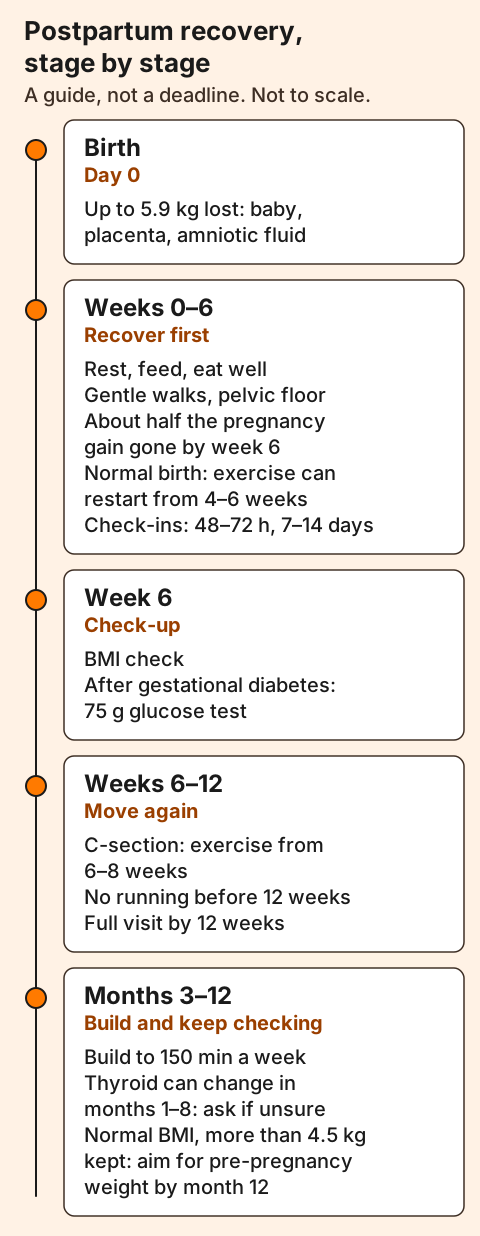
A guide, not a deadline. Figure and table sources: AIIMS-DST 2023; NHS; WHO 2022; MoHFW 2018; ACOG 2018; Goom et al. 2019; American Thyroid Association.[5][10][17][20][23][27][28]
| Stage | What your body is doing | Food and movement | Checks |
|---|---|---|---|
| Weeks 0–6 | Fluid shed in week 1; about half the pregnancy gain gone by week 6 | Eat well, feed, gentle walks and pelvic floor work; after a normal birth, exercise can restart from 4–6 weeks | Postnatal check-ins at 48–72 hours, 7–14 days and week 6 |
| Week 6 check | Most fluid gone; stored fat remains | Talk about a weight plan here | BMI; 75 g glucose test if you had gestational diabetes |
| Weeks 6–12 | Slow fat loss can begin | Small, regular meals; after a C-section, exercise from 6–8 weeks | Full postpartum visit by 12 weeks |
| Months 3–12 | Many women still above pre-pregnancy weight | Plate-based meals; build to 150 minutes a week plus strength work; running only after 12 weeks | Thyroid if you feel unwell (months 1–8); yearly diabetes test after gestational diabetes |
See your own week-by-week recovery with our free tool.
Weeks 0–6: recover first
After a straightforward birth, gentle exercise can start as soon as you feel up to it.[23] Indian guidance suggests slowly getting back to exercise within 4 to 6 weeks.[5]
The NHS says it is usually a good idea to get advice at your 6-week check before high-impact exercise, such as running or aerobics.[23] The WHO also recommends screening mothers for depression and anxiety after birth.[28]
Week 6 check
Indian guidance says every new mother should have her BMI checked at 6 weeks. Women with a BMI of 23 or more should be offered a weight programme.[5] If you had gestational diabetes, this is when you should have a 75 g glucose test.[20]
Weeks 6–12: move again
After a C-section or a complicated delivery, Indian guidance suggests returning to exercise in 6 to 8 weeks, after your first check-up.[5] Our guide to weight loss after a C-section covers that recovery in detail.
Months 3–12: build the habit
So how long does it take to lose baby weight? For many women, most of a year. For normal-weight women who still carry more than 4.5 kg, the AIIMS guideline suggests aiming for pre-pregnancy weight over 12 months.[5]
For overweight mothers, the same guideline sets a clinical goal of losing 5 to 10% of body weight over 6 months.[5] Your doctor sets the pace. It is a target, not a promise. Still carrying weight at a year? See losing weight 1 year postpartum.
What's "normal"? Real numbers from Indian mothers
- 64.1% of mothers in a Puducherry study still carried pregnancy weight at 1 year, an average of 5.2 kg.[6]
- 6.0 kg was the average weight kept at 6 months by overweight and obese mothers in an Indian hospital study.[7]
- 55.2% of those mothers kept more than 5 kg.[7]
- About 4%: each extra 1 kg gained in pregnancy raised the risk of keeping weight by about 4%.[6]
Not "back" at six months? You are in large company.
See a doctor now if…
Put this list ahead of any diet plan. Some of these problems can appear up to a year after delivery.[22]
Get medical care immediately if you have:[22]
- A severe or worsening headache, changes in vision, dizziness or fainting
- A fever of 38 °C (100.4 °F) or higher
- Chest pain, a fast or irregular heartbeat, or trouble breathing
- Severe swelling of your hands or face, or severe belly pain
- Severe nausea and throwing up
- Heavy bleeding or large clots, or a foul-smelling discharge
- Swelling, pain or redness in one leg or arm (this one applies up to 6 weeks after birth)
- Extreme or overwhelming tiredness
After a C-section, contact your doctor straight away if the wound gets more red, painful or swollen, or leaks pus or foul-smelling fluid. These can be signs of infection.[41]
In India, call 112, the national emergency number, which also covers ambulance services.[39] Abroad, call your local emergency number.
Thoughts of harming yourself or your baby need emergency help now.[19][22] Go to the nearest hospital or call 112. In India you can also call Tele-MANAS, the free government mental health helpline, on 14416 or 1-800-891-4416, any time.[38] In the US, call or text 988.[40]
Low mood that lasts more than 2 weeks: see a doctor. Baby blues tend to ease within about 2 weeks. Longer or stronger symptoms may be postpartum depression, which usually needs treatment.[19] About 22% of Indian mothers have postpartum depression, a review of Indian studies found.[18] Asking for help is part of recovery.
See a pelvic health physiotherapist if you have leaking urine or stool, a feeling of heaviness, a bulge or gap along the middle of your tummy, pelvic or low back pain, or bleeding beyond 8 weeks that is not your period.[27]
We are coaches and dietitians. We don't diagnose. Your doctor comes first.
Postpartum weight loss diet plan (Indian): plate and sample day
This postpartum weight loss diet plan uses Indian home food. Adjust it with your doctor or dietitian.
How many calories?
ICMR-NIN suggests about 600 extra kcal a day while breastfeeding in the first 6 months, and about 520 extra in months 7 to 12.[1] The AIIMS guideline suggests 300 to 500 extra kcal a day if you breastfeed, and none if you don't.[5] For weight loss, it suggests eating about 500 kcal a day less than you need. Your clinician sets that number for you.[5]
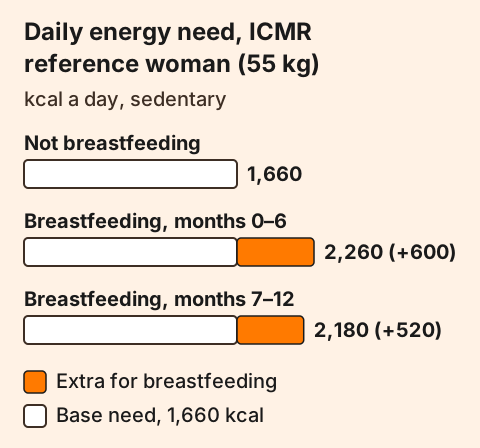
ICMR reference woman, 55 kg, sedentary. Your number depends on your weight and activity: use the calculator. Sources: ICMR-NIN 2020; AIIMS-DST 2023.[1][5]
Weight loss after delivery while breastfeeding: what about milk?
In a US trial of 40 overweight mothers who only breastfed, eating about 500 kcal less plus exercise from 4 weeks did not change how their babies grew.[13] In an 11-day trial with a 35% calorie cut, milk volume did not change, but in leaner mothers on diet alone, the total energy their milk supplied fell.[14] These are small, short studies, not a target for you. Work out your calories while breastfeeding with our free calculator, or see our Indian diet chart for breastfeeding mothers.
Stop cutting calories and get help if:
- your baby has fewer wet diapers (from day 5, expect at least 6 in 24 hours)[33]
- your baby is not gaining weight steadily after the first 2 weeks[33]
- your milk seems to drop: eating under 1,800 kcal a day may reduce milk for some women[32]
- you feel dizzy or faint[22]
Speak to your doctor, midwife or a lactation consultant soon.[33] Our coaches suggest you wait until feeding is going well before eating less (the trial above only started at 4 weeks[13]), and agree the timing with your doctor.
Fill the plate the ICMR-NIN way
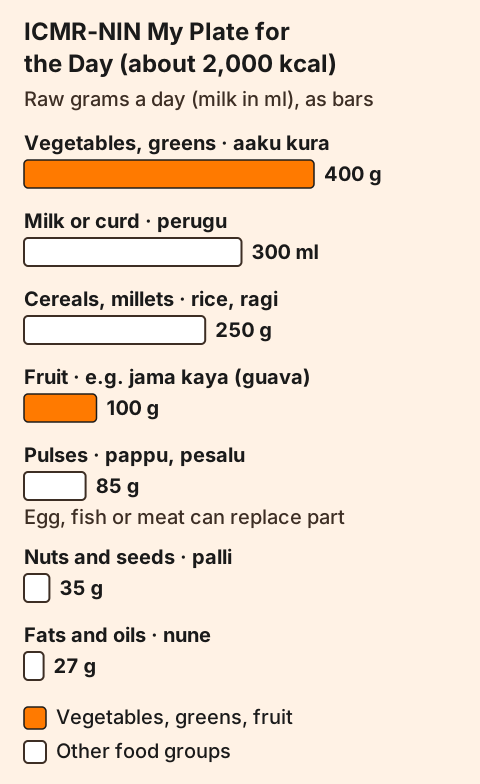
ICMR-NIN "My Plate for the Day", raw weights for about 2,000 kcal. Source: ICMR-NIN Policy Brief 2024.[3]
About half the plate is vegetables, greens and fruit. The rest is cereals and millets, pulses (or some egg, fish or meat), milk or curd, nuts, and a little oil.[3]
Protein matters more now: ICMR-NIN adds about 17 g a day for breastfeeding mothers in the first 6 months.[1] Include pulses, nuts, fish, milk and eggs every day.[2] AIIMS suggests 5 to 6 small meals a day with no skipping.[5]
- Salt and water: use iodised salt and drink enough water.[2] Breastfeeding raises your fluid needs.[32]
- Vitamin B12: if you eat no eggs, fish or meat, ask your doctor about B12. Babies of mothers who eat no animal foods can get too little.[35]
- Tea and coffee: keep to 2 to 3 cups a day.[5]
A sample Telugu day (veg and non-veg)
One example day at two levels, sized by our team from the ICMR-NIN plate and food tables.[3][4]
| Meal | What to eat | Breastfeeding (about 2,000–2,300 kcal) | Not breastfeeding (about 1,400–1,700 kcal) |
|---|---|---|---|
| Early morning | Water, then milk | 1 glass milk (150 ml) | 1 glass milk (150 ml) |
| Breakfast | Pesarattu (green gram dosa) with allam pachadi (ginger chutney), or egg dosa | 3 medium + 2 tbsp pachadi | 2 medium + 2 tbsp pachadi |
| Mid-morning | Ragi java or ambali (ragi porridge) and a guava | 1 cup java + 1 guava | 1 guava |
| Lunch, veg | Rice, pappu (dal), aaku kura (leafy greens), perugu (curd) | 1½ cups rice, 1 katori each of pappu, aaku kura and perugu | 1 cup rice, rest the same |
| Lunch, non-veg | Swap the pappu for kodi kura (chicken curry) or chepala pulusu (tangy fish curry) | 75 g chicken or fish | 75 g chicken or fish |
| Evening | Roasted chana, sprouts or a boiled egg | 1 handful chana + 10 peanuts, or 1 egg | 1 small handful chana, or 1 egg |
| Dinner | Jonna rotte (jowar roti) or phulka, pappu and kura (vegetable curry) | 2 rotte or phulka, 1 katori pappu, 1 katori kura | 1–2 phulka, 1 katori pappu, 1 katori kura |
1 katori = a small bowl of about 150 ml. Cooking oil for the day is included in the estimates. Totals vary with oil, milk type and dosa size.
Totals are estimates and example levels, not prescriptions. The lower column sits near the 1,660 kcal everyday need of the ICMR reference woman,[1] so it is not a set weight-loss intake. Your number comes from the calculator and your clinician.
Why these foods? Per 100 g raw, ragi gives about 364 mg of calcium, and whole green gram (pesalu) about 22.5 g of protein.[4] If you sweeten the ragi java, keep total added sugar to 25 to 30 g a day.[3]
"Doing the month" and food rules at home
Many Indian families follow "doing the month": rich food and rest for about the first 40 days.[5] The AIIMS guideline lists the rich food and low activity of this period among barriers to weight management.[5] Keep the rest and the family help. Ease off the extra ghee and sugar, and start moving once your doctor says you can.
In coastal Andhra Pradesh, 99.3% of 161 breastfeeding mothers surveyed avoided at least one food, often curd, fruit, greens, pulses, eggs or nuts.[8] Yet ICMR-NIN advises pulses, nuts, milk and eggs every day.[2] So bring back the perugu, the greens and the eggs, unless your doctor has said otherwise.
Avoiding milk and curd? Ask your doctor about calcium and vitamin D tablets, which AIIMS advises as the doctor suggests.[5] Ragi is a good non-dairy calcium source.[4] AIIMS also discourages milk-boosting laddoos heavy in ghee and sugar.[5] More in our guide to traditional postpartum foods.
Moving again: from walks to strength
Start with walking, then add core work for your tummy, back, pelvic floor and glutes.[5] Build to at least 150 minutes a week of moderate activity,[5][9] such as 30 minutes on 5 days, plus two strength days.[5] Use the talk test to check your pace, and breastfeed or pump before you exercise.[5]
- Running: wait at least 12 weeks before planning a return.[27]
- Swimming: wait 7 days after your postnatal bleeding stops.[23]
- Tummy gap (diastasis recti): 60% of first-time mothers in a Norwegian study had one at 6 weeks, and 32.6% at 12 months. Most were mild.[26] A physio can check yours.[27] See our diastasis recti guide.
- After a C-section: the cut layers of your tummy wall take months to get their strength back, so build up slowly.[27]
Short walks with the stroller count: even light activity beats sitting, the WHO says.[9]
Postpartum weight loss tips that research supports
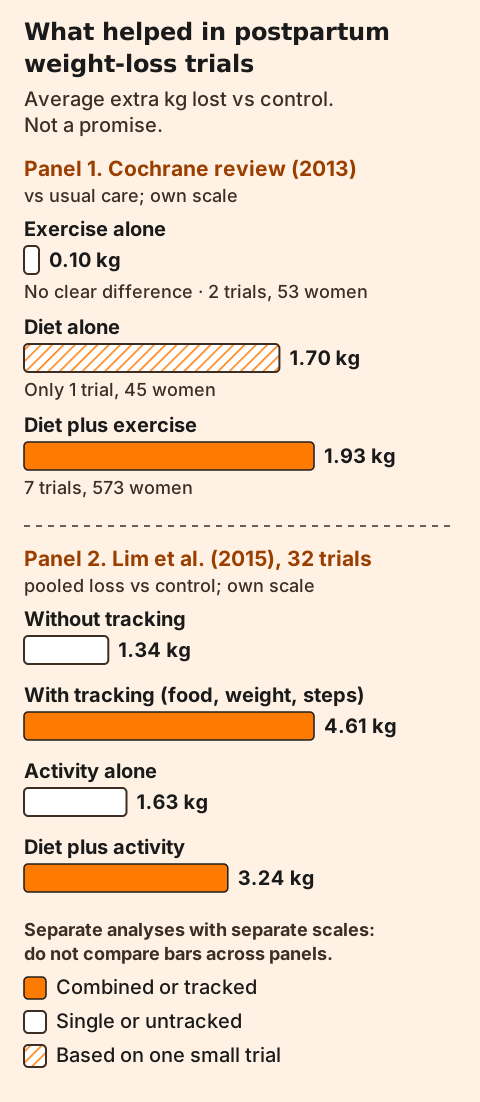
Average differences in trials, not a promised result. The two panels are separate analyses. Sources: Cochrane 2013; Lim et al. 2015.[11][12]
Combine food and movement. In a Cochrane review, diet plus exercise gave about 1.93 kg more loss than usual care. Exercise alone made no clear difference, and diet alone also cost some muscle.[11]
Track something. Programmes where mothers wrote down their food, weight or steps gave 4.61 kg loss, against 1.34 kg without tracking.[12] Diet plus activity beat activity alone, 3.24 kg against 1.63 kg.[12]
Don't under-eat. In the Indian hospital study, eating too little at 3 months was linked to more weight kept at 6 months.[7] AIIMS says meal skipping, crash diets and fad diets should always be discouraged.[5]
Skip slimming shortcuts. Check with your doctor before any diet pill, weight-loss injection (such as semaglutide), slimming tea or herbal "fat-burner". ICMR-NIN says breastfeeding mothers should take medicines only on a doctor's advice.[2]
Protect sleep where you can. In a US study of 940 mothers, sleeping 5 hours or less at 6 months was linked to about 3 times the odds of keeping 5 kg or more at a year.[16] ICMR-NIN links 6 to 8 hours of sleep with less unhealthy eating.[2] Ask for night help where you can.
Checks that change your weight plan
Sometimes "why am I not losing?" has a medical answer.
Had gestational diabetes?
Gestational diabetes brings about 10 times the risk of type 2 diabetes later.[21] Blood sugar usually returns to normal after delivery,[20] but you still need follow-up:
- What test: a 75 g glucose test (OGTT) at about 6 weeks after delivery.[20]
- How often: then a diabetes check every year, as Indian guidance advises.[20] The ADA says every 1 to 3 years.[34]
- What to do: keep up food and activity changes.[20] If a test shows prediabetes and you also carry extra weight, the ADA recommends an intensive lifestyle programme and/or metformin. Your doctor decides.[34]
In a large South Asian study, 8.8% already had type 2 diabetes about 6.5 months after delivery,[29] so never skip the test. See our gestational diabetes diet guide.
On diabetes medicine? Most women with gestational diabetes need no diabetes medicine after delivery.[34] If you take insulin, insulin needs drop quickly after delivery, and breastfeeding plus irregular sleep and meals can make low blood sugar more likely, the ADA says.[34] Ask your doctor to adjust the plan before you eat less.
Thyroid
Thyroid changes after birth can shift your weight in months 1 to 8.[17] Postpartum thyroiditis affects about 5 to 10% of women in US studies. The overactive phase can cause weight loss and poor sleep; the underactive phase, tiredness, weight gain, constipation and low mood.[17]
Already on thyroid tablets (levothyroxine) from before or during pregnancy? Your dose may go back to your pre-pregnancy dose after delivery, as your doctor decides.[36] Don't change it yourself. Ask your doctor when to recheck your thyroid blood test. See our guide to thyroid and weight loss.
PCOS
With PCOS, weight gain over the years is more common.[37] The 2023 international guideline aims first to prevent further gain, then, if you carry extra weight, a modest loss with a calorie plan made for you.[37]
Anaemia and tiredness
Blood loss in childbirth is a common cause of anaemia.[25] Signs include tiredness, breathlessness, dizziness and headache.[25] ICMR-NIN says the iron-folic acid and calcium tablets started in pregnancy should continue while you breastfeed.[2] Take them as your doctor advised.[5]
BMI for Indian bodies
For Indian women, a BMI of 23 or more is a reason to talk to your doctor: that is where the AIIMS guideline offers a weight programme.[5] Indian cut-offs are lower than global ones, with 23 as the start of overweight in the 2009 Indian consensus.[24] A 2025 update goes further and treats a BMI above 23 as Stage 1 obesity.[31] Check yours with our free BMI calculator.
For working moms and NRI moms
Back to the office: pack your 5 to 6 small meals as a tiffin plus a desk snack, so you don't skip meals.[5] If you walk at lunch, pump first.[5]
NRI moms: abroad, there is often no family help and the groceries differ. Simple swaps:
| Back home | Easy swap abroad |
|---|---|
| Pesalu for pesarattu | Whole moong or moong dal from an Indian store |
| Perugu (homemade curd) | Plain Greek yogurt |
| Fresh aaku kura | Frozen spinach |
| Chepala pulusu with local fish | Salmon or tilapia pulusu |
Your US clinic may use global BMI cut-offs; Indian experts set lower ones for Asian Indians,[24] so ask which fits you.
Key takeaways
- Recover first. Rest, feed and eat well; walk when you feel up to it.[23]
- Use the 6-week check for BMI, and a glucose test after gestational diabetes.[5][20]
- Eat enough while feeding. Any cut in calories is set by your clinician.[1][5]
- Combine diet, movement and tracking. That mix did best in trials.[11][12]
- Know the red flags and call for help early.[22]
How a coach can help
Flexcellence's Pre/Post Pregnancy plan pairs a nutritionist with a fitness and physio coach, uses normal Indian food, and starts only once your doctor has cleared you. We can't promise a number on the scale. We can help you build a plan you can keep.
Start with the free postpartum calorie calculator. When you're ready, book a free 30-minute consultation, or get the Flexcellence app on the App Store or Google Play.
Frequently asked questions
How soon after delivery can I start losing weight?
Indian guidance checks your BMI at 6 weeks and starts weight programmes from there.[5] Gentle walks can start sooner,[23] and structured exercise restarts 4 to 6 weeks after a normal birth or 6 to 8 weeks after a C-section.[5]
How long does it take to lose baby weight?
Longer than most expect. In a South Indian study, 64.1% of mothers still carried some pregnancy weight at 1 year.[6] For normal-weight mothers still carrying more than 4.5 kg, Indian guidance suggests aiming for pre-pregnancy weight over 12 months.[5]
Can I diet while breastfeeding without losing milk?
You need extra food while feeding.[1] Small trials found a calorie cut did not affect baby growth[13] or short-term milk volume,[14] but crash diets are not safe.[5] Ask your doctor or dietitian to set your number.
When can I exercise after a C-section?
Indian guidance suggests 6 to 8 weeks, after your first check-up, starting with walking and gentle core work.[5] Wait at least 12 weeks before planning a return to running.[27]
Does breastfeeding help you lose weight?
A little: in a review of 14 cohort studies, breastfeeding mothers kept only 0.38 kg less weight on average.[30] Combine it with food changes and activity.[5]
Is it normal not to lose weight 6 months after delivery?
Yes. Overweight mothers in an Indian hospital study kept 6.0 kg on average at 6 months.[7] If you also feel very tired, low or constipated, ask about a thyroid test.[17]
Your next step: work out your calories, then take this page to your 6-week check.
Updated 8 November 2026. Medical review pending. This article is general information, not medical advice. Talk to your doctor before starting any diet or exercise plan after delivery.
Common questions
How soon after delivery can I start losing weight?
Indian guidance checks your BMI at 6 weeks and starts weight programmes from there. Gentle walks can start sooner, and structured exercise restarts 4 to 6 weeks after a normal birth or 6 to 8 weeks after a C-section.
How long does it take to lose baby weight?
Longer than most expect. In a South Indian study, 64.1% of mothers still carried some pregnancy weight at 1 year. For normal-weight mothers still carrying more than 4.5 kg, Indian guidance suggests aiming for pre-pregnancy weight over 12 months.
Can I diet while breastfeeding without losing milk?
You need extra food while feeding. Small trials found a calorie cut did not affect baby growth or short-term milk volume, but crash diets are not safe. Ask your doctor or dietitian to set your number.
When can I exercise after a C-section?
Indian guidance suggests 6 to 8 weeks, after your first check-up, starting with walking and gentle core work. Wait at least 12 weeks before planning a return to running.
Does breastfeeding help you lose weight?
A little: in a review of 14 cohort studies, breastfeeding mothers kept only 0.38 kg less weight on average. Combine it with food changes and activity.
Is it normal not to lose weight 6 months after delivery?
Yes. Overweight mothers in an Indian hospital study kept 6.0 kg on average at 6 months. If you also feel very tired, low or constipated, ask about a thyroid test.
Reviewed by
Not yet reviewed by a Flexcellence coach.
Sources
ICMR-National Institute of Nutrition, Hyderabad. A Brief Note on Nutrient Requirements for Indians: RDA and EAR 2020 (2020).
ICMR-National Institute of Nutrition, Hyderabad. Dietary Guidelines for Indians 2024 - summary booklet (2024).
ICMR-National Institute of Nutrition, Hyderabad. Policy Brief: Promotion of 'My Plate for the Day' and physical activity (2024).
ICMR-National Institute of Nutrition (Longvah T, Ananthan R, Bhaskarachary K, Venkaiah K). Indian Food Composition Tables 2017 (2017).
Journal of Family Medicine and Primary Care (Kumari A, Ranjan P, Vikram NK et al.; AIIMS-DST initiative). Evidence and consensus-based clinical practice guideline for the management of obesity and overweight in postpartum women: An AIIMS-DST initiative (2023).
International Journal of Gynecology & Obstetrics (Patel N, Raj R, Sagili H et al.; JANMAM cohort). Postpartum weight change one year after delivery and associated factors among women in Puducherry, South India: Findings from the JANMAM cohort (2026).
Obesity Research & Clinical Practice (Kaur D, Malhotra A, Ranjan P et al.). Predictors of postpartum weight retention: A hospital-based longitudinal observational study in India (2026).
International Journal of Community Medicine and Public Health (Kudumula V, Maram KP, Nukala B, Paturi VRR). High prevalence of food taboos and dietary restrictions in lactating mothers from coastal districts of a south Indian state: a hospital based study (2021).
British Journal of Sports Medicine / World Health Organization (Bull FC et al.). World Health Organization 2020 guidelines on physical activity and sedentary behaviour (2020).
American College of Obstetricians and Gynecologists (Obstetrics & Gynecology). ACOG Committee Opinion No. 736: Optimizing Postpartum Care (2018).
Cochrane Database of Systematic Reviews (Amorim Adegboye AR, Linne YM). Diet or exercise, or both, for weight reduction in women after childbirth (2013).
Obesity Reviews (Lim S, O'Reilly S, Behrens H et al.). Effective strategies for weight loss in post-partum women: a systematic review and meta-analysis (2015).
New England Journal of Medicine (Lovelady CA, Garner KE, Moreno KL, Williams JP). The effect of weight loss in overweight, lactating women on the growth of their infants (2000).
American Journal of Clinical Nutrition (McCrory MA, Nommsen-Rivers LA, Mole PA, Lonnerdal B, Dewey KG). Randomized trial of the short-term effects of dieting compared with dieting plus aerobic exercise on lactation performance (1999).
Obstetrics and Gynecology Clinics of North America (Gunderson EP). Childbearing and obesity in women: weight before, during, and after pregnancy (2009).
American Journal of Epidemiology (Gunderson EP, Rifas-Shiman SL, Oken E et al.; Project Viva). Association of fewer hours of sleep at 6 months postpartum with substantial weight retention at 1 year postpartum (2008).
American Thyroid Association. Postpartum Thyroiditis (2026).
Bulletin of the World Health Organization (Upadhyay RP et al.). Postpartum depression in India: a systematic review and meta-analysis (2017).
US National Institute of Mental Health (NIMH). Perinatal Depression (2023).
Ministry of Health and Family Welfare, Government of India (Maternal Health Division). Diagnosis & Management of Gestational Diabetes Mellitus: Technical and Operational Guidelines (2018).
BMJ (Vounzoulaki E, Khunti K, Abner SC, Tan BK, Davies MJ, Gillies CL). Progression to type 2 diabetes in women with a known history of gestational diabetes: systematic review and meta-analysis (2020).
US Centers for Disease Control and Prevention (CDC) - Hear Her campaign. Urgent Maternal Warning Signs (2024).
NHS (UK National Health Service). Keeping fit and healthy with a baby (2026).
Journal of the Association of Physicians of India (Misra A et al., Consensus Group). Consensus statement for diagnosis of obesity, abdominal obesity and the metabolic syndrome for Asian Indians and recommendations for physical activity, medical and surgical management (2009).
World Health Organization. Anaemia (fact sheet) (2025).
British Journal of Sports Medicine (Sperstad JB, Tennfjord MK, Hilde G, Ellstrom-Engh M, Bo K). Diastasis recti abdominis during pregnancy and 12 months after childbirth: prevalence, risk factors and report of lumbopelvic pain (2016).
Goom T, Donnelly G, Brockwell E - UK physiotherapy expert consensus (PDF hosted by Athletics Northern Ireland). Returning to running postnatal: guidelines for medical, health and fitness professionals managing this population (2019).
World Health Organization. WHO recommendations on maternal and newborn care for a positive postnatal experience (2022).
JAMA Network Open (Tandon N, Gupta Y, Kapoor D et al.; LIVING Collaborative Group). Effects of a Lifestyle Intervention to Prevent Deterioration in Glycemic Status Among South Asian Women With Recent Gestational Diabetes: A Randomized Clinical Trial (2022).
Clinical Nutrition (Jiang M, Gao H, Vinyes-Pares G et al.). Association between breastfeeding duration and postpartum weight retention of lactating mothers: A meta-analysis of cohort studies (2018).
Diabetes & Metabolic Syndrome: Clinical Research & Reviews (Misra A, Vikram NK, Ghosh A, Ranjan P, Gulati S; India Obesity Commission). Revised definition of obesity in Asian Indians living in India (2025).
Academy of Nutrition and Dietetics (eatright.org). Losing Weight While Breastfeeding (2026).
NHS Start4Life (UK National Health Service). Milk supply (2026).
American Diabetes Association (Diabetes Care 2026;49(Suppl 1):S321-S338). 15. Management of Diabetes in Pregnancy: Standards of Care in Diabetes - 2026 (2026).
US Centers for Disease Control and Prevention (CDC). Maternal Diet and Breastfeeding (2026).
American Thyroid Association. Hypothyroidism in Pregnancy (2026).
Fertility and Sterility (Teede HJ, Tay CT, Laven JJE et al.; International PCOS Network). Recommendations from the 2023 international evidence-based guideline for the assessment and management of polycystic ovary syndrome (2023).
Press Information Bureau, Ministry of Health and Family Welfare, Government of India. Advancing India's Mental Healthcare and Well-Being (Tele MANAS) (2026).
Press Information Bureau, Ministry of Home Affairs, Government of India. Status of implementation of Emergency Response Support System (ERSS) (2020).
988 Suicide & Crisis Lifeline (US). 988 Suicide & Crisis Lifeline (2026).
NHS (UK National Health Service). Caesarean section: recovery (2023).