Weight Loss Plateau: Why It Happens and How to Break It
Scale stuck for weeks? Learn if it is a real weight loss plateau, 6 common reasons, what to change on an Indian plate, and when to see a doctor.
The short answer
A plateau is normal: a lighter body burns less, portions and daily movement drift, and short sleep can add up. First check it is real, then track your food again, reset your target with your coach, and change one thing at a time. Do not cut calories further.
Work out your own numbers
Adjust calories when progress stalls due to metabolic adaptation.
Free, takes a minute, and uses the same formulas our coaches use.
Open the Plateau Breaker CalculatorOn this page
Same food, same walk, and the scale has not moved for weeks. If that is you, take a breath. This is one of the most common points where people give up, and it is also the point where cutting food even further feels like the only answer. It usually is not.
This guide shows you how to tell a real plateau from normal ups and downs, the six usual reasons the scale stops, a short list of changes to try one at a time, and the signs that mean you should see a doctor instead. We write as a nutrition and fitness coaching team. We cannot diagnose anything, and nothing here replaces your own doctor or dietitian.
This week, in short (our coaches suggest)
- Check the stall is real: weigh the same way for 3 to 4 weeks.
- Measure oil, rice and snacks for 7 to 10 days.
- Reset your calorie target at today's weight. Do not slash it.
- Put protein at every meal and aim for 7 to 8 hours of sleep.
- Change one thing at a time. See a doctor first if a red flag below fits you.
What a plateau really is, and when it is normal
A plateau is a stretch where your weight stays about the same even though you are still following your plan. It is a standard pattern, not a personal failure. Reviews of weight-loss treatments describe the same shape again and again: early loss, then a levelling off.[6] In a review of 80 randomised trials that followed people for at least a year, weight loss typically levelled off at about 6 months.[5]
Why does it happen? In a model of adult metabolism, energy use falls as weight falls, which shrinks the gap between food eaten and energy burned, so weight loss slows.[7] The same model says the change keeps slowing: about half of the eventual weight change from a lasting diet change happens in about a year, and the rest comes more slowly.[7]
This also explains why the old rule "3,500 kcal equals 1 pound" (about 7,700 kcal per kg) lets people down. A 2013 commentary that compared predictions with seven closely supervised experiments found that this rule grossly overestimates the weight actually lost.[9] The energy needed per kg also changes as you lose, because more of the lost weight comes from lean tissue.[8] So a scale that slows down is partly just arithmetic.
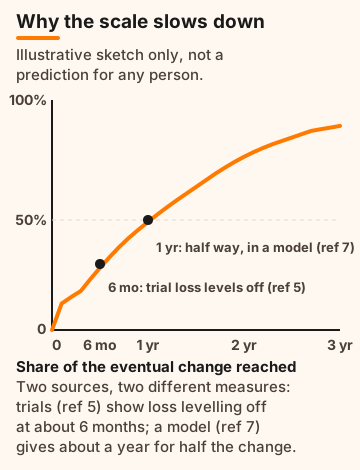
Illustrative sketch only, not a prediction for any person. Timings come from the trial review[5] and the metabolism model[7] above.
How long should you wait before calling it a plateau? We could not find a research source that defines a plateau as a fixed number of flat weeks, and web articles disagree. Our coaches usually wait about 3 to 4 weeks of steady tracking before calling it a plateau and changing anything. That is our practical rule, not a study result.
First, check that it is really a plateau
Many "plateaus" are noise. Before you change your food, run through this list.
Plateau checklist (our coaches suggest)
- Weigh the same way every time. Same time of day, same clothes, after using the toilet. Look at the weekly average, not one morning.
- Compare the same day of your cycle. See the note below.
- Measure something besides weight. Waist with a tape, how your clothes fit, your energy and sleep. Muscle and fat can change at different speeds.
- Note unusual days. A very salty dinner, a hard workout or travel can change a single reading. Look at the trend over weeks.
- Count the weeks. Have you tracked honestly for 3 to 4 weeks, or only for a few days?
On the cycle point: in a study of 62 healthy women who kept daily diaries over 765 menstrual cycles, self-reported fluid retention (bloating) peaked on the first day of the period and was lowest in the mid-follicular phase, the days after the period ends.[26] The study measured how bloated women felt, not their weight. Our coaches suggest comparing the same cycle day each month, for example the week after your period, so that normal fluid swings do not look like a stall.
If all of this checks out and the trend really is flat, move to the next section. If you are not sure what your daily calories should be now, the free Plateau Breaker Calculator asks for your original daily calorie need and how many weeks you have been on a deficit, and helps you reset your target.
The 6 usual reasons the scale stops
1. Portions and "extras" drift
This one is uncomfortable and very common. In a 1992 study of 224 people with obesity who came for treatment, 10 (9 women and 1 man) had a history of not losing weight on diets and said they ate under 1,200 kcal a day. They were studied closely over 14 days, with 80 other patients as controls. Their measured metabolic rates were within 5% of what was predicted, so a "slow metabolism" was ruled out. On average they under-reported their food intake by 47% and over-reported their physical activity by 51%.[16] This is a very small group, so treat it as a hint, not a rule. The authors also noted a high share of thyroid medicine use in this group, which is one more reason to talk to your doctor if you take any.[16] And it does not mean you are lying. It shows how easy it is to lose track of a bite here and a spoon there.
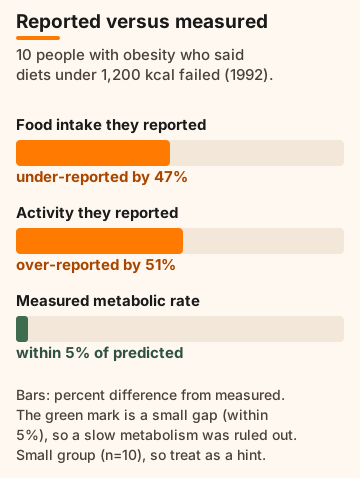
Figures from a 1992 study of 10 people with obesity (9 women, 1 man) who reported that diets under 1,200 kcal a day were not working, measured over 14 days.[16]
A review of 22 studies found that tracking food, exercise or weight was consistently linked with more weight loss, though the quality of the evidence was weak.[17]
On a South Indian plate, our coaches see the drift in a few places: the cooking oil that grew from one teaspoon to three, the rice portion that crept up, fried snacks at chai time, and sweet chai or lassi (a sweet curd drink). Juices, soft drinks and alcohol add calories too, and ICMR-NIN advises avoiding soft drinks and alcohol.[1] For a reference point, ICMR-NIN (the Indian nutrition research institute in Hyderabad) puts visible fat and cooking oil at 20 to 50 g per person per day depending on energy need, which is about 4 to 10 teaspoons, with 1 teaspoon being about 5 g.[2]
2. Your body is lighter, so your target is lower
Energy needs depend on body weight and activity, so it makes sense to recheck them as your weight changes. As an example, ICMR-NIN's reference Indian woman weighs 55 kg. Her energy need is 1,660 kcal a day if her work is sedentary and 2,130 kcal a day if her work is moderate.[2] The point is not the exact number. It is that a target set at your starting weight can be too high once you weigh less.
3. Your body pushes back (metabolic and hormone changes)
This is real, but it is usually modest, and it is not the main story for most people. Here is what the research shows, and who it was done on.
- Hormones. In 50 adults with overweight or obesity who lost a mean 13.5 kg on a 10-week very-low-energy diet, hormones that signal fullness (leptin, peptide YY, cholecystokinin) and insulin fell, ghrelin (a hunger hormone) rose, and hunger rose. Many changes were still there a year later.[11]
- Appetite. In a 52-week trial in 153 people, where weight loss came from a medicine and not from dieting, estimated appetite rose by about 100 kcal a day for each kg lost. That was more than three times bigger than the drop in calories burned.[10]
- Energy use. In a 1995 study, 18 people with obesity and 23 people who had never been obese were studied after losing 10 to 20% or gaining 10% of their body weight. Keeping weight 10% or more below the usual level lowered total daily energy use by 6 to 8 kcal per kg of fat-free mass (everything except fat, such as muscle and bone).[12] A review calls this "adaptive thermogenesis": metabolic, hormonal, behavioural and nervous-system responses that defend body energy stores and make it hard to keep weight off.[13]
- An extreme case. In 14 contestants of a 30-week TV weight-loss show who lost a mean 58.3 kg, resting energy use was still about 499 kcal a day lower than expected six years later.[14] That is very fast loss in a small group, not what to expect from a normal plan.
How large this effect is in everyday dieters is still debated. What it means for you: your body defends its weight, so go slower, not harder.
4. Everyday movement quietly falls
Not all calories burned come from workouts. Non-exercise activity (fidgeting, standing, walking around the house) is another part of the energy you burn, and it varies a lot. In a study of 16 non-obese volunteers who were overfed for 8 weeks, differences in this everyday movement explained a 10-fold difference in fat gained between people.[18] That study was about gaining, but it shows how much this kind of movement can differ from person to person.
Exercise programmes also often produce less weight loss than predicted, mainly because the prescribed dose is low and people tend to eat more.[20] For a desk-job woman, our coaches look at hours of sitting, lifts instead of stairs and how many calls are taken while walking. Sitting less is easier to keep up than another hour in the gym.
5. Short sleep
In a small 14-day trial in 10 adults with overweight (3 women and 7 men), everyone ate the same calorie-restricted diet and had either 8.5 or 5.5 hours of sleep opportunity (each person did both). With short sleep, the share of weight lost as fat fell by 55% (1.4 kg of fat lost versus 0.6 kg), and lean mass loss rose by 60% (1.5 kg versus 2.4 kg). Hunger also increased. The authors list the small size and short length as limits, so read it as a hint.[25] ICMR-NIN recommends 7 to 8 hours of sleep a day and says it helps avoid unhealthy eating and weight gain.[1]
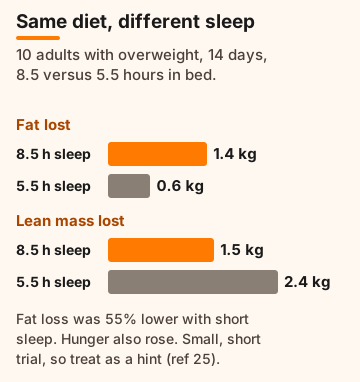
Same calorie-restricted diet with 8.5 or 5.5 hours of sleep opportunity, in 10 adults with overweight over 14 days.[25]
6. Losing muscle instead of fat
When you eat less, you can lose some muscle along with fat. Diet-induced weight loss reduces muscle mass, but adequate protein helps preserve it, and both endurance and resistance exercise help preserve muscle during weight loss.[24] In a meta-analysis of 24 trials with 1,063 adults and a mean of 12 weeks on the same calories, higher-protein diets gave slightly more fat loss (0.87 kg) and kept slightly more lean mass (0.43 kg) than standard-protein diets.[23] ICMR-NIN suggests about 15% of energy from protein during weight loss.[1] More is not better: the muscle review stresses adequate, not excessive, protein.[24] The Indian protein RDA is 0.83 g per kg of body weight per day, and about 1 g per kg for cereal-based diets with lower-quality protein.[2]
How to break a weight loss plateau on an Indian diet, one change at a time
Change one thing, give it 2 to 3 weeks, then look at the trend. The order below is what our coaches suggest. The individual numbers come from the sources shown.
1. Track honestly for 7 to 10 days. Measure cooking oil in teaspoons, rice by the cup and note every snack, sweet and drink. Tracking is linked with more weight loss, and self-reports can be far off, so measuring helps.[16][17]
2. Reset your target, do not slash it. Use the Plateau Breaker Calculator or ask your coach to recalculate your needs at your current weight. For planning a weight-loss diet, ICMR-NIN describes typical weight-loss diets as an energy deficit of 500 to 750 kcal a day and says not to go beyond a 40% deficit. It advises slow and steady loss and warns that extreme approaches may harm health.[1] That is a planning range, not a promise of how much you will lose. Do not cut lower than your coach's plan.
3. Put protein at every meal. Our coaches suggest dal, curd, eggs, fish, paneer or sprouts at each meal. These per-100-g raw values come from the Indian Food Composition Tables:[4]
| Food (raw, per 100 g) | Protein |
|---|---|
| Whole green gram (pesara pappu, used for pesarattu) | 22.5 g |
| Black gram dal (minapa pappu, used for idli and dosa) | 23.1 g |
| Pigeon pea or red gram dal (kandi pappu, the usual tur dal) | 21.7 g |
| Rohu (a freshwater fish) | 19.7 g |
| Paneer (fresh Indian cheese) | 18.9 g (and 24.8 g fat) |
| Whole egg | 13.3 g |
Raw values do not tell you the protein in a cooked bowl, since water changes the weight. Use them to compare foods, not to count grams of a ready dish.
4. Trim the cereal, grow the plate. In ICMR-NIN's "My Plate for the Day" at about 2,000 kcal, the raw weights are cereals including millets 250 g (about 42% of energy), pulses 85 g, milk or curd 300 ml, vegetables and greens 400 g, fruit 100 g, nuts and seeds 35 g, and oil 27 g. Vegetables, fruit, greens and roots should make up about half the plate.[3] Our coaches usually trim cereals first rather than cutting other food groups. The suggested ratio of cereals to pulses is about 3:1 to 5:1.[1]
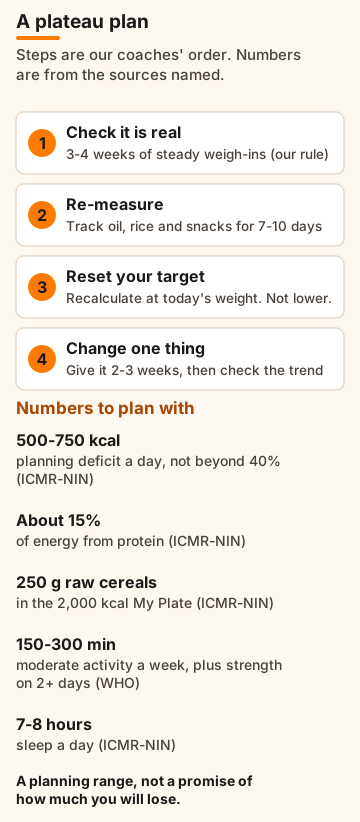
Order of steps is our coaches' suggestion. Numbers are from ICMR-NIN[1][3] and WHO[22]. A planning range, not a promise of results.
Swaps our coaches use: a slightly smaller rice portion, one more ladle of sambar (lentil-vegetable stew) or dal, and ragi (finger millet) or jowar (sorghum) for part of the rice. Per 100 g raw, ragi has 11.2 g of fibre and jowar 10.2 g, against 2.8 g for milled raw rice.[4]
5. Move more, in a way you can keep. WHO advises adults 150 to 300 minutes of moderate activity a week, plus muscle-strengthening on at least 2 days a week.[22] ICMR-NIN advises at least 30 to 45 minutes of brisk walking or moderate activity a day.[1] On its own, 150 to 250 minutes a week of moderate activity gives only modest weight loss, and it works better alongside moderate, not severe, diet restriction.[21] Walking has other benefits too: in a pooled analysis of 15 cohorts with 47,471 adults, more daily steps went with a lower risk of death.[19] That is a health reason to keep walking, not a plateau fix.
6. Protect your sleep and your stress. Aim for 7 to 8 hours.[1][25] If work or family keeps you up, tell your coach. It is part of the plan, not an excuse.
Optional, only with approval: a planned diet break
In the MATADOR trial, 51 men with obesity were randomised and 47 started. Both groups ate 67% of their maintenance calories, either for 16 weeks straight or as eight 2-week diet blocks alternating with 2-week breaks at maintenance (30 weeks in total). Among the 36 who completed the plan, the break group lost 14.1 kg versus 9.1 kg. This is a completers-only figure. The fall in resting energy use did not differ between groups (about 502 versus 624 kJ a day); it was smaller with breaks only after adjusting for changes in body composition.[15] So do not read it as proof of a metabolic benefit. It was a small trial in men only and may not apply to women. A planned break is not for anyone who is pregnant or breastfeeding, has diabetes on medicine, or has had an eating disorder or disordered eating, unless their doctor agrees.
What not to do
- Crash diets or skipping meals to "break through"
- Detox drinks, fat burners or tablets from the internet
- Cutting calories further without your coach or dietitian, because extreme approaches may harm health[1]
- Adding a long fast or random "cheat days". A planned break is a different thing and needs a plan.
Two sample plateau days on a South Indian plate
These are patterns, not prescriptions, and portions depend on your size, activity and health. They are our coaches' suggestions, not calculated calorie plans. A katori is a small bowl of about 150 ml. A poriyal is a dry vegetable stir-fry. Phulka is a thin roti made without oil. Perugu is curd.
| Meal | Day 1 | Day 2 |
|---|---|---|
| Breakfast | 2 medium pesarattu (green gram dosa) with ginger chutney and 1 katori sambar (lentil-vegetable stew) | 2 idli (steamed rice and lentil cakes), 1 katori sambar and 1 boiled egg |
| Lunch | 1 katori cooked rice (or 1 ragi sankati, a finger millet ball), 1 katori dal, 1 katori vegetable curry, a big bowl of raw salad, 1 katori perugu | 1 katori cooked rice, 1 katori sambar, 1 katori beans or cabbage poriyal, 1 small piece of fish curry or 1 katori sprouts, 1 katori perugu |
| Snack | 1 guava and 1 cup chai without sugar | 1 small handful of roasted chana (chickpeas) and 1 cup chai without sugar |
| Dinner | 2 phulka, 1 katori vegetable curry, 1 katori dal | 2 phulka, a bowl of vegetable curry, paneer bhurji (crumbled fresh Indian cheese) made with a small piece of paneer |
| Oil | About 4 teaspoons across the whole day, measured | About 4 teaspoons across the whole day, measured |
Our coaches suggest eating dinner at least 2 hours before bed. We have left out calorie numbers for cooked dishes, because the Indian Food Composition Tables list raw foods only.[4] For oil, ICMR-NIN gives 4 to 10 teaspoons a day depending on energy need.[2]
For a fuller plan, see calorie deficit with Indian meals. For protein targets, read how much protein per day for weight loss.
When it is not just a plateau
Most plateaus are the normal things above. But sometimes a stuck scale is a sign to see a doctor. Please do not diet harder to solve these.
See your doctor if you notice any of these
- Thyroid symptoms. The NHS lists severe tiredness, feeling unusually cold, weight gain, constipation, poor concentration, low mood, dry skin, thinning hair, a hoarse voice, and irregular or heavy periods. These usually develop slowly and can have other causes, so ask for a check.[28]
- Eating-disorder warning signs. Constant worry about weight and shape, eating very little, strict food rules, making yourself sick or using laxatives, exercising excessively, feeling cold, tired or dizzy, fainting, or missed periods. The NHS lists these as signs of an eating disorder.[30] If this sounds like you, please do not use any advice here about breaks or fasting. Speak to a doctor first.
- Other flags (our coaches' list): fast weight change you cannot explain, swelling in your legs or face, severe tiredness, periods that have stopped, dizziness, or chest pain on exercise.
- Pregnancy or breastfeeding. Do not diet to lose weight without your doctor.
- Diabetes on medicine. Do not change food or exercise without your doctor, as your doses may need to change. If you use insulin or tablets such as glimepiride or gliclazide, eating less can cause low blood sugar (hypoglycaemia). This is our coaches' safety advice, so check with your doctor before cutting calories.
- Already on a doctor's or dietitian's weight plan? Follow that first. This guide does not use BMI or waist cut-offs, including Indian-specific ones.
Thyroid. We are not saying thyroid problems cause your plateau. We are saying that if you have the symptoms above, a blood test is worth asking about. Our article on thyroid and weight loss explains more.
Medicines. In a review of 257 randomised trials covering 54 drugs and 84,696 patients, some medicines were linked with weight gain on average, including amitriptyline (1.8 kg), olanzapine (2.4 kg), gabapentin (2.2 kg), pioglitazone (2.6 kg), glimepiride (2.1 kg) and gliclazide (1.8 kg).[27] These are trial averages, not what will happen to you. Never stop or change a medicine yourself. Talk to the doctor who prescribed it.
Menopause and perimenopause. In 156 women followed yearly for four years, the 51 who became postmenopausal by year 4 had a significant rise in visceral (deep belly) fat. In a subset of 34 women measured in a whole-room calorimeter, sleeping energy use fell 7.9% in those who reached menopause and 5.3% in those who did not. The abstract does not say whether that difference was tested.[29] This does not mean a plateau is unavoidable at that age. It means body fat and energy use can shift, and a doctor can help.
PCOS. If you have PCOS, weight loss can feel slower, and we have a full guide to PCOS weight loss.
When to ask for help
If you have tracked for 4 weeks, made one change at a time, and nothing has moved, or if any flag above fits you, please see your doctor first, and then a dietitian. You can also use the free Plateau Breaker Calculator to reset your calorie target.
If you would like a real person to look at your food, sleep and routine together, Flexcellence offers a free 30-minute consultation call with our coach team. The plan is built on the Indian food you already eat. There is no pressure, and we do not promise results. Book a free consultation.
Common questions
How long does a weight loss plateau last?
There is no fixed answer. The only timing we can cite is that weight loss typically levelled off at about 6 months in a review of 80 trials. Our coaches usually wait 3 to 4 weeks of steady tracking before changing anything. If nothing moves after that, see your doctor and then a dietitian.
Why has my weight stopped dropping even though I eat the same?
In the standard model, a lighter body burns less energy, so the same food gives a smaller gap than before. Portions and extras also drift without us noticing, and short sleep can shift loss away from fat. Recheck your portions and oil for a week, then reset your target with your coach.
Should I eat less to break a plateau?
No. ICMR-NIN advises slow, steady loss, a typical deficit of 500 to 750 kcal a day, and not going beyond a 40% deficit, and warns that extreme approaches may harm health. Recheck your tracking and talk to your coach or dietitian before cutting anything.
Can thyroid or PCOS cause a plateau?
They can be worth checking. The NHS lists severe tiredness, feeling cold, weight gain, constipation, low mood and irregular or heavy periods as underactive thyroid symptoms, which develop slowly. If you have these, ask your doctor for a check. We also have guides on thyroid and PCOS weight loss.
Does a diet break or cheat day help?
In one small trial in men, people who alternated two-week diet blocks with two-week breaks at maintenance calories lost more weight among those who finished it. It may not apply to women, and we found no research support for unplanned cheat days. A break is not for everyone, so only consider it with your doctor or coach.
Does weight stall during periods?
Feeling bloated may make progress harder to see. In 62 women followed over 765 cycles, self-reported fluid retention peaked on the first day of the period. The study measured how bloated women felt, not their weight. Our coaches suggest comparing your weight on the same cycle day each month, such as the week after your period.
Reviewed by
Not yet reviewed by a Flexcellence coach.
Sources
ICMR-National Institute of Nutrition, Hyderabad. Dietary Guidelines for Indians (Revised Edition 2024) (2024).
ICMR-National Institute of Nutrition, Hyderabad. A Brief Note on Nutrient Requirements for Indians: RDA and EAR 2020 (2020).
ICMR-National Institute of Nutrition, Hyderabad. Policy Brief: Promotion of 'My Plate for the Day' and physical activity (2024).
ICMR-National Institute of Nutrition (Longvah T, Ananthan R, Bhaskarachary K, Venkaiah K). Indian Food Composition Tables 2017 (2017).
Journal of the American Dietetic Association (Franz MJ et al.). Weight-loss outcomes: a systematic review and meta-analysis of weight-loss clinical trials with a minimum 1-year follow-up (2007).
Medical Clinics of North America (Hall KD, Kahan S). Maintenance of Lost Weight and Long-Term Management of Obesity (2018).
The Lancet (Hall KD, Sacks G, Chandramohan D et al.). Quantification of the effect of energy imbalance on bodyweight (2011).
International Journal of Obesity (Hall KD). What is the required energy deficit per unit weight loss? (2008).
International Journal of Obesity (Thomas DM, Martin CK, Lettieri S, Bredlau C, Kaiser K, Church T, Bouchard C, Heymsfield SB). Can a weight loss of one pound a week be achieved with a 3500-kcal deficit? Commentary on a commonly accepted rule (2013).
Obesity (Polidori D, Sanghvi A, Seeley RJ, Hall KD). How Strongly Does Appetite Counter Weight Loss? Quantification of the Feedback Control of Human Energy Intake (2016).
New England Journal of Medicine (Sumithran P et al.). Long-term persistence of hormonal adaptations to weight loss (2011).
New England Journal of Medicine (Leibel RL, Rosenbaum M, Hirsch J). Changes in energy expenditure resulting from altered body weight (1995).
International Journal of Obesity (Rosenbaum M, Leibel RL). Adaptive thermogenesis in humans (2010).
Obesity (Fothergill E, Hall KD et al.). Persistent metabolic adaptation 6 years after "The Biggest Loser" competition (2016).
International Journal of Obesity (Byrne NM et al.) - MATADOR study. Intermittent energy restriction improves weight loss efficiency in obese men: the MATADOR study (2018).
New England Journal of Medicine (Lichtman SW et al.). Discrepancy between self-reported and actual caloric intake and exercise in obese subjects (1992).
Journal of the American Dietetic Association (Burke LE et al.). Self-monitoring in weight loss: a systematic review of the literature (2011).
Science (Levine JA, Eberhardt NL, Jensen MD). Role of nonexercise activity thermogenesis in resistance to fat gain in humans (1999).
The Lancet Public Health (Paluch AE et al., Steps for Health Collaborative). Daily steps and all-cause mortality: a meta-analysis of 15 international cohorts (2022).
Obesity Reviews (Thomas DM et al.). Why do individuals not lose more weight from an exercise intervention at a defined dose? An energy balance analysis (2012).
Medicine & Science in Sports & Exercise (Donnelly JE et al., ACSM Position Stand). Appropriate physical activity intervention strategies for weight loss and prevention of weight regain for adults (2009).
British Journal of Sports Medicine / World Health Organization (Bull FC et al.). World Health Organization 2020 guidelines on physical activity and sedentary behaviour (2020).
American Journal of Clinical Nutrition (Wycherley TP et al.). Effects of energy-restricted high-protein, low-fat compared with standard-protein, low-fat diets: a meta-analysis of randomized controlled trials (2012).
Advances in Nutrition (Cava E, Yeat NC, Mittendorfer B). Preserving Healthy Muscle during Weight Loss (2017).
Annals of Internal Medicine (Nedeltcheva AV et al.). Insufficient sleep undermines dietary efforts to reduce adiposity (2010).
Obstetrics and Gynecology International (White CP, Hitchcock CL, Vigna YM, Prior JC). Fluid Retention over the Menstrual Cycle: 1-Year Data from the Prospective Ovulation Cohort (2011).
Journal of Clinical Endocrinology & Metabolism (Domecq JP et al.). Clinical review: Drugs commonly associated with weight change: a systematic review and meta-analysis (2015).
NHS (UK). Underactive thyroid (hypothyroidism): symptoms (reviewed 28 April 2025) (2025).
International Journal of Obesity (Lovejoy JC et al.). Increased visceral fat and decreased energy expenditure during the menopausal transition (2008).
NHS (UK). Eating disorders: overview (reviewed 23 January 2024) (2024).