Online nutritionist in India: how to choose, and cost
How to choose an online nutritionist or dietitian in India: check credentials, compare total cost, spot red flags and fit Indian food.
The short answer
A good online nutritionist in India has a qualification you can check, a doctor or certified health professional you can reach when your health needs it, a plan built on your own food and schedule, and a full price told up front. Be wary of anyone who promises fast results.
On this page
Searching for an online nutritionist (or "online dietician") in India throws up hundreds of names, apps and Instagram pages. This guide is a buyer's checklist, not a sales pitch.
The short plan: (1) check the person's qualification, (2) make sure you can reach a doctor or certified health professional, and (3) get the total price in writing before you pay. If you are pregnant, breastfeeding, have diabetes or a thyroid problem, read the "Who needs a doctor" list further down first.
This is general information, not medical advice. Your own doctor knows your history.
What an Indian nutritionist or dietitian is (and how to check)
Job titles are confusing, so here is a plain-words guide.
| Title | What it usually means | What to ask |
|---|---|---|
| Nutritionist | A general word. We found no single protected title in the sources used for this page | Degree, university, years of experience |
| Dietitian | Often used for someone with clinical nutrition training. We could not confirm a fixed legal definition | Course, hospital or clinic experience |
| Registered Dietitian (RD) | Met the Indian Dietetic Association (IDA) RD requirements [22] | Registration, checked in the IDA directory |
| Health or fitness coach | May have a fitness or coaching certificate, not a nutrition degree | Which body certified them, and for what |
| Doctor (MBBS and above) | A registered medical practitioner. Can diagnose and prescribe | Registration number |
What the RD route involves
These are the main requirements on the IDA page. You need an undergraduate degree in food, nutrition and dietetics (or a Home Science or other degree with enough nutrition subjects), plus a postgraduate diploma or MSc in foods and nutrition, clinical nutrition or dietetics. You must be an IDA life member before the internship. Then there are two paths: six months of internship at a hospital the IDA recognises, or five years of full-time clinical dietitian work in a recognised multispecialty hospital. If that hospital is not on the IDA list, a recommendation letter is also needed [22]. Rules can change, so read the live IDA page.
Where to verify
The IDA has a public "Find a Registered Dietitian" directory, so you can search a name [22]. Separately, Parliament passed the National Commission for Allied and Healthcare Professions Bill in March 2021. The Bill lists nutrition science professionals and provides for central and state registers [23]. We could not confirm when its registers come into force or how complete they are, so a missing name does not always mean someone is unqualified. Ask what they hold and where it was issued.
What they cannot do
In our view, prescribing and changing medicines is a doctor's job. India's telemedicine practice guidelines, released in 2020, cover tele-consults by registered medical practitioners [24]; they do not set rules for nutritionists. A good nutritionist will send you back to your doctor for medicine questions. Be careful with any coach who sells supplements or tells you to change insulin, thyroid or other medicines.
8 things to check before you pay
- Qualifications and experience of the person who will actually talk to you. NIDDK suggests asking about staff credentials, training and experience [1]. Ask for names, not just the company's pitch.
- A doctor or certified health professional within reach. NIDDK suggests asking whether you can speak with a doctor or certified health professional, and whether the staff will coordinate with your own doctor [1].
- A plan built on your food. NIDDK suggests asking how the programme adjusts for cultural foods [1]. Our coaches also suggest asking about regional dishes, vegetarian or egg choices, festivals and cooking at home. Education that fits your culture is also a recommendation in diabetes care [6].
- Contact schedule. How many sessions, how often, who replies and during which hours? Most of the intensive programmes the US Preventive Services Task Force reviewed had 12 or more sessions in the first year, though it said trial differences made it hard to say which features work best [4]. One US guideline calls 14 or more sessions in 6 months high intensity [7].
- Total price and extras. Ask for the total price from start to finish and what costs extra, such as tests, supplements, counselling or follow-up [1].
- A maintenance plan. Ask what happens after your goal. In a 2007 review, people slowly regained weight once active programmes ended [5].
- A realistic goal. NIDDK suggests a starting aim of about 5 to 10% of your weight in 6 months for adults [1]. A 2013 US guideline notes even 3 to 5% brings health benefit [7]. Our coaches also prefer slow and steady changes. Weight-loss targets are not suitable for children, teens, pregnant or breastfeeding women, or anyone with a past eating disorder. That is general safety advice, so talk to your doctor.
- How they handle your condition. For diabetes, the American Diabetes Association recommends individualised nutrition therapy by a registered dietitian nutritionist, which is the US credential [6]. An Indian RD is a separate credential, so ask what they hold. For PCOS, no single diet is named best [28]. In pregnancy, involve your doctor.
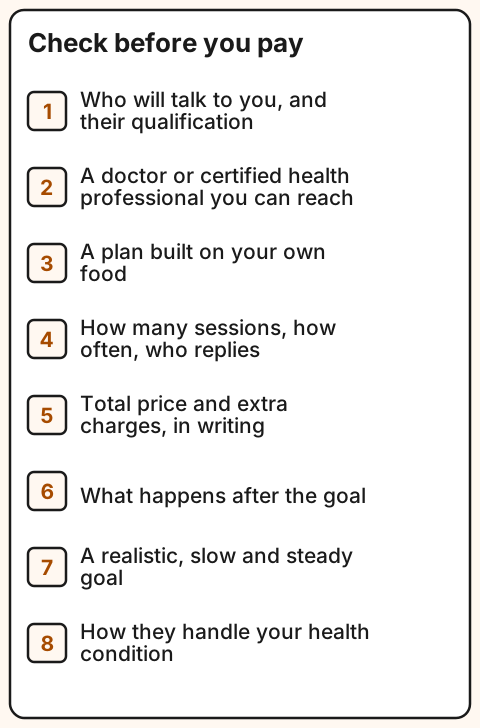
Eight questions to ask any online nutritionist before paying. The first, second, third, fifth and seventh come from NIDDK guidance [1].
The session numbers come from US documents on adults with obesity, so use them as a rough guide only.
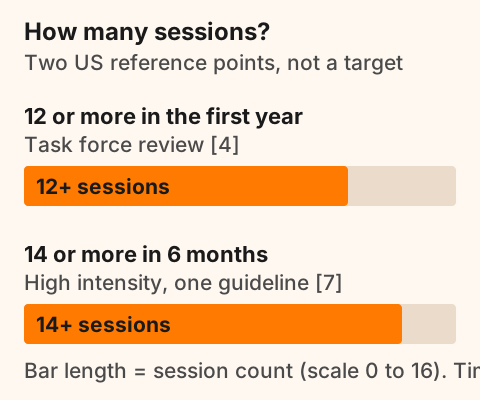
Two US reference points: most of the intensive programmes the task force reviewed had 12 or more sessions in the first year [4], and one guideline calls 14 or more in 6 months high intensity [7]. The task force did not say that more sessions work better.
Other things our coaches suggest asking
These are our coaches' suggestions, not study findings: the refund and cancellation terms, how your health reports are stored and who can see them (India's Digital Personal Data Protection Act, 2023, is the relevant law), whether plans are written by a person or generated automatically, the languages they work in, and whether they will read your lab reports. For a doctor, you can ask for the registration number and check it with the medical register.
What a good first call covers
These are our coaches' suggestions, not study findings. Expect questions about your medical history, medicines, recent test reports, daily routine, food habits and what you have tried before. Bring any reports you have. Ask how the plan will be reviewed after the first 4 weeks, and who you can message in between.
What does an online nutritionist cost in India?
We do not quote a "typical" price. We found no published, sourced survey of Indian online nutrition fees, and unsourced ranges on the internet are often marketing. What we can give you is a way to compare.
What drives the price
- One consult, a monthly plan, or a 3, 6 or 12-month package
- One coach, or a nutritionist plus a fitness coach
- Whether tests are included
- How often follow-ups happen, and who replies in between
How to compare offers
NIDDK says to ask for the total price start to finish and for extra charges [1]. Then do three sums:
- Total price for the whole programme, with renewals
- Price per month (total divided by months)
- Price per scheduled contact (total divided by planned sessions)
Here is an example with made-up numbers, not a real price. Say a plan costs Rs 9,000 for 3 months and includes 12 reviews. That is Rs 3,000 a month and Rs 750 a review. If a cheaper plan costs Rs 6,000 but has 3 reviews, it is Rs 2,000 a month and Rs 2,000 a review. The cheaper plan is not cheaper per review.
Flexcellence runs a free 30-minute call first, so you can ask for our plan prices and all the questions above before paying. Whatever you choose, ask for the total in writing.
Red flags: when to walk away
NIDDK lists warning signs: very fast or effortless loss (its example is 30 pounds, about 13.6 kg, in a month), loss without changing diet or activity, "eat anything" claims, spot reduction (fat loss from one body part), hidden small print, and before-and-after photos that look too good to be true [1]. Our coaches add two of their own: no timeline shown with before-and-after photos, and pressure to buy within the hour.
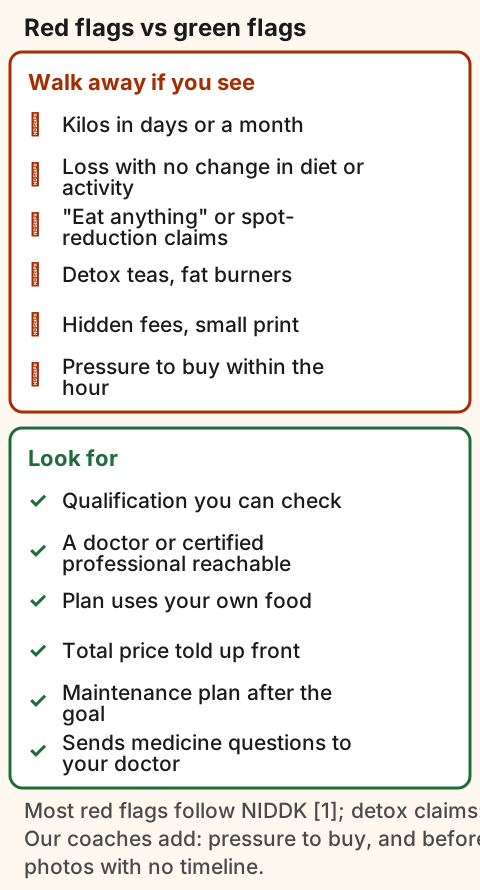
Most red flags follow the NIDDK list [1] and detox claims follow the reviews cited below; pressure to buy and photos with no timeline are our coaches' additions. The green flags are our own summary of the checks above.
- Promises of kilos in days. Speed does not protect you. In one trial of 200 randomised adults with obesity, a 12-week rapid-loss group and a 36-week gradual group both regained about 71% of the lost weight by 144 weeks among the 104 who completed (76% in the intention-to-treat analysis) [19]. Only about half of the gradual group and 81% of the rapid group reached the 12.5% loss target. Plan for maintenance, not a sprint.
- Detox teas and fat burners. A review of 315 trials of supplements and alternative therapies for weight loss found only 52 trials at low risk of bias with enough data. Of those, 16 showed a significant weight difference (0.3 to 4.93 kg) [20]. A critical review found very little clinical evidence for detox diets [21].
- Very low calorie plans. A 2013 US guideline says diets under 800 kcal a day need medical supervision [7].
- Hidden fees. See check number 5.
Eating disorder warning signs
Constant worry about weight, eating very little, strict food rules, making yourself sick, using laxatives, too much exercise and avoiding eating with others are warning signs. Physical signs include feeling cold, tired or dizzy, fainting, a racing heartbeat and missed periods [29]. If this sounds like you, see a doctor as soon as you can [29]. A good nutritionist will not push you further.
Does online nutrition coaching actually work?
Sometimes, by a modest amount. The reviews below measure different things in different people, so read them as a rough picture, not a ranking.
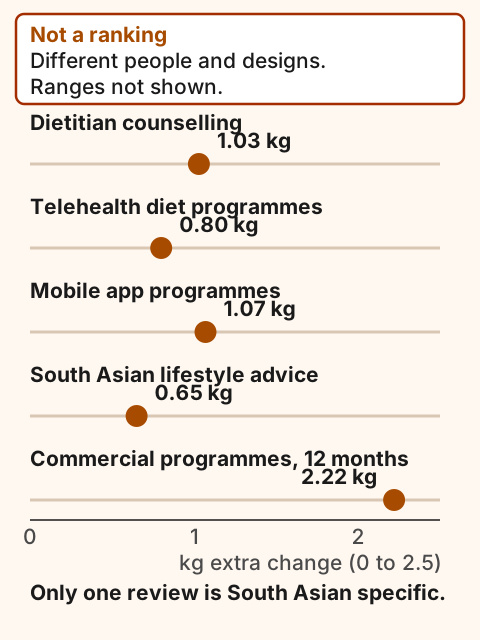
Extra weight change versus comparison groups in five separate reviews; groups, settings and follow-up times differ, and the list is not a ranking. Dietitian counselling, 5 trials, 1,598 adults [2]. Telehealth diet programmes, 25 trials, 7,384 adults with chronic disease [3]. Mobile apps, 12 studies [14]. Lifestyle advice in South Asian groups, prevention trials [12]. Commercial programmes at 12 months, 5 study arms [17].
What the studies say, in plain numbers
- Dietitian counselling. A review found 14 trials of one-to-one dietitian sessions in adults. Combining 5 of them (1,598 people), the dietitian groups lost 1.03 kg more than usual-care groups. The authors said the risk of bias ranged from unclear to high [2].
- Telehealth diet programmes. A review of 25 trials (7,384 adults with a chronic disease) looked at diet education by phone or online for more than 4 weeks. Across the review, weight was about 0.80 kg lower, but the range of results just reached zero, so this is borderline, and not every trial measured weight. Fruit and vegetable intake rose by about one serving a day [3].
- Counselling over a year. A 2007 review of 46 trials found the largest net effect was about 1.9 BMI units at 12 months. The trials were mixed and mostly of moderate to poor quality. People slowly regained weight after active programmes ended [5].
- Apps alone. Twelve studies of mobile app programmes (in children and adults) linked them to about 1.07 kg lower weight than comparison groups. Long-term effects were unclear [14].
- Culturally tailored advice. In diabetes-prevention trials in South Asian groups, lifestyle advice alone was linked to 0.65 kg extra weight change, and 1.13 kg with a supervised activity programme [12].
Human coach or app?
In a US trial of 368 adults with prediabetes and overweight, 31.7% of people using an AI-led app and 31.9% of people with remote human coaches met a health goal at 12 months. Most people in both groups did not meet it [15]. This was a US group, 71% women, so it does not tell us how Indian users would do. We compare apps and coaches in more detail in calorie app vs coach.
Online or in person?
Telehealth can remove the need to travel to a clinic [3]. A review of web-only programmes found they led to short-term but not long-term extra weight loss compared with offline programmes, and many people dropped out, so staying engaged matters [13]. Our coaches suggest a fixed weekly slot for check-ins and logging meals in one place. More tips are in diet plan for working women. If you live abroad, check the coach's time zone and whether the plan works with the groceries you can get. Our page on online Indian dietitians in the USA covers this. For what happens in a first session, see online dietitian consultation.
Honest limits
Average effects are small, and trial quality is mixed. Only one of the reviews above looked at South Asian groups specifically [12], so treat the others as a rough guide for India at best. Real-life programmes can do less than trial arms. In a review of trials in everyday settings, commercial programmes lost 2.22 kg more than controls at 12 months, while programmes run by primary care teams showed 0.45 kg and no clear effect [17]. None of this is a promise for you.
Eating Indian food with an online coach
A plan that cannot live with your kitchen will not last. India's national dietary guidelines from ICMR-NIN in Hyderabad favour a mix of whole grains, pulses and millets, with plenty of fresh local vegetables, and limit ultra-processed foods [26]. Your plan should work with idli (steamed rice and urad dal cake), dosa (thin fermented crepe), pesarattu (green gram dosa), pulusu (tamarind-based stew), pappu (cooked dal), curd rice and ragi mudde (finger millet ball), and adjust portions rather than ban them.
Here is what a food-fit plan might look like. These are our coaches' practical suggestions, not findings from a study. They are examples, not a prescription. Portions differ a lot between people. If you are pregnant, breastfeeding, have diabetes, are underweight or are older, do not copy portions from a table like this. Ask your doctor or a Registered Dietitian to set them for you.
| Goal or situation | Common plate | Our coaches suggest |
|---|---|---|
| Weight loss, breakfast | 3 idlis with chutney | 2 idlis, sambar (lentil-vegetable stew) and a protein like an egg or a small bowl of curd |
| Weight loss, breakfast | Plain dosa | Pesarattu with ginger chutney, as the green gram adds protein |
| Vegetarian, egg-free breakfast | Upma (semolina porridge) with little vegetable | Vegetable upma with a bowl of curd or sprouts (sprouted moong) |
| Weight loss, lunch | Large pile of rice, thin dal | Slightly less rice, thicker pappu, a vegetable curry and a salad |
| Weight loss, lunch | Biryani every day | Keep biryani for the weekend, with raita (curd with chopped vegetables) and vegetables on the side |
| Snack | Biscuits with chai (tea with milk) | Roasted chana (chickpeas) or a fruit |
| Weight loss, dinner | 3 to 4 rotis with a little sabzi (cooked vegetable curry) | 2 phulkas (thin oil-free rotis), more vegetables and a protein side |
| Low energy or building strength | Tea and a biscuit for breakfast | A real breakfast with protein, such as egg, paneer (fresh cheese) or dal |
What counts as obesity for Asian Indians?
A 2025 paper from a group of Indian experts (a Delphi consensus) proposes calling a BMI above 23 kg/m² the earliest stage of obesity in Asian Indians [27]. That is a proposal from one expert group, not an official rule, so ask your doctor which cut-off they use. For context, a national survey sampled 113,043 adults aged 20 and over in 31 states and union territories between 2008 and 2020. Using WHO criteria, it found 11.4% had diabetes and 15.3% had prediabetes. It used WHO Asia-Pacific guidelines for obesity [25]. These are survey-period figures, not today's rates.
Who needs a doctor before (or alongside) a nutritionist
This list is general safety advice from us. See your doctor before you start, or alongside, if:
- You are pregnant, trying to conceive or breastfeeding.
- You have diabetes and take medicines, or you think you may have it. If you take insulin or similar medicines, cutting calories can cause low blood sugar, so ask your doctor before changing how you eat.
- You have a thyroid problem, or symptoms but no diagnosis.
- You have missed periods or very irregular cycles.
- Your weight changes fast without a reason.
- You have had an eating disorder, or you worry a lot about weight and food [29].
- You have kidney disease or any new symptoms.
Get urgent medical help, not a nutrition chat, for fainting, chest pain, severe vomiting or signs of low blood sugar such as shaking, sweating and confusion.
PCOS guidelines recommend screening for depression and considering eating disorders regardless of weight [28]. Our pages on PCOS weight loss and the diabetes diet chart for Indians go into more detail.
How Flexcellence would score on this checklist
We would rather you check us than trust us. Here is an honest self-score.
- True: a free 30-minute call before you pay; a nutrition coach and a fitness or physio coach; weekly check-ins; plans built around Indian food for Telugu speakers worldwide; optional medical tests.
- Not true: we are not daily coaching. Check-ins are weekly. We do not claim our coaches are doctors or Registered Dietitians. Our coaches' listed certifications are from fitness bodies such as NASM, ACSM, NSCA and ISSN, so ask any provider, us included, for the nutrition qualification behind your plan.
Next steps
Try our free health calculators, such as the BMI calculator with Asian cut-offs, to see where you stand. Then use the eight checks above with any provider. If you want to try us, book a free 30-minute consultation call and bring this checklist along. See your doctor first if any warning sign above applies to you.
Common questions
Is a nutritionist the same as a dietitian in India?
Not always. The Indian Dietetic Association runs a Registered Dietitian (RD) pathway with set degree, membership and internship rules [^22]. We could not find one protected title called "nutritionist" in the sources we used, so ask for the exact qualification. A 2021 Bill passed by Parliament lists nutrition science professionals [^23].
How do I check whether an online dietitian is qualified?
Ask for their degree, university and years of experience. For Registered Dietitians, the Indian Dietetic Association has a public Find a Registered Dietitian directory [^22]. The US health institute NIDDK also suggests asking about staff training and experience, and whether you can speak with a doctor or certified health professional [^1].
How much does an online nutritionist cost in India?
Prices vary a lot, and we have no sourced market range, so we do not quote one. Ask for the total price from start to finish and any extra charges for tests, supplements or follow-up [^1]. Then divide by months and by planned sessions to compare offers fairly.
Who is the best online nutritionist in India?
There is no single best one for everyone, and we found no fair ranking to point to. Decide by checking the qualification, whether you can reach a doctor or certified health professional, the total price, and whether the plan fits your food [^1]. Our eight checks above work for any provider, including us.
Is online consultation as good as visiting in person?
Evidence is mixed. A review of 25 telehealth diet trials found weight about 0.80 kg lower across the review, a borderline result [^3]. A 2013 US guideline says electronic programmes with personal feedback are an option, with a smaller average effect than face-to-face [^7]. Web-only programmes often lose participants [^13].
Can an online nutritionist treat PCOS, thyroid or diabetes?
A nutritionist can guide food and habits alongside your doctor. In our view, diagnosing and changing medicines is a doctor's job. For diabetes, the American Diabetes Association recommends individual nutrition therapy from a registered dietitian nutritionist, the US credential [^6]. For PCOS, no single diet is named best [^28].
Will I have to give up rice, roti or my regional food?
A good plan should not ask that. India's national dietary guidelines favour a mix of whole grains, pulses, millets and local vegetables [^26]. Portions and pairings usually change, not your whole cuisine.
Reviewed by
Not yet reviewed by a Flexcellence coach.
Sources
US National Institute of Diabetes and Digestive and Kidney Diseases (NIDDK). Choosing a Safe & Successful Weight-loss Program (2025).
Healthcare (Basel) (Williams LT et al.). How Effective Are Dietitians in Weight Management? A Systematic Review and Meta-Analysis of Randomized Controlled Trials (2019).
The American Journal of Clinical Nutrition (Kelly JT et al.). Telehealth methods to deliver dietary interventions in adults with chronic disease: a systematic review and meta-analysis (2016).
US Preventive Services Task Force (JAMA). Behavioral Weight Loss Interventions to Prevent Obesity-Related Morbidity and Mortality in Adults: Recommendation Statement (2018).
Annals of Internal Medicine (Dansinger ML et al.). Meta-analysis: the effect of dietary counseling for weight loss (2007).
American Diabetes Association (Diabetes Care). 5. Facilitating Positive Health Behaviors and Well-being to Improve Health Outcomes: Standards of Care in Diabetes-2025 (2025).
Circulation (AHA/ACC/The Obesity Society). 2013 AHA/ACC/TOS guideline for the management of overweight and obesity in adults (2014).
Journal of Human Nutrition and Dietetics (Farhat G et al.). Effectiveness of lifestyle interventions/culturally bespoke programmes in South Asian ethnic groups targeting weight loss for prevention and/or remission of type 2 diabetes: a systematic review and meta-analysis (2024).
Journal of Medical Internet Research (Beleigoli AM et al.). Web-Based Digital Health Interventions for Weight Loss and Lifestyle Habit Changes in Overweight and Obese Adults: Systematic Review and Meta-Analysis (2019).
JMIR mHealth and uHealth (Islam MM et al.). Use of Mobile Phone App Interventions to Promote Weight Loss: Meta-Analysis (2020).
JAMA (Mathioudakis N et al.). An AI-Powered Lifestyle Intervention vs Human Coaching in the Diabetes Prevention Program: A Randomized Clinical Trial (2025).
Obesity Reviews (Hartmann-Boyce J et al.). Behavioural weight management programmes for adults assessed by trials conducted in everyday contexts: systematic review and meta-analysis (2014).
The Lancet Diabetes & Endocrinology (Purcell K et al.). The effect of rate of weight loss on long-term weight management: a randomised controlled trial (2014).
Obesity (Batsis JA et al.). A Systematic Review of Dietary Supplements and Alternative Therapies for Weight Loss (2021).
Journal of Human Nutrition and Dietetics (Klein AV, Kiat H). Detox diets for toxin elimination and weight management: a critical review of the evidence (2015).
Indian Dietetic Association (IDA). RD Eligibility (Registered Dietitian examination) (2026).
PRS Legislative Research. The National Commission for Allied and Healthcare Professions Bill, 2020 (passed by Parliament March 2021) (2021).
World Medical & Health Policy (Venkatesh U et al.). Telemedicine practice guidelines in India: Global implications in the wake of the COVID-19 pandemic (2022).
The Lancet Diabetes & Endocrinology (ICMR-INDIAB; Anjana RM et al.). Metabolic non-communicable disease health report of India: the ICMR-INDIAB national cross-sectional study (ICMR-INDIAB-17) (2023).
ICMR-National Institute of Nutrition, Hyderabad. Dietary Guidelines for Indians (2024) - summary booklet (2024).
Diabetes & Metabolic Syndrome: Clinical Research & Reviews (Misra A et al.). Revised definition of obesity in Asian Indians living in India (2025).
Journal of Clinical Endocrinology & Metabolism (Teede HJ et al.). Recommendations From the 2023 International Evidence-based Guideline for the Assessment and Management of Polycystic Ovary Syndrome (2023).
NHS (UK). Eating disorders: overview (2024).