Diet App vs Nutritionist: Which Keeps Weight Off?
Is a calorie app enough, or do you need a coach? Trial numbers, Indian-food tracking limits, and how to choose, in plain words.
The short answer
An app can help you log food and lose some weight. Some trials found that adding a dietitian gave a little more, others did not clearly show it, and one large review rated the coaching evidence weak. Programmes with ongoing contact help people keep weight off. The evidence is mixed and mostly not Indian, so choose by your needs and see a doctor first.
On this page
"I can log my food on my phone for free. Why would I pay for a person?" It is a fair question. Here is the short version: an app helps some people, a person sometimes adds a little on top, and the evidence is mixed. This article looks at what trials say about calorie apps, what changes when a real person supports you, what helps people keep weight off, and where apps struggle with Indian food. We also tell you when each option fits and when to see a doctor first. This is general information, not medical advice. Because obesity is a long-term condition, the WHO says care should also be long-term and followed up regularly.[20]
What a calorie app does well
Self-monitoring (writing down what you eat) is linked with weight loss across many reviews. One review of 22 studies found this link consistently, but called the level of evidence weak, because the studies had method problems.[10] Another review of 39 randomised-trial studies found that more digital logging was linked with weight loss, but that is an association, not proof that logging caused the loss.[9]
When digital self-monitoring was tested in 12 randomised trials, people lost 2.87 kg more on average than comparison groups. Tailored versions did better than one-size-fits-all versions.[24] A review of 34 trials found that apps led to 1.99 kg more loss at 3 months and 2.80 kg more at 6 months, though the results varied a lot from trial to trial. The number of features in an app did not predict who lost more.[1]
So an app can be a useful tool. Many coaches find that seeing your food as numbers makes it easier to notice patterns than going by memory, though that is a view, not a trial result.
Where it stops
Few interventions in one review kept people logging on 75% of days or more.[9] So it helps to expect your logging to slip. An app can show you a number, but it cannot ask why you skipped dinner, notice that your week was hard, or change your plan when your period, your shift or your baby changes things. That last part is our observation as coaches, not a trial result.
App alone vs app plus a person: what the trials found
The evidence here is mixed, so please read the numbers as averages for groups of people, not as a promise for you. Two recent trials compared an app (in Brazil, a web programme) with the same tool plus a dietitian:
| Trial | Who | App or web programme only | Plus dietitian |
|---|---|---|---|
| China, 6 months[6] | 395 adults with overweight or central obesity (extra fat around the waist) | 2.28% of body weight lost | 4.94% lost |
| Brazil, 24 weeks (web programme, not an app; dietitian coaching ran for the first 12 weeks)[7] | 1,298 adults with BMI 25 or more across 3 arms (the table shows two); weights self-reported; 28.89% lost to follow-up | 1.08 kg lost | 1.57 kg lost |
The China trial gives the clearer signal. In the Brazil trial the gap is about 0.5 kg. The authors call the losses small, and report that the dietitian group completed more sessions (7.6 against 5.2) and had a significantly higher chance of clinically meaningful weight loss (5% or more).[7] Both groups lost little, so we would not call the gap large.
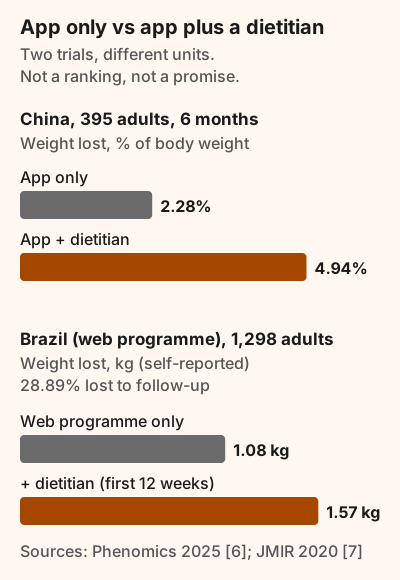
Figure 1. Two trials (China: an app; Brazil: a web programme), two different units, so do not compare across them.[6][7]
Among Chinese participants with high compliance scores, the gap shrank to a non-significant 6.30% vs 4.79%.[6]
Reviews point the same way, with caveats. A review of 34 app trials compared subgroups across trials (not head-to-head). Where a human-delivered behavioural component was added, there was 2.03 kg more loss at 3 months and 2.63 kg at 6 months. Combinations of an app, an activity tracker and a behavioural component were also significant, and the authors describe the human-based component as remaining key. The results varied a lot between trials.[1] Another review of 14 articles (2,478 people) found that health coaching plus a self-monitoring app improved weight by 2.15 kg, but the combination was superior only to usual care for weight, not to apps alone. It did beat apps alone for waist circumference, and the authors say more research is needed on the added benefit over an app alone.[2] A US trial in primary care tested a whole package (an app, a smart scale, dietitian calls and clinician counselling) in socioeconomically disadvantaged patients with obesity and conditions such as hypertension, diabetes or high cholesterol. It led to 4.4 kg more loss than usual care at 6 months, but the app was only one part.[8]
Remote support can work
Remote support worked in this US trial. In the POWER trial, 415 US adults with obesity and at least one heart risk factor were followed for 24 months. The self-directed group lost 0.8 kg on average. The group with remote support (phone, website and email) lost 4.6 kg. The group with in-person plus remote support lost 5.1 kg.[4] The remote group did about as well as the in-person group. This was a US trial, so it does not tell us how this works in India.
Honest limits
One review of 38 coaching studies rated the quality of the evidence as very low, and found that the coaching effect was trivial in size. In the higher-quality studies, it found no evidence that coaching affected weight loss.[3] The trials above are mostly from the USA, China and Brazil, not India. In our search we did not find an Indian trial that compares an app with a coach for weight loss. Most trials were in adults with overweight or obesity, so they do not tell you what will happen for you.
What we can say fairly is this. Apps help some people. In some trials adding a human added a little, but one review did not show a weight advantage over an app alone, and one large review of coaching found only trivial effects. It does not help everyone equally.
Keeping the weight off is a different problem
Losing weight and keeping it off need different things. A review of 11 studies noted that most people regain weight after treatment ends. Where people got extended care, they kept about 3.2 kg more weight off, measured about 17.6 months after the programme.[12]
A larger review of 45 trials (7,788 adults who had lost at least 5% of their weight) found that behavioural programmes on food and activity cut regain by 1.56 kg at 12 months.[13]
What this means for you: in both reviews, the helpful part was ongoing support after the first loss, not a particular tool. These studies did not test apps on their own.
The Look AHEAD trial followed 5,145 US adults with overweight or obesity and type 2 diabetes. After 8 years, the group that received ongoing behavioural counselling had lost 4.7% of body weight on average. The group with support and education only had lost 2.1%.[14]
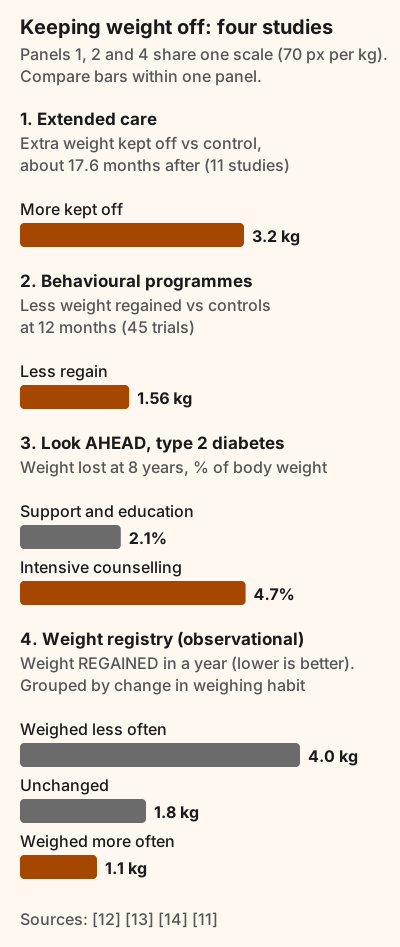
Figure 2. Four studies with different measures. Compare bars within a panel only. Panels 1 to 3 show weight kept off or lost; panel 4 shows weight regained, so lower is better, and it is observational.[12][13][14][11]
Our coaches suggest for maintenance
These are our coaches' habits, not research findings. Plan ahead for festival, travel and NRI-visit weeks: aim to keep your usual dal and protein portions steady and enjoy the special dish in a normal-sized serving. Keep a weekly check-in. Decide in advance what you will do if the scale rises for two weeks, such as looking at your logs and calling your coach or dietitian rather than crash dieting. NICE's guidance chapter covers physical activity as well as diet, so movement belongs in the plan.[19]
Regular weighing
In a registry of 3,003 people who had lost 30 lb (about 13.6 kg) or more and kept it off for a year or more, the researchers grouped people by how their weighing changed over the next year. Those who weighed themselves less often than at baseline gained 4.0 kg on average. Those whose habit stayed the same gained 1.8 kg, and those who weighed more often gained 1.1 kg. This was observational (researchers watched people rather than assigning them to a treatment), and registry members are self-selected (they chose to join), so it does not prove that weighing causes the difference.[11]
What NICE says
The UK's NICE guideline says that if you follow a diet with an energy deficit, you should be offered support (for example from a registered dietitian or nutritionist) and follow-up, to help you keep the loss up long term. It also advises against nutritionally unbalanced restrictive diets.[19]
What an app alone does not supply
An app can give you the weighing and the logging. The maintenance trials above mostly tested ongoing contact with people. That is the part an app on its own does not supply. We are not saying a coach guarantees you will keep the weight off. No one can promise that.
Where calorie apps struggle with Indian food
One study checked 18 popular nutrition apps from Australian app stores against food records. The 16 apps where you log by hand overestimated energy for a Western diet by 1,040 kJ on average, and underestimated it for an Asian diet by 1,520 kJ. Seven apps used AI to read food photos. The authors found those AI energy estimates inaccurate, and said the AI models need training for mixed dishes and culturally diverse foods. MyFitnessPal and Fastic had the highest accuracy (97% and 92%) in that comparison.[17] These were Australian apps and diets, not Indian home cooking, so treat this as a warning, not a measurement of your app.
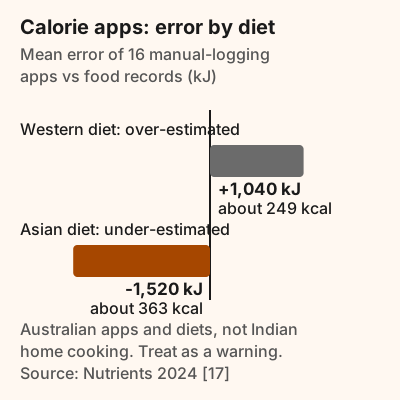
Figure 3. Mean energy error of 16 manual-logging Australian apps compared with food records.[17]
Why might home food cause trouble? The Indian Food Composition Tables list nutrient values for 528 key foods, per 100 g of edible portion.[22] In our view, a cooked home dish has to be built up from the ingredients and portions you used, and an app database may not match your family's recipe. That is our reasoning, not a finding from the tables.
Our coaches suggest watching a few places where logs usually drift. This is our practical advice, not a research finding.
| Food (explained) | What usually goes wrong in the log | What our coaches suggest |
|---|---|---|
| Rice (cooked) | Entered as "1 bowl", but bowls differ a lot in size | Use the same katori (small steel bowl) every time, or weigh the cooked rice once to learn your usual portion |
| Pesarattu (green gram dosa) with ginger chutney | App lists "dosa" in general, with different batter and oil | Choose the closest entry, then add the oil you used by teaspoon |
| Pulusu (tamarind-based stew) or sambar (lentil-vegetable stew) | Counted as "dal" with no vegetables or oil | Log the dal and vegetables as they went into the pot, and note the tadka (tempering) oil |
| Phulka (thin oil-free roti) vs a roti with ghee or oil | The same entry for both | Count the number of rotis and note any ghee or oil on top |
| Idli, upma, poha | Plate sizes vary, and chutney or sambar is skipped | Count idlis, and log the chutney and sambar as separate items |
| Cooking oil and ghee | Forgotten, because it is not on the plate | Note the spoonfuls that went into the pan, because oil adds up quickly |
Here is one lunch logged badly and then well. This is an illustration of our method, with no calorie figures, because your portions will differ.
- Logged badly: "Rice, dal, curry, roti." Four lines, sizes guessed, no oil.
- Logged well: "Cooked rice, 1 katori (my usual bowl, measured once with water). Toor dal, 1 katori, with 1 tsp tadka oil. Brinjal curry, half a katori, 2 tsp oil used in the pan. Phulka, 2, no ghee."
The second version takes about a minute longer, and it is the one an app (or a coach) can actually work with.
If you want to understand how to build Indian meals around a calorie goal, our article on calorie deficit with Indian meals goes into it.
The ICMR-NIN Dietary Guidelines for Indians say a slow and steady reduction in body weight is advisable, and note that extreme approaches for weight loss may lead to health hazards. They also point towards whole grains and millets, and whole fruit rather than juice.[21] A good coach turns that kind of advice into your plate, with your food, rather than a generic entry in a database.
When tracking can hurt
Counting calories is not harmless for everyone. In a survey of 105 people diagnosed with an eating disorder, about 75% had used MyFitnessPal, and 73% of those users perceived that it contributed to their eating disorder. This was self-reported perception, so it does not prove the app caused anything.[15]
A different trial gave a calorie app for about one month to 200 US undergraduate women at low eating-disorder risk. It found no change in eating-disorder risk, anxiety, depression or body satisfaction.[16] Both findings can be true. The risk is different for different people.
See your doctor or a mental-health professional if:
- you feel anxious or guilty when you cannot log a meal
- you skip meals to "stay under" your number
- you have had an eating disorder in the past
- you are pregnant or breastfeeding and thinking of cutting calories. None of the studies here tell you what is safe in pregnancy or while feeding a baby, so ask your doctor or midwife first
- you are losing weight quickly without trying
- you have a condition such as diabetes, thyroid disease or PCOS and are changing your food or medicines
Weight-loss medicines and bariatric surgery exist and are decided by doctors. Children, teenagers, older adults and people with kidney disease should not change their diet on the strength of an app or this article, and should see their doctor first.
If you take diabetes medicines, do not cut your food on your own. The NHS explains that low blood sugar mostly affects people with diabetes who take insulin or some other diabetes medicines (it names gliclazide and glimepiride), and that missing or delaying meals or not eating enough carbohydrate makes it more likely.[27] If you eat less, your doctor may need to change your dose, so talk to them before you start.
Do not run a very low-calorie diet on your own. NICE says to consider low-energy diets of 800 to 1,200 kcal a day only as part of a multicomponent strategy with long-term support in a specialist service, for people living with obesity (or overweight with type 2 diabetes). It limits very-low-energy diets (under 800 kcal) to specialist services, for people with obesity who have a clinically assessed need to lose weight rapidly.[19]
App, coach, or both: a quick way to choose
There is no single right answer. The table below is our view as a coaching team. Where a trial supports a point, we have cited it. The rest is our coaches' experience.
| You might start with an app if | A coach or dietitian may fit better if | Talk to a doctor first if | |
|---|---|---|---|
| Health | You are generally healthy and want to understand your eating | You have PCOS, thyroid issues, diabetes or are planning pregnancy, and want food advice that fits your doctor's plan | You are pregnant, breastfeeding, on medicines for diabetes or blood pressure, or have lost weight without trying |
| Accountability | You stay consistent on your own | You start well and then drop off | You feel distressed when you cannot follow your numbers |
| Food variety | You eat fairly standard, packaged or restaurant foods | You cook mostly at home with regional dishes | You have food allergies or intolerances that cause symptoms |
| Budget and time | You want a low-cost start and can log for a few minutes a day | You can pay for support and want fewer decisions to make yourself | Cost should never push you to a risky crash diet |
| History | This is your first attempt | You have lost weight before and regained it | You have had an eating disorder |
Two points are backed by research. Tailored digital approaches did better than non-tailored ones.[24] And in the big review of app trials, a human-delivered behavioural component was linked with more loss in subgroup comparisons, though the authors note the results varied a lot between trials.[1] Everything else in the table is our practical judgement.
Using both is also fine. In the US Track trial the app was one part of a wider package that also had dietitian calls and clinician counselling.[8] If you are comparing coaches, our guide to choosing an online nutritionist in India can help, and what happens on a dietitian consultation explains what to expect on a first call.
If you are already stuck after some loss, read about the weight-loss plateau before you cut calories further.
Looking for a HealthifyMe alternative?
If you are comparing HealthifyMe with other apps or coaching services, we do not rank brands here, because the trials above did not test named products. These are our questions to ask of any app or service:
- Does it let you log home-cooked Indian dishes by ingredient and spoon, not just by a generic name?
- What are their credentials? The trials above used registered dietitians, and in India "coach" is not a protected title, so ask for the qualification and whether a doctor oversees the plan.
- Is a qualified dietitian or nutritionist available, and how often do you actually talk to them?
- Does it follow up after the first few weeks, when most people slow down?
- Does it ask about your medical history, and send you to a doctor when something is outside a coach's scope?
- Can you see what it costs before you commit?
Working women and NRIs: making either option stick
Remote support worked in the US POWER trial, which is not an Indian or NRI study, so we cannot say how it carries over.[4] For people with prediabetes, the Indian text-message trials are about preventing diabetes, not about app versus coach for weight, so treat them as a side note. In 537 working men aged 35 to 55 with impaired glucose tolerance (blood sugar higher than normal but below the diabetes range) in southeast India, diabetes developed in 18% of the group that got frequent phone messages and 27% of the group that got standard advice (hazard ratio 0.64). This was men only.[25] A larger trial of text messages in 2,062 adults with prediabetes in India and the UK found no significant effect on diabetes at 2 years.[26]
Our coaches suggest a few practical habits, which are our advice and not research findings:
- Fix a weekly check-in slot, and keep it like a meeting.
- Log one meal well, rather than all meals badly.
- If you live abroad, choose a call time that works in your time zone.
How to choose, in three lines
- An app is a reasonable start if you are healthy, stay consistent and can log home food carefully.
- A person may help more if you drop off after a few weeks, cook regional food at home, have a medical condition, or have regained weight before.
- Whatever you pick, plan for what happens after the first loss, and see your doctor first if any red flag above applies to you.
How Flexcellence coaching works, and what we cannot promise
At Flexcellence, you get a free 30-minute consultation call first. A paid plan gives you a nutrition coach and a fitness coach in one app, with plans built on Indian food, and calorie tracking inside the app.
What we cannot do: we cannot promise a number of kilos, and we do not claim our coaching is proven better than an app. We work with your doctor's guidance if you have a medical condition, and we send you to your doctor first when something is outside a coach's scope.
If you want to see how this looks for you, you can start with our free health calculators. Or book a free 30-minute consultation. There is no pressure to join, and you can ask us anything about how coaching compares with the app you use now.
Common questions
Is a calorie counting app enough to lose weight?
For some people, yes. In 12 trials, digital self-monitoring led to about 2.87 kg more loss than comparison groups, and app trials showed small average losses at 3 and 6 months. These are group averages, not a promise, and results vary a lot.
Do coaches or dietitians help more than an app alone?
The evidence is mixed. In China, app plus dietitian lost 4.94% of body weight against 2.28% for app only over 6 months. In Brazil, with a web programme, the gap was small (1.57 kg against 1.08 kg), though the authors report more engagement and a higher chance of losing 5% or more with a dietitian. One review of 38 coaching studies rated the evidence very low quality and found no effect in higher-quality studies. Its authors concluded the evidence is not of sufficient quality to support health coaching for weight loss.
Which is better for keeping weight off?
The maintenance trials mostly tested ongoing contact with people. Extended care kept about 3.2 kg more weight off at around 17.6 months, and behavioural programmes cut regain by 1.56 kg at 12 months. These studies did not test apps alone, and no option guarantees you keep the weight off.
Are calorie apps accurate for Indian food?
We do not know, because that study used Australian apps and Australian diets, not Indian home cooking. It found hand-logging apps under-estimated energy for an Asian diet by 1,520 kJ (about 363 kcal) on average, and photo-based AI energy estimates were inaccurate. The risk is real for home-cooked dishes. Logging rice and oil carefully helps.
What should I look for in a HealthifyMe alternative?
The trials did not test named apps, so we cannot rank them. Look for logging that handles home-cooked Indian dishes by ingredient and spoon, access to a qualified dietitian (ask for their credentials), regular follow-up after the first weeks, and a clear route to your doctor for medical conditions.
Can calorie counting be harmful?
It can be, for some people. In a survey of 105 people with an eating disorder, 73% of MyFitnessPal users perceived that it contributed to it. A one-month trial in low-risk young women found no change in mental health. If tracking makes you anxious, or you have had an eating disorder, speak to your doctor first.
Can I use both an app and a coach?
Yes. In a US trial the app was one part of a package that also had a smart scale, dietitian calls and clinician counselling, and the package led to 4.4 kg more loss than usual care at 6 months. Many people use an app for logging and a coach for planning and support.
Reviewed by
Not yet reviewed by a Flexcellence coach.
Sources
JMIR mHealth and uHealth (Antoun J et al.). The Effectiveness of Combining Nonmobile Interventions With the Use of Smartphone Apps With Various Features for Weight Loss: Systematic Review and Meta-analysis (2022).
JMIR (Chew HSJ et al.). Effectiveness of Combined Health Coaching and Self-Monitoring Apps on Weight-Related Outcomes in People With Overweight and Obesity: Systematic Review and Meta-analysis (2023).
Advances in Nutrition (Sieczkowska SM et al.). Health Coaching Strategies for Weight Loss: A Systematic Review and Meta-Analysis (2021).
New England Journal of Medicine (Appel LJ et al., POWER trial). Comparative effectiveness of weight-loss interventions in clinical practice (2011).
Phenomics (Li X et al.). Impacts of Behavioral Compliance on Weight-Loss and Metabolic Profile in a Smartphone App-Based Lifestyle Intervention or Plus Dietitian Supporting: A Randomized and Controlled Trial Among Chinese (2025).
JMIR (Beleigoli A et al.). Personalized Web-Based Weight Loss Behavior Change Program With and Without Dietitian Online Coaching for Adults With Overweight and Obesity: Randomized Controlled Trial (2020).
American Journal of Preventive Medicine (Bennett GG et al., Track trial). Effectiveness of an App and Provider Counseling for Obesity Treatment in Primary Care (2018).
Obesity (Patel ML, Wakayama LN, Bennett GG). Self-Monitoring via Digital Health in Weight Loss Interventions: A Systematic Review Among Adults with Overweight or Obesity (2021).
Journal of the American Dietetic Association (Burke LE, Wang J, Sevick MA). Self-monitoring in weight loss: a systematic review of the literature (2011).
Obesity (Butryn ML et al.). Consistent self-monitoring of weight: a key component of successful weight loss maintenance (2007).
Obesity Reviews (Middleton KM, Patidar SM, Perri MG). The impact of extended care on the long-term maintenance of weight loss: a systematic review and meta-analysis (2012).
BMJ (Dombrowski SU et al.). Long term maintenance of weight loss with non-surgical interventions in obese adults: systematic review and meta-analyses of randomised controlled trials (2014).
Obesity (Look AHEAD Research Group). Eight-year weight losses with an intensive lifestyle intervention: the look AHEAD study (2014).
Eating Behaviors (Levinson CA, Fewell L, Brosof LC). My Fitness Pal calorie tracker usage in the eating disorders (2017).
Journal of the Academy of Nutrition and Dietetics (Hahn SL et al.). Introducing Dietary Self-Monitoring to Undergraduate Women via a Calorie Counting App Has No Effect on Mental Health or Health Behaviors: Results From a Randomized Controlled Trial (2021).
Nutrients (Li X et al.). Evaluating the Quality and Comparative Validity of Manual Food Logging and Artificial Intelligence-Enabled Food Image Recognition in Apps for Nutrition Care (2024).
NICE. Overweight and obesity management (NG246): Physical activity and diet (2025).
World Health Organization. Obesity and overweight (fact sheet) (2025).
ICMR-National Institute of Nutrition, Hyderabad. Dietary Guidelines for Indians (2024 revision), incl. My Plate for the Day (2024).
ICMR-National Institute of Nutrition (Longvah T et al.). Indian Food Composition Tables 2017 (2017).
Obesity Reviews (Berry R, Kassavou A, Sutton S). Does self-monitoring diet and physical activity behaviors using digital technology support adults with obesity or overweight to lose weight? A systematic literature review with meta-analysis (2021).
The Lancet Diabetes & Endocrinology (Ramachandran A et al.). Effectiveness of mobile phone messaging in prevention of type 2 diabetes by lifestyle modification in men in India: a prospective, parallel-group, randomised controlled trial (2013).
Diabetologia (Nanditha A et al.). A pragmatic and scalable strategy using mobile technology to promote sustained lifestyle changes to prevent type 2 diabetes in India and the UK: a randomised controlled trial (2020).
NHS. Low blood sugar (hypoglycaemia) (2026).